














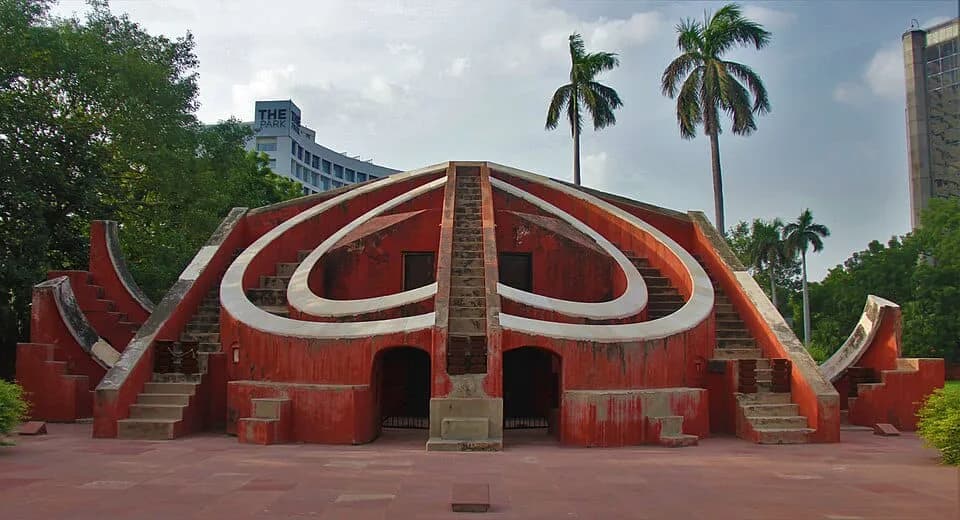









Jantar Mantar in New Delhi is known today as a gathering place for peaceful protests and demonstrations. Students, farmers, activists and civil society groups often assemble here to voice their concerns.
Centuries before it became a symbol of public expression, it served a completely different role. It was a massive scientific instrument built to measure time and study the movement of celestial bodies with great precision.
Telling time using the sun
Also Read | Mission Sudarshan Chakra: India to begin Kusha interceptor trials for air defence shield
Jantar Mantar works by tracking the sun’s position in the sky. As the sun moves from east to west through the day, the shadows cast by its instruments shift, and this shift is used to calculate the time.
The Samrat Yantra, a giant sundial
The most famous structure here is the Samrat Yantra, a huge triangular sundial standing about 27 metres tall. It is one of the largest sundials in the world.
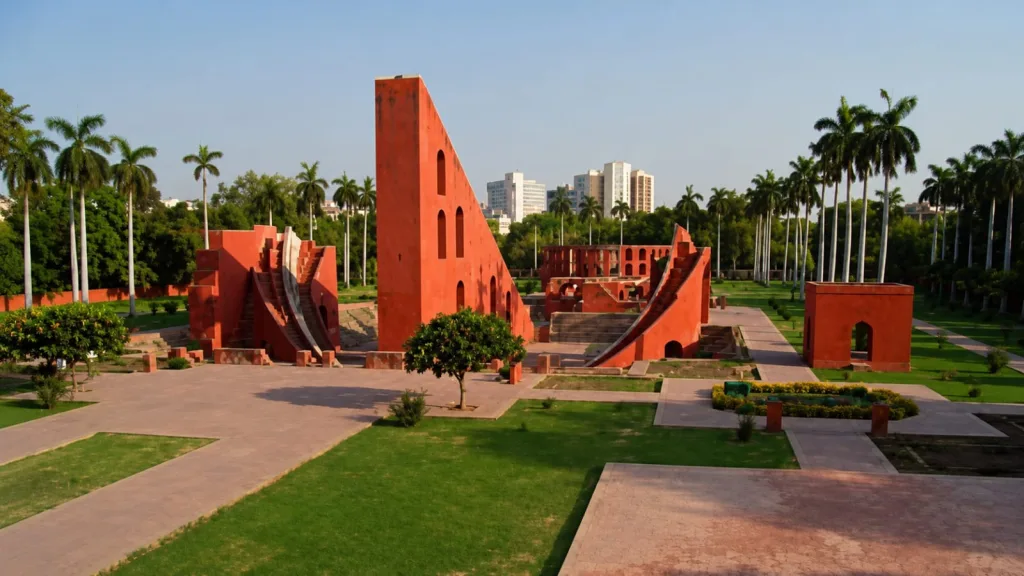
Its sloping edge is aligned with the earth’s axis and points toward the North Pole. On either side of this triangular structure are curved stone quadrants marked with divisions for hours, minutes and seconds.
Also Read | Delhi taxi operators announce Parliament march against E20 petrol on August 4
As the sun moves, the shadow of the triangular wall falls across these markings, and the exact position of the shadow tells the local solar time.
Remarkable accuracy for its time
Even though it was built in the early 1700s, the Samrat Yantra can measure time accurately to within about two seconds under good weather conditions. This made it one of the most advanced astronomical tools of its era.
A small correction needed today
The time the Samrat Yantra shows is local solar time, based on the sun’s position over Delhi. Since India now follows Indian Standard Time, a small adjustment is required to match the sundial’s reading with the time on your watch.
Also Read | ‘We have just inaugurated a new river in our society’: Man from Gujarat shows neck-deep water
More than a timekeeper
Jantar Mantar was not built only to tell time. It was designed to observe the sun, moon and planets, predict eclipses, prepare astronomical tables and improve the accuracy of calendars.
Vision of a king
The observatory was commissioned by Maharaja Sawai Jai Singh II between 1721 and 1724. He was a passionate astronomer who felt the existing astronomical calculations of his time needed improvement. He went on to build five such observatories across India, including in Jaipur, Ujjain, Varanasi and Mathura.
Also Read | Supreme Court Metro shut amid protests, CJI says he’ll intervene if station isn’t reopened
Built entirely of stone
Unlike modern telescopes, the instruments at Jantar Mantar are made completely of stone, marble and masonry. Their massive size helped reduce measurement errors, making the readings more precise.
Still working after 300 years
Even today, visitors can watch the sun’s shadow move across the Samrat Yantra. On a clear day, it still tells time accurately, just as it did nearly three hundred years ago.
FAQs
What is Jantar Mantar famous for today?
It is known as one of Delhi’s most prominent sites for peaceful protests and public demonstrations.
What was Jantar Mantar originally built for?
It was built as a giant astronomical observatory to measure time, track celestial bodies and improve calendars.
