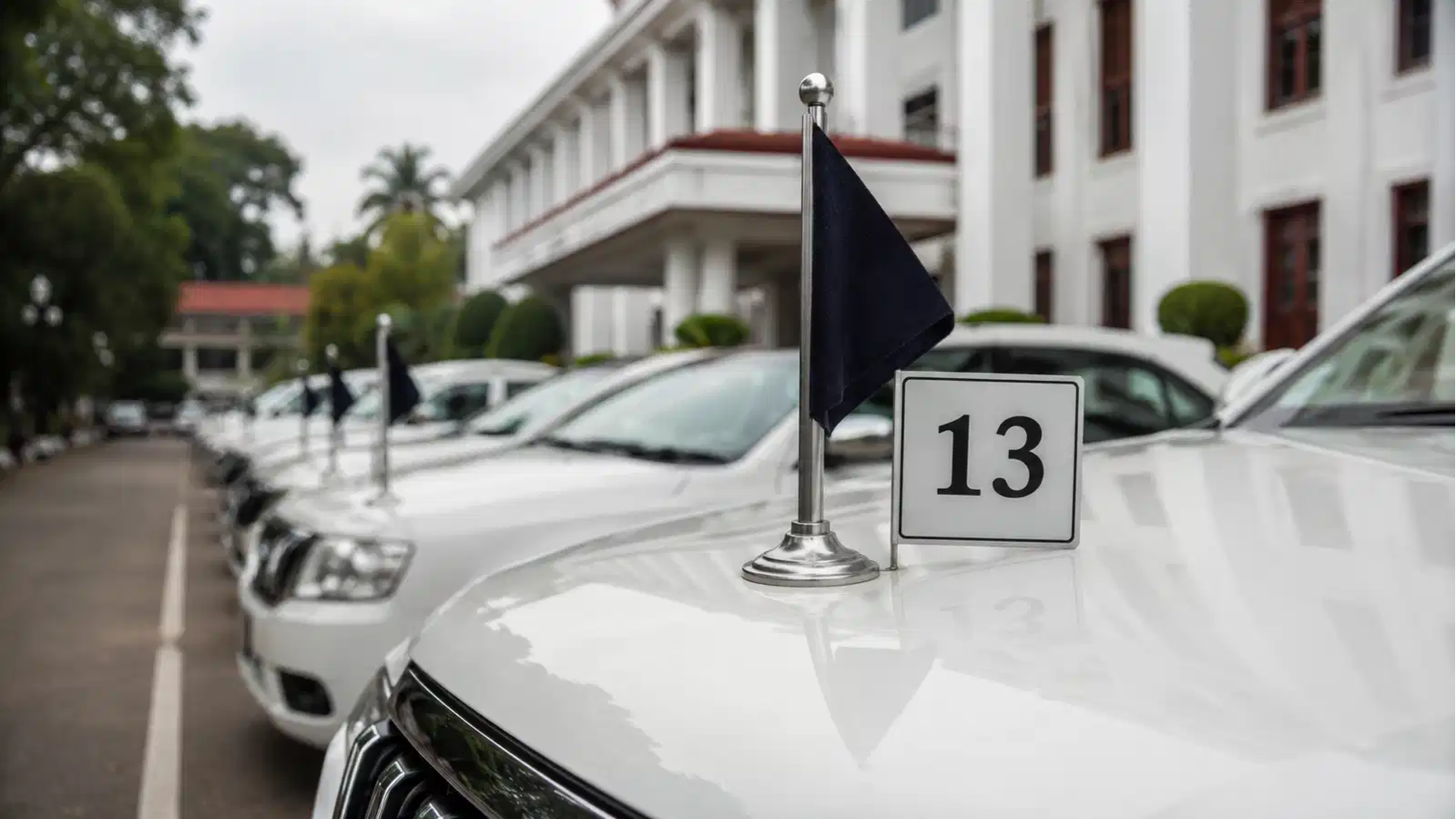
Kerala’s new UDF government has barely settled into office, but an old political superstition is once again making headlines, no minister wants official vehicle number 13.
Days after VD Satheesan and his 20-member Cabinet took oath, the allocation of government vehicles triggered fresh discussion after official car number 13 reportedly remained unclaimed.
The hesitation is not new. Across multiple governments in Kerala over the years, ministers have repeatedly avoided the number, despite the state’s strong public image as a centre of rationalist and progressive politics.
Why car number 13 became political news again
According to reports citing the Kerala Public Relations Department, official vehicle numbers from 1 to 12 were quickly allotted among ministers in the newly formed government.
Also Read | US state secretary Marco Rubio’s first India visit from May 23-26 to focus on Quad, defence and trade talks
Chief Minister VD Satheesan received car number 1, while senior ministers including Ramesh Chennithala and PK Kunhalikutty were assigned other early numbers in sequence.
But number 13 found no takers.
The development immediately reignited a familiar debate in Kerala’s political circles and on social media, where users questioned why elected representatives continue to avoid the number despite regularly advocating scientific temper and rational thinking.
One widely shared online comment joked that “even atheists fear 13”, while others pointed out that the superstition appears to cut across party lines and ideologies.
Interestingly, Congress leader CK Hareendran reportedly chose room number 13 at the MLA hostel to signal that he does not believe in such superstitions, even though the vehicle number itself remained unclaimed.
A superstition that survives every government
The controversy around number 13 has surfaced repeatedly in Kerala politics over the years.
In 2016, BJP leaders had mocked the then Left Democratic Front (LDF) government after no minister initially accepted car number 13. The row eventually ended when former finance minister Thomas Isaac volunteered to use the number publicly.
During an earlier Left government led by former chief minister VS Achuthanandan, former minister MA Baby had also reportedly insisted on using vehicle number 13 to challenge the superstition.
Despite those symbolic gestures, the hesitation around the number appears to return with almost every new administration.
Even courts were dragged into the debate
The superstition surrounding number 13 has extended beyond politics in Kerala.
The Kerala High Court had once skipped courtroom number 13 altogether while numbering its court halls, leading to legal and political controversy.
The matter eventually reached the Supreme Court of India after a petitioner argued that a constitutional institution should not encourage superstition.
The Kerala High Court initially dismissed the plea and imposed a fine on the petitioner. However, the Supreme Court later criticised the omission, observing that constitutional institutions should not promote such beliefs.
“The High Court is an institution. It should not be allowed to encourage this sort of superstitions,” the apex court had remarked during the hearing.
Also Read | Why are India’s nights becoming hotter and more dangerous? Here's what experts say
Rationalism versus political reality
The latest controversy has once again exposed an unusual contradiction in Kerala’s public life.
The state has long projected itself as politically aware, highly literate and deeply influenced by rationalist movements. Yet cultural beliefs and symbolic superstitions continue to quietly influence political behaviour across governments.
While the debate around vehicle number 13 may appear minor, it repeatedly becomes a larger conversation about how deeply superstition still survives within institutions that publicly champion rational thinking.