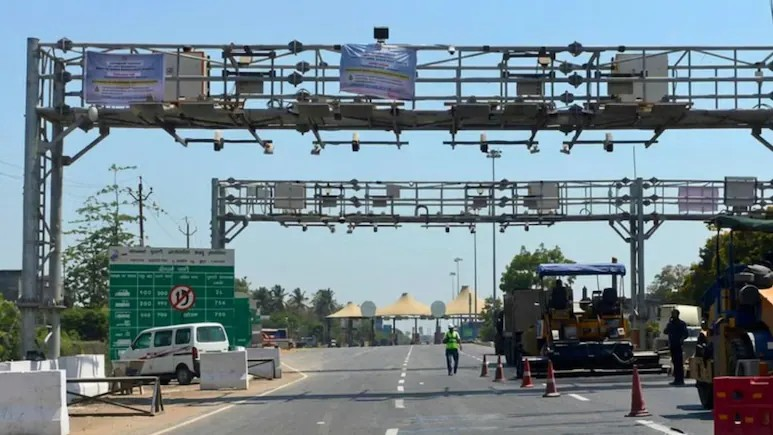
Delhi’s first barrier-less toll plaza is already facing enforcement challenges, with motorists reportedly finding ways to bypass payments just weeks after the system became operational.
The issue has now triggered widespread discussion online, with several users calling for stricter penalties and tougher action against toll evaders.
The toll plaza, located on the Mundka-Bakkarwala stretch of UER-II, was introduced by the National Highways Authority of India as part of its push toward seamless traffic movement through barrier-free toll collection technology.
Also Read | From silk stoles for Meloni to Kesar mangoes for UAE: What PM Narendra Modi gifted leaders across 5 nations
How the barrier-less toll system works
The new Multi-Lane Free Flow (MLFF) toll system operates without physical barriers or stopping points. It uses high-performance RFID readers and Automatic Number Plate Recognition (ANPR) technology to identify vehicles moving through the toll zone.
AI-enabled cameras installed overhead capture number plates and FASTag details, after which the toll amount is automatically deducted from the linked FASTag wallet. The system was designed to reduce congestion, cut waiting times and improve traffic flow on busy stretches.
How motorists are dodging payments
According to reports, some commuters have started exploiting loopholes in the system to avoid paying toll charges. Authorities found that several motorists were tampering with High Security Registration Plates (HSRP), using obscured or modified number plates that prevent cameras from accurately identifying vehicles.
 People commute on a bike as a woman and a little girl are wrapped in scarves to protect themselves from heat during the summer. ANI
 In some cases, FASTags were either improperly placed or not attached to windscreens at all, making automatic deductions impossible. Reports cited by TOI suggested that vehicles without readable FASTags currently account for less than one per cent of users, but officials believe even small gaps can significantly weaken enforcement if left unchecked.
NHAI has acknowledged the issue and said enforcement systems are being reviewed to improve payment compliance.
Internet reacts with penalties — and jokes
The controversy quickly spilled onto social media, where users began offering suggestions on how authorities should deal with toll evaders. One widely discussed proposal suggested imposing penalties three times the original toll amount on motorists caught bypassing the system.
Toll booths can install paint guns and shoot at cars whose numbers are tampered with 🔫 ---->>>> "Barrier-Less Toll Rollout Sees Misuse: Highway Authority Reveals How Users Are Dodging Fees" https://t.co/8tPKFZCvod
— Deepak Abbot (@deepakabbot) May 20, 2026
Others demanded automatic challans, stricter HSRP enforcement and blacklisting of repeat offenders. Some users, however, responded with humour. One viral comment jokingly suggested installing “paint guns” at toll points to mark vehicles with tampered number plates.
@MORTHIndia @NHAI_Official@NHAIINDIA
— Jayadev M (@mjayadev) May 19, 2026
Please penalize the actual evaders with a fine 3 times the toll amt along with the toll amt,
Barrier-Less Toll Rollout Sees Misuse: Highway Authority Reveals How Users Are Dodging Fees https://t.co/m6gMoOFbs8
While light-hearted, the online reactions highlighted growing frustration over misuse of public infrastructure intended to make travel smoother and faster.
Also Read | Delhi records hottest May night in 14 years amid severe heatwave
Bigger questions over smart infrastructure enforcement
The incident has also reignited larger conversations around India’s expanding use of AI-based traffic and transport systems. Experts note that barrier-less tolling depends heavily on reliable enforcement, accurate number plate visibility and consistent FASTag compliance.
Without strict penalties and monitoring, officials fear motorists could increasingly exploit technological loopholes, undermining the purpose of smart mobility systems.
The Delhi rollout is being closely watched because barrier-less toll collection is expected to expand across more highways in the coming years as part of India’s broader digital transport push.