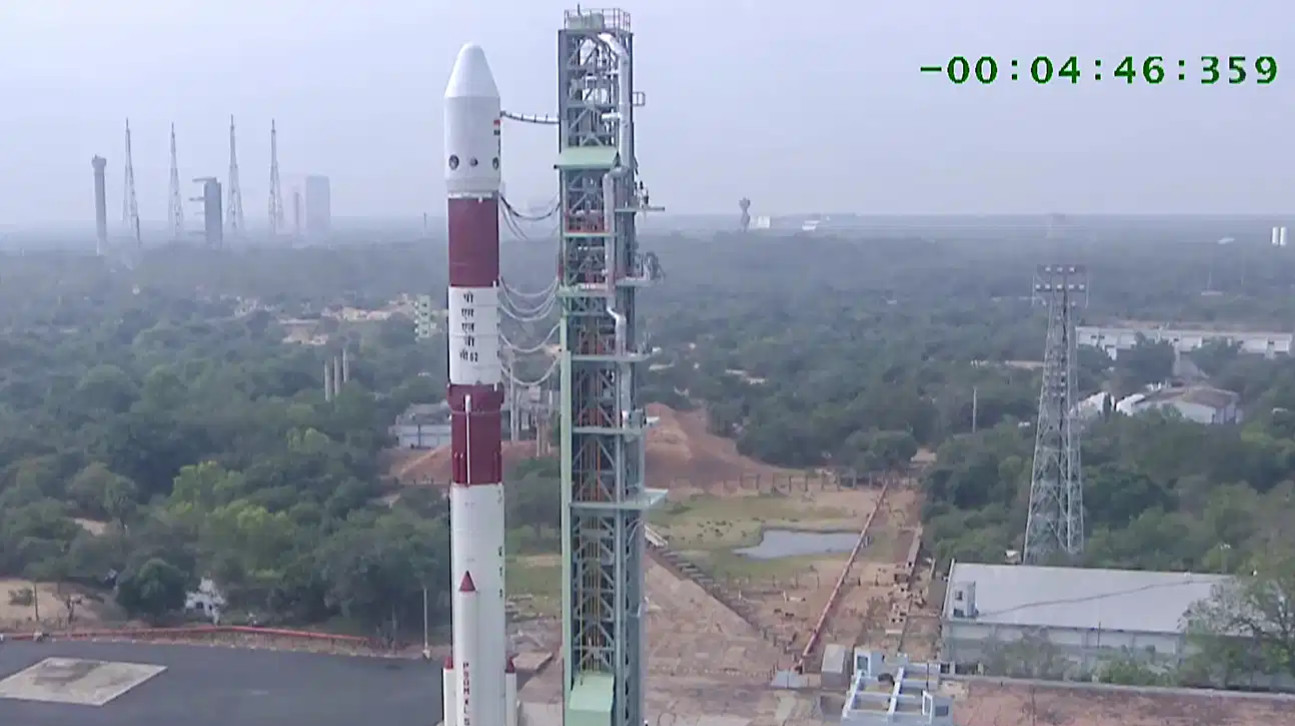
The Indian Space Research Organisation’s PSLV-C62 mission suffered a major setback on Monday after an anomaly during the rocket’s third stage prevented 15 of the 16 satellites on board from being placed into their intended orbit. However, amid the failure, a small experimental capsule named KID (Kestrel Initial Technology Demonstrator) managed to separate from the launch vehicle and transmit data, according to its developers.
The 44.4-metre-tall, four-stage PSLV lifted off as scheduled at 10.18 am from the Satish Dhawan Space Centre in Sriharikota, carrying the EOS-N1 mission payload. The launch was intended to deploy a primary Earth Observation satellite along with multiple co-passenger satellites into a 512-km Sun-Synchronous Orbit after a flight lasting about 17 minutes.
Also Read | Border tensions rise as Pakistani drones spotted near LoC in Rajouri, Indian Army opens fire
Initial stages of the flight proceeded normally, with ISRO scientists providing live updates from Mission Control. The situation changed shortly after the third stage ignition, when deviations in the rocket’s trajectory were observed.
Third-stage anomaly disrupts mission
As per a Hindustan Times report, ISRO Chairman V Narayanan said that the disturbances were detected during the third stage, when strap-on motors were providing thrust.
“Disturbances in the rocket and later deviation from the flight path were observed when the vehicle was in the third stage,” Narayanan said, adding that a detailed analysis has been initiated to identify the cause.
This marks the second consecutive setback for the PSLV programme. A previous mission in May 2025 (PSLV-C61/EOS-09) had also failed due to a motor pressure issue, resulting in a drop in chamber pressure.
ISRO confirmed the anomaly in a post on its official X handle, stating:
“The PSLV-C62 mission encountered an anomaly during the end of PS3 (third stage) of the vehicle. A detailed analysis has been initiated.”
Also Read | Why did ISRO's first mission of 2026 fail? Chairman answers
In a brief press interaction later, Narayanan said the mission “could not proceed in the expected flight path” and that conclusions would be shared after data from all ground stations was analysed.
‘KID’ capsule separates and sends data
Despite the loss of most payloads, Orbital Paradigm, a Spanish startup, said its KID capsule successfully separated from the PSLV and transmitted telemetry.
“Our KID capsule, against all odds, separated from PSLV C62, switched on, and transmitted data. We're reconstructing trajectory. Full report will come,” the company said in a post on X.
KID is a small-scale prototype re-entry vehicle, designed as a technology demonstrator.