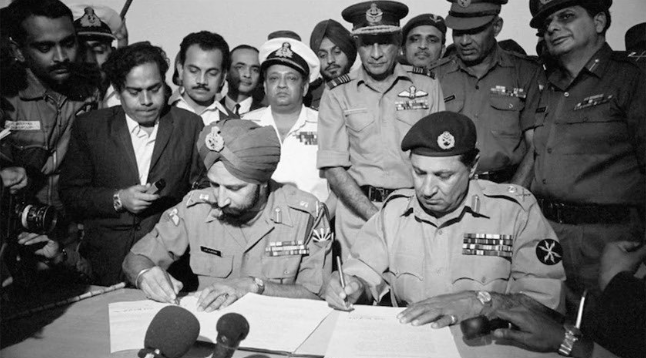
On December 16, 1971, Bangladesh rose from the ashes. Years of struggle, deaths, and being subjected to the most ghastly of torture finally had a name - Bangladesh. Chief of Pakistan Eastern Command Lt. Gen. A.A.K. Niazi surrendered to Lt. Gen. Jagjit Singh Aurora, GOC-in-C, Eastern Command of the Indian Army on this day. The picture of surrender remains etched in the memory of every Indian, and the Bangladesh Vijay lives as a moment of pride in the hearts of every Indian who witnessed their once fellow citizens being freed from the clutches of oppression.
The sacrifice of thousands of Indians and Bangladeshi ‘Muktijoddhas’ is history written in blood. The fiery words of Sheikh Mujibur Rahman and Indira Gandhi’s grit will always be something straight out of a fable. Among the many people, from high-ranking bureaucrats to soldiers, commoners who had to face the brunt of Pakistan, who got displaced, murdered, and were subjected to torture, the Indian bravehearts who set out to free their neighbours from the bloody iron claws of Yahya Khan, stand five Indian bravehearts who won it for the people.
Sam ‘Bahadur’ Manekshaw
Sam Hormusji Framji Jamshedji Manekshaw, or Sam ‘Bahadur’ as he was lovingly known by his compatriots in the army, was the Chief of Army Staff when the War of 1971 broke out. The military mastermind was asked by Prime Minister Indira Gandhi in a cabinet meeting towards the end of April in the same year if the Indian Army was prepared to go to war with Pakistan. Manekshaw, famously, revealed that the armed forces were not prepared, and thus Gandhi and Manekshaw began to set up the chessboard.
Manekshaw planned and executed the training and arming of the ‘Mukti Bahini’, and India officially entered the war on December 3, 1971, after Pakistani aircraft bombed Indian airbases in western India. The Indian Army entered East Pakistan from all sides, and on December 4, the Indian Navy and Air Force joined in. Within 12 days, the Pakistani forces capitulated. 93,000 Pakistani soldiers surrendered, Yahya’s army laid down arms, and Bangladesh was born. The genius of Sam ‘Bahadur’.
Rameshwar Nath (R.N.) Kao
The Chief of the Research and Analysis Wing (R&AW) played a pivotal role in ensuring India’s victory over Pakistan. After Pakistan launched ‘Operation Searchlight’, R&AW played a crucial role in the creation of Bangladesh. It supplied arms and training to the ‘Mukti Bahini’ in the early stages of the conflict. As mass killings and widespread sexual violence took place, Indian operatives entered East Pakistan, armed local fighters, and channelled the growing anger of the population into organised resistance.
As Nitin A. Gokhale writes in his bestselling biography of the ‘Gentleman Spymaster’, “The Pakistani Army’s brutality ensured that the Bengalis, Hindus as well as Muslims, despite many political differences, rose as one against Pakistan. R&AW’s job was to tap into the rage. RNK used different agencies and personalities to harness and coordinate the raw anger amongst the refugees to create different outfits that would harass and impose a battle of attrition on the Pakistani forces throughout the summer and monsoon months of 1971, preparing the ground for the final assault by the Indian Army, which was brilliantly led by Sam Manekshaw.”
Kao’s work didn’t finish in 1971. He was sent to Dhaka in May 1975 to warn Sheikh Mujibur Rahman that some members of his army were plotting to murder him. This warning ultimately turned into a nightmare situation for South Asia on August 15, 1975.
Phanindra Nath (P.N.) Banerjee
Phanindra Nath Banerjee, or ‘Nath Babu’ as he was known in Bangladesh, was an Indian Police Service (IPS) officer, who served as the Commissioner (Eastern Zone) of the Special Bureau, which was the field formation of R&AW. After R&AW was formed in 1968, P.N. Banerjee moved from the Intelligence Bureau to the new agency with R.N. Kao and became one of his trusted aides. Posted in Kolkata, he was responsible for operations in East Pakistan. Working from Dhaka, Banerjee built close links with Bangladeshi leaders, including Sheikh Mujibur Rahman. He also ran a major deception operation, quietly misleading the Americans into believing India was too unstable to intervene for the brewing Naxalite movement in West Bengal, even as the Indian Army prepared for action. Banerjee oversaw India’s coordination with the Bangladesh government-in-exile in Kolkata and was in charge of both open and secret guerrilla operations inside East Pakistan.
J.F.R. Jacob
Lieutenant General Jack Farj Rafael (J.F.R.) Jacob was serving as the Chief of Staff of the Indian Army's Eastern Command during the war. After the launch of Operation Searchlight, mass violence started, forcing over 10 million refugees into India. As tensions rose, J.F.R. Jacob was tasked with preparing war plans. While the initial strategy focused on capturing a few key towns, Jacob argued that Dhaka was the real objective. He proposed a fast “war of movement” that bypassed fortified towns, cut Pakistani communications, and advanced directly to the capital. His plan was eventually approved.
The strategy succeeded. Indian forces captured Dhaka in under two weeks, and on 16 December 1971, Jacob flew in to secure the unconditional surrender of Pakistani commander A. A. K. Niazi, ending the war.
Jagjit Singh Aurora
When the war broke out on December 3, 1971, Eastern Army Commander Lt. Gen. Jagjit Singh Aurora led Indian ground forces into East Pakistan. His troops advanced in a carefully planned, multi-front operation, engaging Pakistani forces in some areas while bypassing them in others to move quickly. Within less than two weeks, Indian forces reached and captured Dhaka. Pakistan’s Lt. Gen. A. A. K. Niazi signed an unconditional surrender before Aurora, marking the largest surrender since World War II.