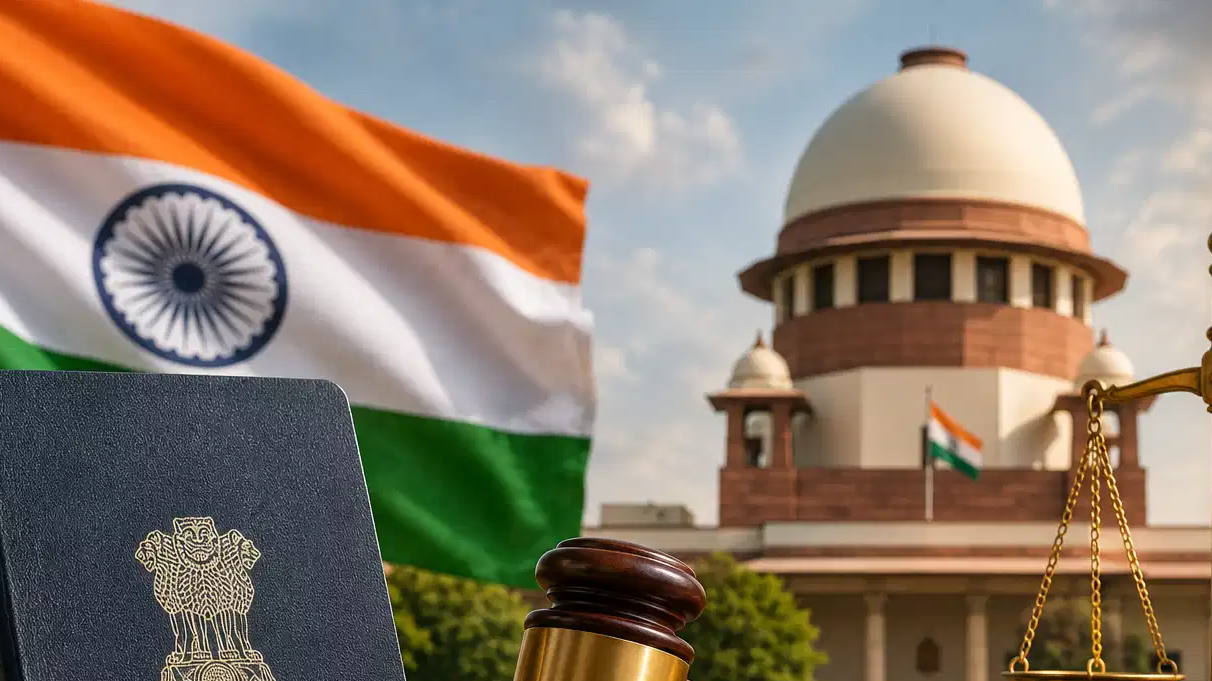
The Centre on Thursday clarified that an Indian passport has never been treated as conclusive proof of citizenship, asserting that the legal position is neither new nor the result of a recent policy change.
The clarification follows remarks made by the Ministry of External Affairs (MEA) during Passport Seva Divas, where officials said a passport is primarily a travel document and should not be regarded as definitive proof of citizenship. The statement triggered political criticism and widespread debate on social media.
Addressing the controversy, a government official said the position has existed for decades. "It was not decided yesterday that the Passport is not a proof of citizenship. It was not even decided in the last 12 years," the official said.
Also Read | Can a passport prove citizenship? India, US, UK and Germany explained
Centre cites law and court rulings
Defending the government's stand, officials pointed to provisions of the Passports Act, 1967, and judicial precedents.
According to the government, Section 5 of the Passports Act allows passport authorities to issue passports after conducting the necessary inquiry, while Section 20 empowers the Central Government to issue passports or travel documents to non-citizens in cases where it considers such action to be in the public interest.
Officials also referred to Bombay High Court rulings, saying the court has held that possession of a passport alone does not conclusively establish Indian citizenship.
The latest reference comes after observations made by the Bombay High Court while hearing a case involving individuals accused of being illegal immigrants despite possessing Indian passports.
Citizenship determined under separate law
This was reaffirmed by the Centre that issues pertaining to citizenship are regulated by the Citizenship Act, 1955, as well as regulations made thereunder.
Citizenship in India can be obtained either through birth, descent, registration, naturalisation or incorporation of territory.
Moreover, the government cited a previous response given in the parliament in February 2020 wherein the Ministry of Home Affairs had clarified that there is no one document, whether passport, Aadhaar, PAN card, voter ID or birth certificate, which serves as conclusive evidence of citizenship in all cases. Rather citizenship is decided upon the basis of one’s legal status and records under the Citizenship Act.
Debate follows MEA clarification
This controversy arose following the clarification by the MEA that although passports aid travel abroad and consular protection, they must not be considered conclusive proof of nationality.
Also Read | PM Modi welcomes Amazon's record $48 billion India investment after Jassy meeting
The statement led to queries being raised as to why a passport that is internationally acknowledged as valid for immigration purposes is not considered as conclusive proof of citizenship.
The Centre clarified that this clarification was based on existing legal provisions and that nothing much has changed. The clarification, according to the Centre, is made keeping in mind the fact that citizenship in India is decided via statutory and judicial considerations and not a particular document issued by the government.
FAQS
Q1. Is an Indian passport conclusive proof of citizenship?
No, an Indian passport is merely a travel document. Citizenship is based upon the Citizenship Act of 1955.
Q2. What act does Indian citizenship abide by?
Indian citizenship is regulated by the Citizenship Act of 1955. Citizenship can be acquired through birth, descent, registration, naturalization, or territorial incorporation.