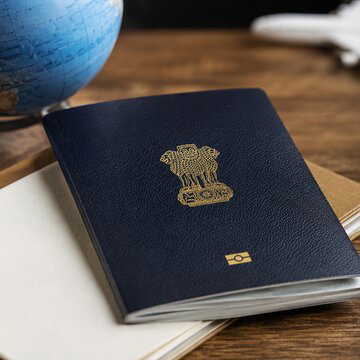
The Indian government's recent clarification that a passport is primarily a travel document and not conclusive proof of citizenship has drawn attention to how different countries determine nationality.
This problem became prominent due to the legal observation that citizenship is regulated by the Constitution of the country, Citizenship Act, and other similar legislations, and not just through a passport alone.
While passports are usually considered sufficient documents that establish citizenship, there are some nations that differentiate between a travel document and legal proof of citizenship.
Also Read | Massive fire breaks out in Delhi slum; large-scale rescue operation underway
India operates on a documentation-based system of citizenship
As per the Indian government, citizenship can be granted as per the Constitution and Citizenship Act, and the issuance of passport is mainly to aid foreign travel.
Courts in India have always observed that having a passport alone is not enough to prove citizenship. As per the observations made recently by the Bombay High Court, those born in India after July 1, 1987, cannot automatically be a citizen unless at least one of their parents is a citizen of India, as per the relevant citizenship legislation.
This observation was made by the court in the case of some people who were charged with illegal immigration even though they had Indian passports.
How other countries treat passports
The legal position differs across countries. In the United States, a valid or even expired full-validity US passport is accepted by the State Department as primary evidence of citizenship.
The United Kingdom generally treats a British passport as prima facie evidence of nationality, although citizenship ultimately derives from British nationality law and passports issued in error can be revoked.
In Canada, passports are issued only to citizens, but a citizenship certificate remains the official legal proof of citizenship. Birth certificates and citizenship certificates are commonly required while applying for a passport.
Australia and Ireland also issue passports only to citizens, though both countries maintain separate citizenship records that may be required in legal or administrative proceedings.
Germany and France require additional proof in some cases
Countries such as Germany, France and South Korea adopt a more document-based approach. German authorities may require a citizenship certificate (Staatsangehörigkeitsausweis) in complex nationality disputes, even if a person holds a German passport.
Similarly, France recognises the Certificate of French Nationality as the definitive legal proof of citizenship in disputed cases. South Korean authorities can independently verify citizenship status, particularly in cases involving dual nationality or claims by descent.
Also Read | First India-built C295 to join IAF, marking private sector breakthrough
Passport remains important, but not always final
Even though passports are accepted as proof of travel and identity all over the world, lawyers have said that the issue of citizenship rests with nationality laws of individual countries.
Hence, the stance taken by India is more aligned to the system followed by continental Europe, where passports act as conclusive proof of nationality only in most cases and not always.
FAQs
Q1. Is an Indian passport conclusive proof of citizenship?
No. As per the Government of India and the courts, a passport is merely a travel document and cannot be taken as conclusive proof of citizenship. Citizenship is determined according to the Constitution, Citizenship Act, etc.
Q2. In which countries does the passport act as proof of citizenship?
In the US, the passport can be used as conclusive proof of citizenship. However, some countries like Canada, Germany and France require further proof of citizenship in certain cases.