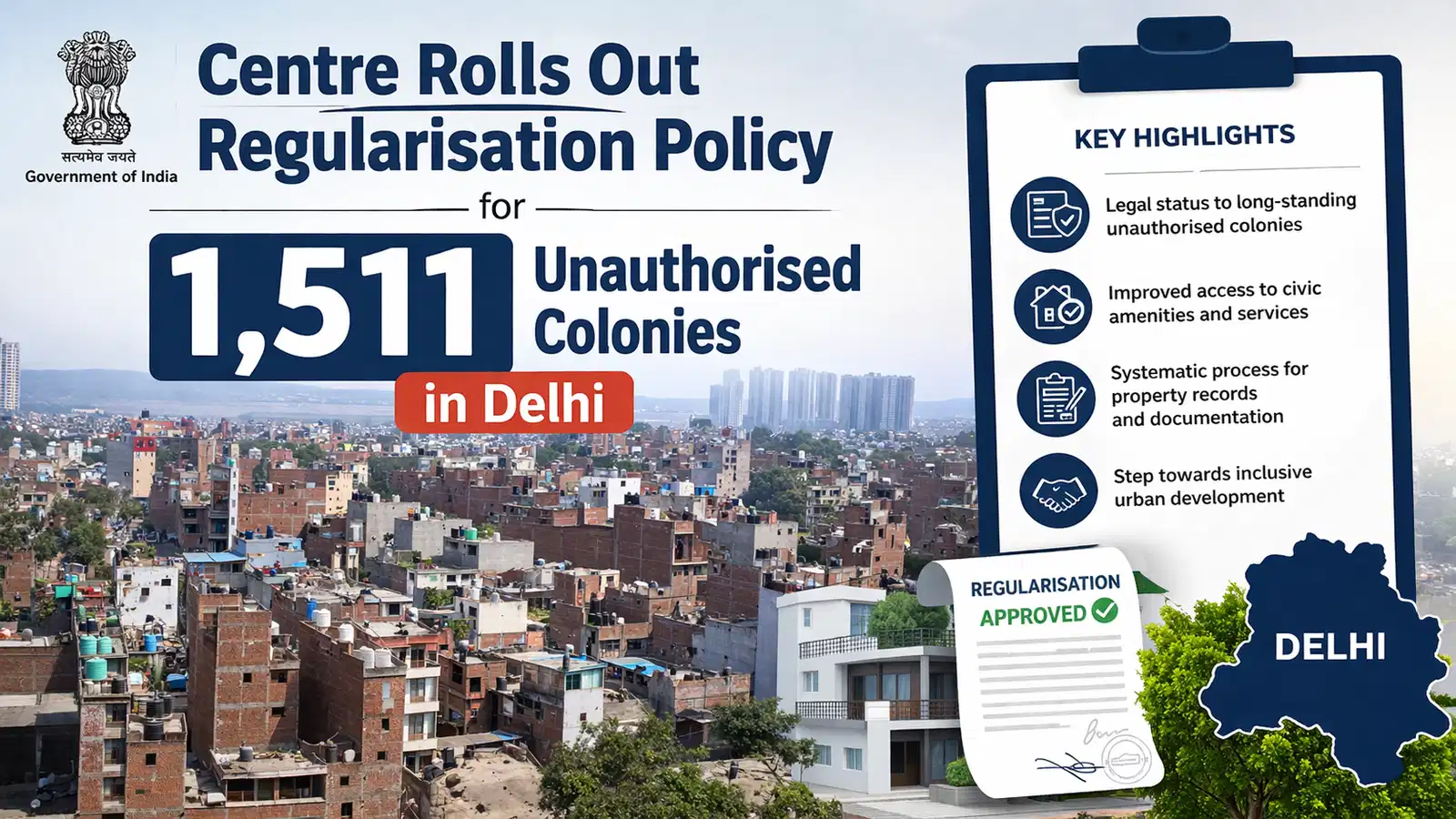
In a significant move aimed at addressing one of Delhi’s most persistent urban challenges, the Centre has announced a regularisation policy covering 1,511 unauthorised colonies. The initiative is expected to benefit lakhs of residents by granting them ownership rights and bringing these settlements into the formal urban framework. While the national capital has around 1,731 unauthorised colonies, those located in restricted zones such as forest and ridge areas have been excluded from the scheme’s purview.
Simpler process under PM-UDAY
According to The Indian Express, the government has eased the application process under the Pradhan Mantri Unauthorised Colonies in Delhi Awas Adhikar Yojana. Residents will now be able to get building plans prepared by architects empanelled with the Municipal Corporation of Delhi and apply for regularisation directly. Earlier, applicants were required to submit an approved layout plan of the entire colony, a condition that often delayed or blocked applications. The removal of this requirement is expected to accelerate the process significantly. From April 24, the PM-UDAY portal will also be transferred from the Delhi Development Authority to the Delhi government’s Revenue Department, which will handle the issuance of conveyance deeds and authorisation slips.
Stricter monitoring through drone surveys
To ensure planned development going forward, all new constructions in these colonies will require approval from the Municipal Corporation of Delhi. Authorities will also deploy regular drone surveys to detect unauthorised construction activity. Officials described this as a crucial step towards enforcing accountability and preventing further unregulated expansion in already congested areas.
Also Read | Internet cut in 5 Manipur districts after two children die in suspected rocket attack
Political and electoral significance
The move carries strong political weight, having been a key promise in the BJP’s campaign for the 2025 Delhi Assembly elections. Senior leaders, including Amit Shah, have repeatedly stated that the scheme could benefit nearly 40 lakh residents across unauthorised colonies. The issue has also been a point of contention between the BJP and the Aam Aadmi Party, with the latter raising concerns over implementation after losing power in the capital.
Also Read | Two children among five killed in Manipur attack as fresh unrest erupts in Bishnupur
Towards planned urban growth
With the combination of simplified ownership procedures and stricter oversight, the new policy is positioned as a step towards planned urbanisation in Delhi. If implemented effectively, it could transform informal settlements into legally recognised neighbourhoods while improving infrastructure, governance and quality of life for residents.