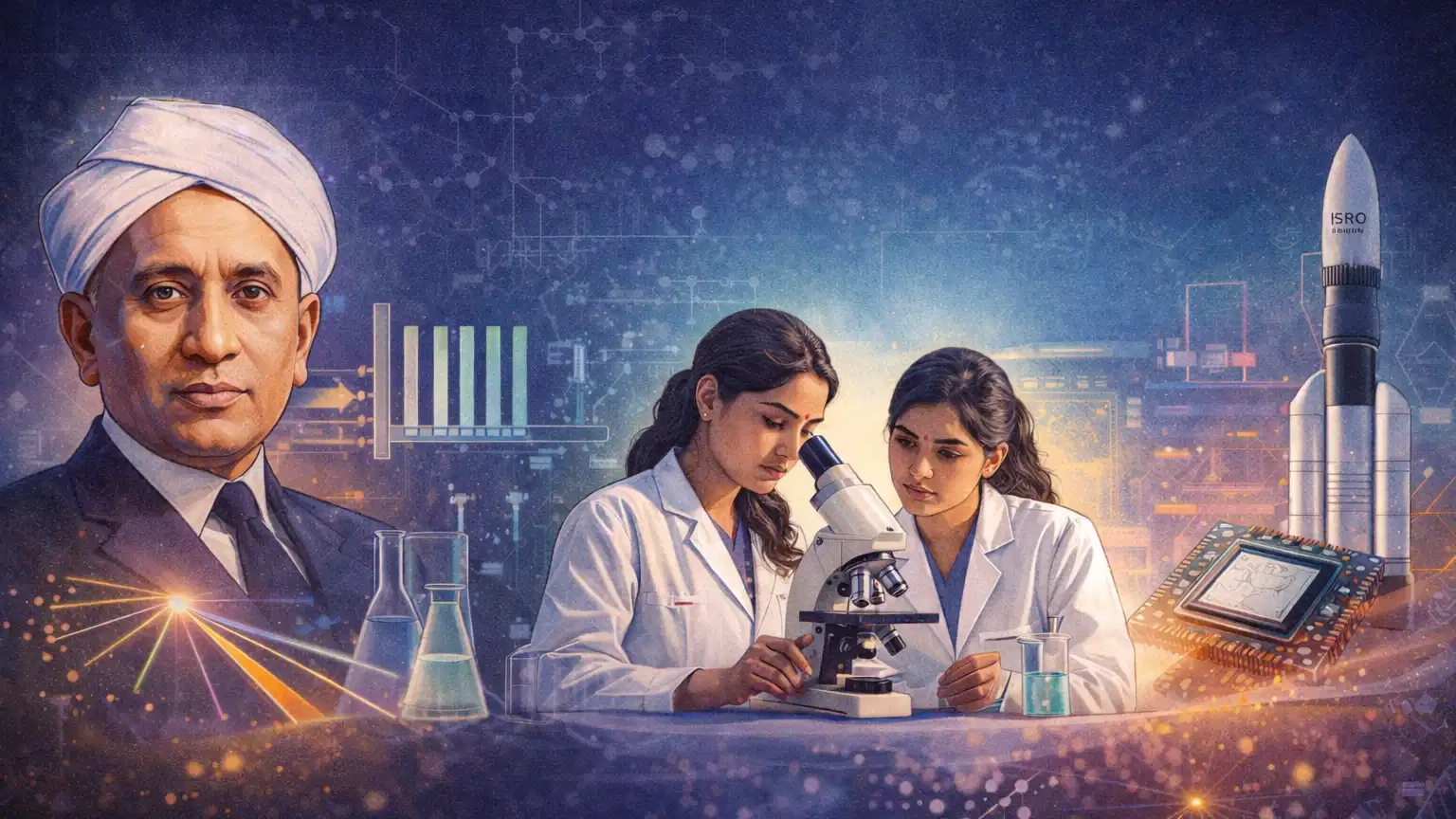
India celebrates National Science Day on February 28 every year to commemorate Sir C.V. Raman’s discovery of the Raman Effect in 1928. Sir C.V. Raman was awarded the Nobel Prize in Physics in 1930 for discovering how light behaves when it is passed through transparent materials.
In Sir C.V. Raman’s experiment, it was found that when light is made to pass through any substance, a small part of it changes its wavelength. By observing this change, scientists are able to analyse the composition of that substance. This discovery later proved to be an important aspect of chemistry, physics, and material science.
Also Read | ‘Right to hold passport is part of personal liberty’: Delhi High Court sets aside Centre’s impounding order
India began celebrating National Science Day in 1987, following the National Council for Science and Technology Communication's recommendation to observe Sir C.V. Raman's discovery every year. Since then, educational institutions, labs, and other scientific organisations observe National Science Day by spreading awareness about scientific learning.
These usually include exhibitions, science fairs, lectures, and quiz competitions. The events are designed in a way that they motivate and interest students in scientific research and innovation.
Theme for National Science Day 2026
The theme for this year’s National Science Day celebration is “Women in Science: Catalysing Viksit Bharat.” The theme emphasises the contribution of women scientists and researchers in the development of scientific research in India.
Institutions across the country are conducting seminars and other programs that highlight the contributions of women researchers and scientists in India. There are also talks about the need for better facilities for women in scientific research.
India has been witnessing a steady growth in its scientific and technology sector. The country ranks 38th in the Global Innovation Index and sixth in the world in intellectual property filings. India ranks among the top in the world in scientific research publications.
In space research, India’s achievements include those of the Indian Space Research Organisation (ISRO), which have been in the form of missions like Aditya-L1 solar mission and Space Docking Experiment (SpaDeX). Alongside this, India has also made advancements in areas like semiconductor design, artificial intelligence, etc.
It is not just a day to commemorate Raman’s discovery, but it is also a day to focus on the role that scientific research has to play in India’s development.