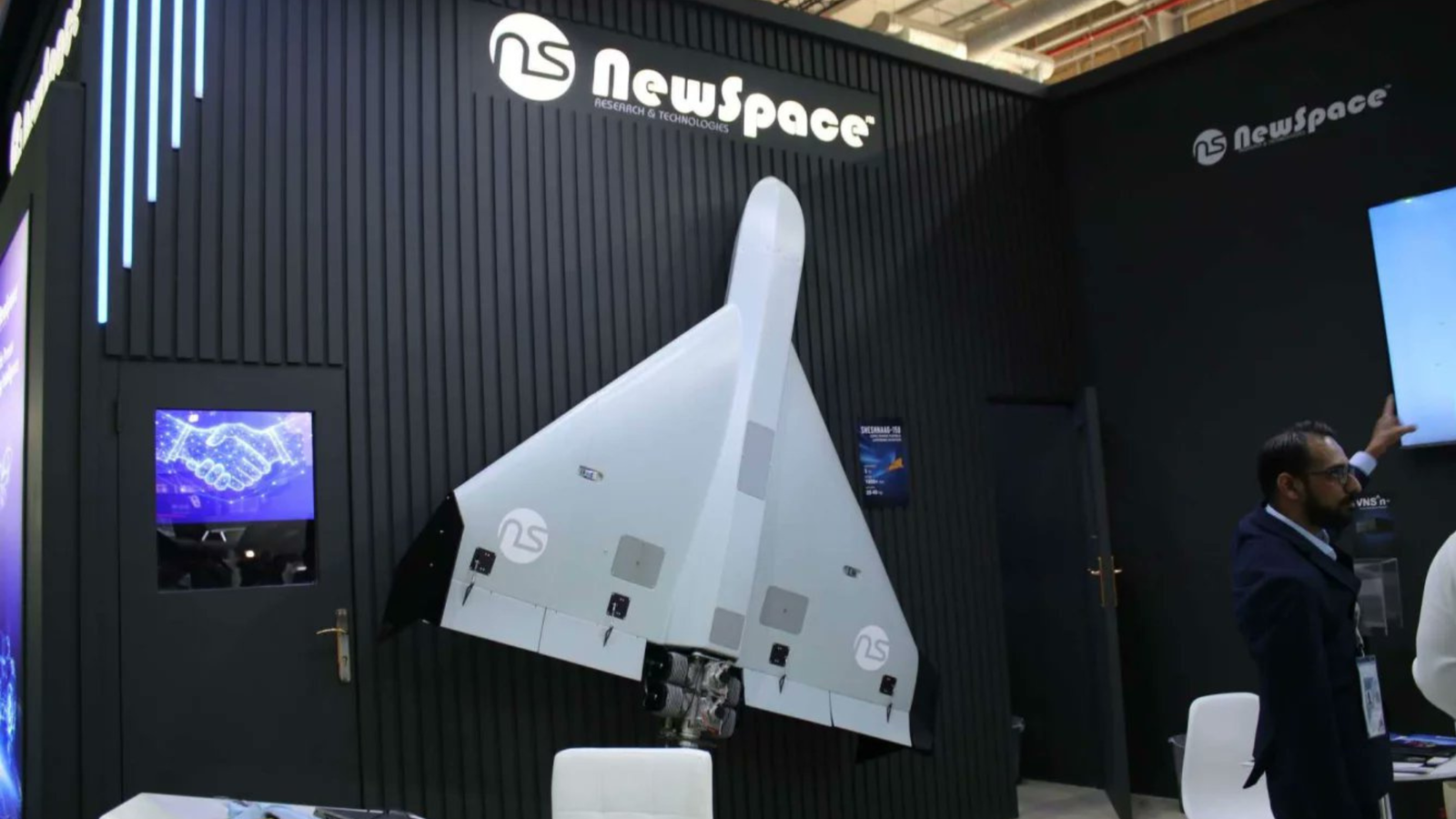
The private defence sector of India has entered the realm of long-range drones with the unveiling of the Sheshnaag 150 swarm drone at the World Defence Show 2026 in Riyadh, Saudi Arabia. The NewSpace Research and Technologies-built system is being marketed as a theatre-level loitering munition with a strike range of over 1,000 km.
Reportedly, the officials of the company said that the Sheshnaag 150 is meant to bridge the gap between short-range drones and stand-off cruise missiles. While the short-range drones are designed for use on the battlefield, the Sheshnaag 150 is designed to penetrate deeper.
Built for distance, designed for precision
The propulsion system of the aircraft has not been disclosed, but its almost five-hour endurance suggests that the aircraft is not powered by a battery pack and must have a small engine installed.
According to NewSpace Research and Technologies officials, the aircraft is designed to carry a warhead of 25-40 kg in weight. The initial test results of the aircraft suggest that the circular error probable of the aircraft is around five metres. Such accuracy levels put the aircraft on par with precision-guided munitions rather than one-way drones.
Also Read | Emmanuel Macron's India visit sparks $40 billion Indian Air Force Rafale mega deal talks with PM Modi
NewSpace claims that its system can deliver a warhead weighing anywhere from 25 to 40 kilograms to a target. Early testing, which they presented, shows that their system has a circular error probable of about five meters. If their accuracy holds up, they could potentially classify their system as a precision-guided system, rather than a standard one-way drone.
Swarm logic and collaborative attack
The strength of the Sheshnaag 150 is the swarm feature. NewSpace defines it as a cooperative attack system rather than individual drones carrying out strikes.
In operation, multiple drones can be launched at the same time. Some drones can act as decoys to elicit responses from the enemy’s radar system. The actual attacking drones can then target the exposed positions. This approach generates what the military calls the ‘multi-axis dilemma’ for the enemy air defence systems, as they will be required to respond to multiple threats from different angles.
Also Read | Is a social media age cap coming? Ashwini Vaishnaw hints at new rules
Where it fits in India’s strike matrix
It has a range of 1,000 kilometres, which means that it could target command centres, air defences, ammo dumps, and airfields without putting manned aircraft at risk. The fact that it's a loitering munition means that they can wait to get confirmation of their target before striking.
There are no known contracts for their system, at least not yet. The system is privately funded, with an emphasis on both internal use and export.