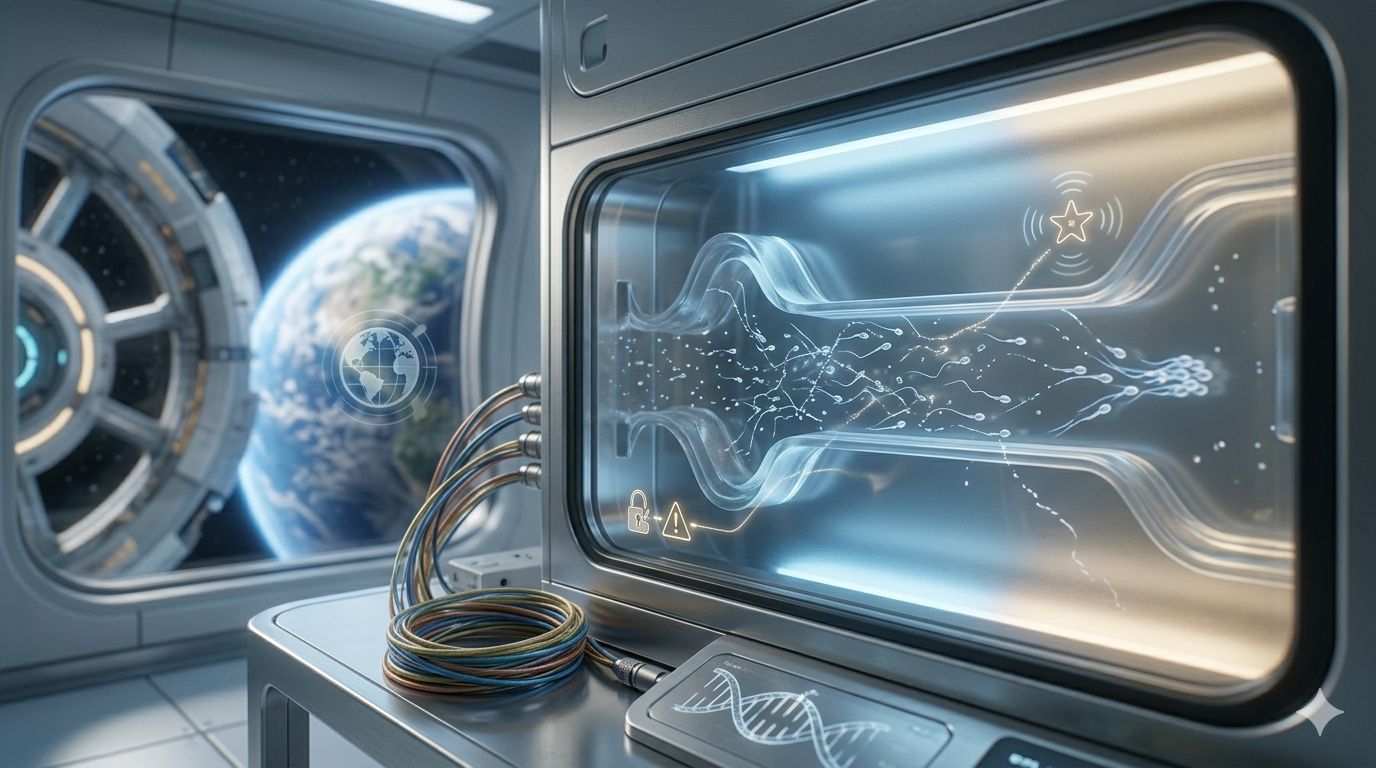
Ever wondered if humans could get pregnant in space? Human reproduction beyond the Earth remains uncertain, with a new study pointing to how microgravity and cosmic radiation could affect fertility. While astronauts have lived aboard the International Space Station for more than two decades, long-term human settlement beyond Earth would eventually require successful reproduction, something scientists are still trying to understand.
Microgravity may affect fertilisation
The study, published in Communications Biology, examined how human sperm behave in microgravity-like conditions, reported NDTV. Researchers used a simulation chamber designed to mimic the female reproductive tract in zero gravity to test how sperm navigate.
Also Read | Is the ‘Opposites Attract’ theory in relationships just a myth? Here’s what science says
They found that sperm struggled to move in the right direction in microgravity, thereby reducing fertilisation rates by up to 30 per cent. The altered environment made it harder for sperm to reach the egg, highlighting a potential challenge for reproduction in space.
Scientists also noted that microgravity can affect hormone regulation, which may reduce both sperm and egg quality. These changes could make conception more difficult during long-duration missions.
Radiation adds another challenge
Beyond microgravity, space radiation poses additional risks. Researchers said radiation exposure can damage DNA, increase cancer risk, and affect reproductive cells. These factors raise concerns about the safety and viability of pregnancy in space environments such as the Moon, Mars, or orbiting habitats.
"As missions to the Moon and Mars move from aspiration to reality, understanding whether humans and the species we depend on can successfully reproduce in those environments is not a curiosity; it is a necessity," Nicole McPherson, the senior study author and a senior lecturer at Adelaide University, said as quoted by Scientific American.
Hormone signal improves sperm navigation
The study also tested whether progesterone could help sperm navigate better in microgravity. Progesterone is a hormone released by cells surrounding the egg and plays a role in guiding sperm.
"Progesterone works as a chemical signal, a kind of biological homing beacon that the egg releases around the time of ovulation," McPherson, who studies reproduction, explained. "Sperm have receptors on their surface that detect this signal and use it to orient themselves and swim toward the source."
Also Read | Feeling alone while raising a family? Here’s the truth behind today’s silent struggle
"It is one of nature's more elegant navigation systems," she adds.
However, researchers cautioned that more work is needed. McPherson noted that the findings are promising but "we are not at the point of suggesting progesterone as a simple fix for fertility in space".