There is something quietly remarkable about a glass vase that began life as a fishing float. That, in essence, is the story of Tsugaru Vidro — a glassmaking tradition from Japan's Aomori Prefecture that refused to sink when the tides turned against it.
For much of its history, the craft existed in service of the sea. Fishermen across Japan's coastal waters relied on glass floats to keep their nets buoyant, and workshops in Aomori were at the heart of that production for decades. It was unglamorous, functional work — but it kept artisans employed and the tradition alive.
Also Read | Why water bars are making a splash at premium Indian weddings
When the tide turned against them
Then came the 1970s. Plastic alternatives flooded the market, cheaper and easier to produce at scale. Demand for glass floats collapsed almost overnight, and with it, the livelihoods of craftsmen who had spent years perfecting their skills. For many regional industries, this is where the story ends — the slow closure of workshops, the departure of young talent, and the quiet death of a local tradition.
In Aomori, the glassmakers chose a different path.
Rather than shutting their furnaces, artisans pivoted to what they knew best: the "free-blowing" technique, a process where molten glass is shaped entirely through breath, without any mold guiding its form. It is a method that demands patience and intuition. Because no two blows are identical, no two pieces ever come out exactly alike. That individuality — once an unavoidable quirk of the production process — became the product's greatest selling point.
A fresh breath through molten glass
The craftsmen turned their attention from maritime equipment to domestic life. Vases, tableware, decorative pieces. They also began experimenting with colour on an ambitious scale, developing a palette of more than 100 distinct hues drawn from nature — the greens of Aomori's forests, the blues of the sea they had long served, the soft amber of an autumn hillside. The goal was to bottle something of the landscape itself within the glass.
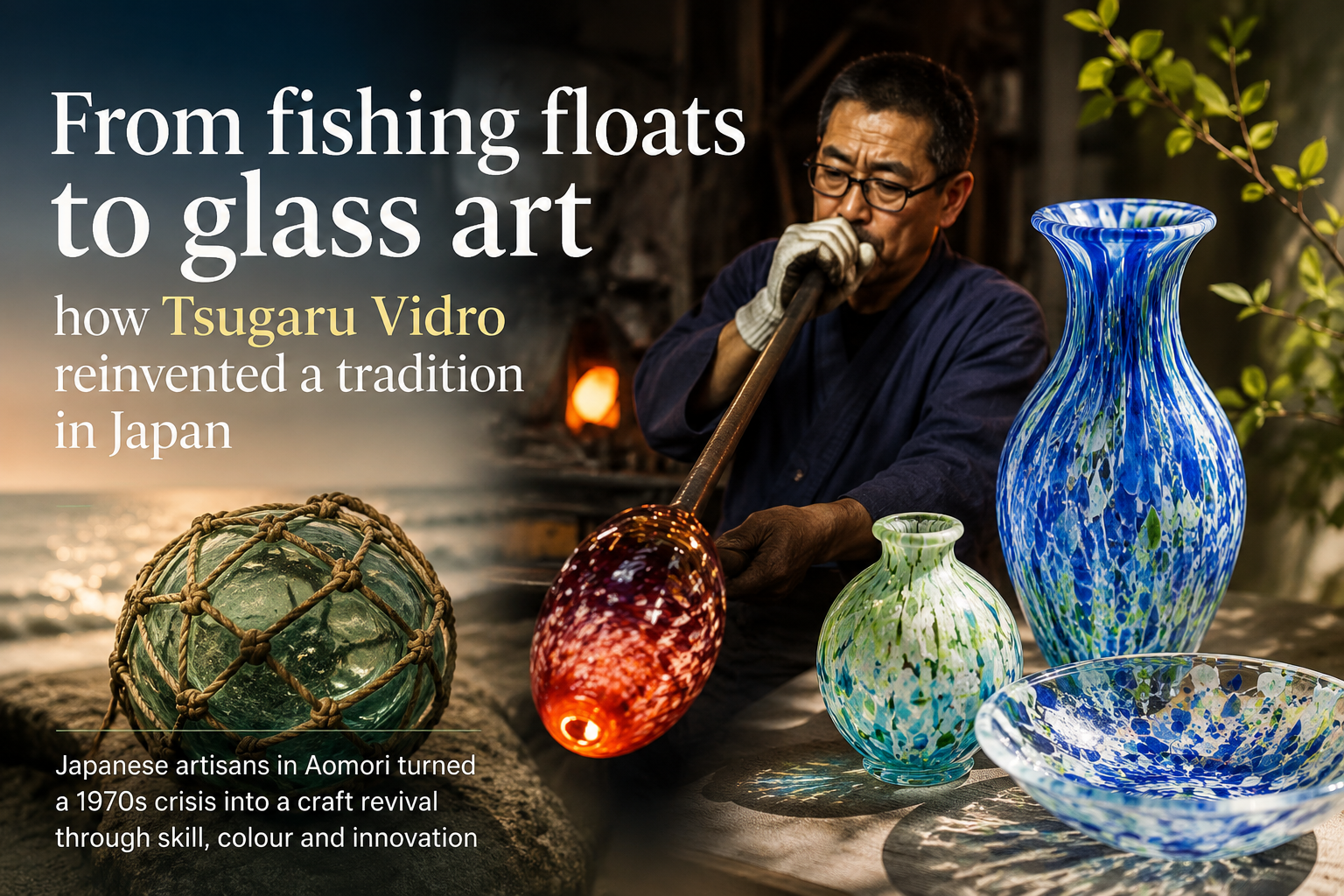
A recent social media post from the Government of Japan captured this evolution in a single frame: glass fishing floats sitting alongside images of artisans at work and the finished decorative pieces now sold to collectors and households across the country. The contrast is striking — the same hands, the same breath, but an entirely different purpose.
The transformation of Tsugaru Vidro has since become something of a case study in industrial reinvention. It illustrates a challenge that is far from unique to Japan: how do regional industries survive when the product they were built around becomes obsolete? The usual answers involve subsidy, nostalgia, or slow decline. Aomori's glassmakers found a third option — adaptation that didn't require abandoning the craft itself, only reframing what the craft was for.
The art of changing course without drifting away
Also Read | Forget swiping: ‘Pitch Your Friend’ is India’s hottest new dating trend
There is a broader lesson here that travels well beyond the shores of northern Japan. Traditional industries often carry within them skills and knowledge that are genuinely difficult to replace. The question is whether those skills can find a new context before the window closes. For Tsugaru Vidro, it did — narrowly, but decisively.
Today, the colourful handblown glassware from Aomori is no longer a relic of the fishing economy. It is a lifestyle product, a cultural export, and a symbol of what becomes possible when craftsmen respond to a shrinking market not with resignation, but with imagination.
FAQs
Q1: What is Tsugaru Vidro?
Ans: Tsugaru Vidro is a traditional glassmaking craft from Japan's Aomori Prefecture that originated from the production of glass fishing floats.
Q2: Why did Tsugaru Vidro artisans switch from fishing floats to tableware?
Ans: Artisans adapted to declining demand for glass fishing floats in the 1970s by using traditional free-blowing techniques to create decorative and functional glassware.