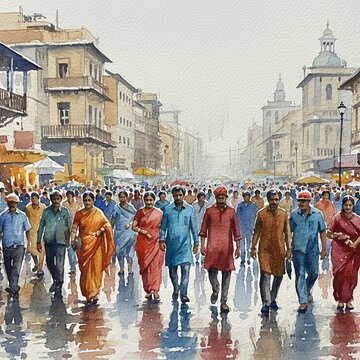
As the Poush Mela approaches, smiles widen on the faces of Bolpur’s hotel owners, while tourists begin to suffer. On one hand, it becomes nearly impossible to find hotel rooms, and even if one does, the prices are three to four times higher than normal. Add to this the inevitable traffic jams. During Poush Mela, Basanta Utsav, and Durga Puja, the peace of Shantiniketan is seriously disturbed.
That said, this is also the time when hotels, eateries, clothing stalls, and decorative shops enjoy good business, and toto-rickshaw drivers finally earn a little extra.
Today, I want to write about my deeply cherished memories of Bolpur from the past and the distorted form it has taken in the present.
ALSO READ| 4-day police custody for Mehbub in Lagnajita Chakraborty stage harassment case
Since childhood, Birbhum has been very dear to me. I have three hometowns:
Kolkata— which gave me my livelihood;
Darjeeling— which gifted me a beautiful childhood;
and Birbhum— where I found profound peace.
I divide my present time among these three beloved “daughters.”
I have seen Bolpur where bullock carts once rolled, seen Bhubandanga with its mud houses, and now I see an oddly decorated Bolpur filled with multi-storied buildings. The undulating red soil along the canal banks has been buried under black asphalt. The rows of Sonajhuri and Palash trees along those roads are gone—devoured by timber-hungry monsters. The Saturday market has now become a daily market. Artists are no longer found there. The very skeleton of the market that Shyamali Khastagir had envisioned with such care is no longer visible. Sonajhuri Haat is now in the hands of traders, brokers, and middlemen.

ALSO READ | Worshipping Gods, rising insecurities, and social service schemes in India
I came here to write about winter in Shantiniketan, yet I’ve wandered into so many other topics! The truth is, my heart aches and grows restless because stains are being left on the creation of my life’s Thakur—my spiritual guide, my musical inspiration, my Rabindranath.
For Calcuttans, Bolpur is a very close and beloved destination. There are very few Bengalis in Kolkata who have not visited Shantiniketan. I go to Bolpur again and again, with or without reason.
In summer, I go for the Krishnachura, Amaltas, and Kurchi blooms;
in the monsoon, to be drenched in green;
in autumn, to touch the kash flowers;
in late autumn, to hear the sound of falling leaves;
in winter, to feel the cool touch of the season;
and in spring, to be intoxicated by Palash, Shimul, and Ashok blossoms.
Nature is so mysterious—it adorns itself in six different forms across the six seasons.
To me, Bolpur is both fondness and love. Bolpur seems to pull me toward it again and again. For me, Bolpur means an intimate connection with Gurudev (Rabindranath Tagore). I hear his resonance in the sky, the air, flowers, and leaves—I listen closely to it. Every brick, stone, patch of red soil, and every alley of Bolpur deserves a story. Today, I present those stories in simple words, in the plain language of Birbhum.
ALSO READ | Dyed in blue, drenched in hope: Walking in the white silence of Gurudongmar
What to explore in Bolpur?
Visva-Bharati University
There is little left to say about this. Rabindranath Tagore’s place in the Bengali heart has endured for generations and will continue to do so. A wonderfully serene environment where, in trees and flowers, branches and leaves, sky and air, you will feel the presence of our 'Praner Thakur, Moner Thakur' (God/Tagore of heart)—Rabindranath.
Deer Park
Located inside Ballavpur forest, this wildlife sanctuary is home to several deer and abundant greenery. From the watchtower, the view of Lalbandh is truly beautiful.
Srijani Gram
A village under the Government of India, where one can see the arts, culture, and lifestyles of various Indian states. This creative village is spread over a vast area.
Sayor Bithi Park
A rural amusement park built around a large lake. Birds are present year-round, and in winter, many migratory birds arrive, drawn by the fish in the water. There are plenty of trees and arrangements for children’s recreation. Boating is available on the lake.
Amar Kutir
Located along a red-soil path by the Kopai River, inside Ballavpur forest, this handicrafts center allows you to see weaving and leatherwork up close. It was once a secret hideout for freedom fighters.
Sonajhuri
One of the main attractions of Shantiniketan today. Every Saturday afternoon until evening, a large rural market is held under the open sky by the Khoai. Anyone who visits once is bound to return.
Kopai River
The Kopai never completely dries up; water flows year-round. During the monsoon it swells, losing its calm demeanor. Its scenery is enchanting—the reflection of the blue sky in its clear water and the white kash flowers dancing along its banks create a unique experience.
Raipur Zamindar Bari
About 7 km from Bolpur, under Supur Gram Panchayat, stands this now-ruined mansion, frequently used for Bengali film and TV shoots. It belongs to the Sinha family of Kolkata. In 1863, Bhuban Mohan Sinha leased 20 acres of land to Debendranath Tagore for an annual rent of just five rupees.
Kankalitala
Located 9 km from Bolpur, this Shakti Peetha is where Sati’s skeleton is believed to have fallen. The temple stands beside the Kopai River, near a cremation ground, with a Shiva temple nearby. Spread over a vast, tree-filled area, Baul songs are often heard here. A sacred pond nearby is believed to contain a part of the Goddess’s body.
Dongali Kali Temple
Very close to Bolpur station near Platform No. 3, this temple is also known as Dakat Kali Bari. The locals have deep faith in it and often visit before and after auspicious events. After her marriage, Suchitra Sen came here to offer prayers.

A little further away
Sabuj Bon (Green Forest)
On the banks of the Ajay River, this place truly refreshes the soul. Located at Rasulpur—158 km from Kolkata and 14 km from Bolpur—this resort and plant museum was created in 2006 by nature lover Abdus Selim on 50 acres of land.
The oldest tree here is 116 years old (Adinathum obesum). The cost for stay and food is ₹1200 per person per day. Accommodation for up to 20 people is available, with transport from Bolpur station for ₹300. The Ajay River lies just half a kilometre away.
The unknown Paharinath
Deep inside Ganpur forest lies Paharinath—largely unknown and neglected. I visit once a year, drawn by the silent presence of this small hill shrine, the forest hermit, and the eerie beauty of the place. The forest is rich with sal, teak, palash, and mahua trees.
One night, under torn moonlight, I saw the hill bathed in silver glow, as if covered with a white, tattered sheet. Clouds struck the moon, breaking it into fragments—an unforgettable sight.
Nearest railway station: Mallarpur
Distance from Bolpur: 70 km by road
Vehicle fare: ₹2500–₹3000
Fossil Park – Chau Pahari
ALSO READ | A temple has been constructed by carving a mountain for 18 years – do you know where it is located?
How can I end without mentioning Chau Pahari? During Falgun, the intoxicating fragrance of mahua fills the air of Birbhum, Bankura, and Purulia. Chau Pahari combines natural beauty with ancient history through its Wood Fossil Park—the only one of its kind in the state.
Discovered in 2006 during pond excavation under a government project, fossils dating back 15–20 million years were found. Today, the park stands as a crown jewel within the forest, bearing testimony to the Miocene era.
How to reach Bolpur
From Kolkata, take National Highway 2 to Bardhaman. From Renaissa More, turn right past the 108 Shiva temples of Nababhat, cross Guskara and Bhedia, and continue straight to Bolpur.
Distance:
Kolkata to Bardhaman – 118 km
Bardhaman to Bolpur – 54 km
Excellent road conditions throughout.