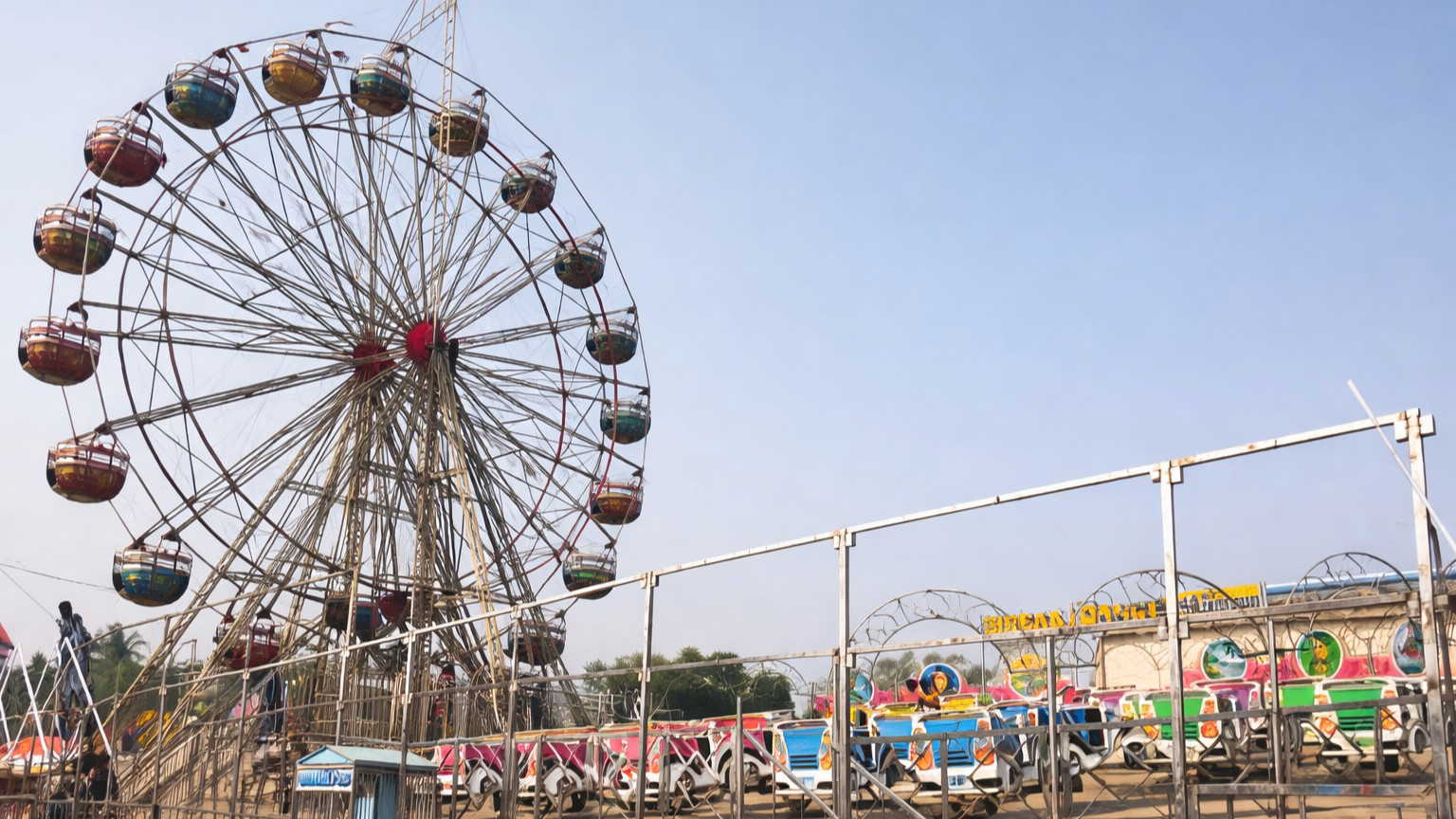
For Kolkatans, winter means cricket on open grounds, in lanes and fields. It means the Book Fair, the zoo, Joynagar’s moa, and picnics—now fashionably renamed “parties.”
But winter in Bolpur is something else altogether: the steady flow of tourists, the intoxicating fragrance of fresh date-palm sap, and a whole garland of fairs.
I have seen many fairs in my life—the Benir Mela of North Bengal, the Ras Mela of Cooch Behar, the Kumbh Mela, Bihar’s Sonepur Mela, Odisha’s Chandrabhaga Mela, Himachal’s Kullu Dussehra, and countless smaller ones.
Yet the fairs that remain etched deepest in my heart are the rustic village fairs of Birbhum, dusted with red earth.
Among the fairs organised by Visva-Bharati, four are especially popular—the Anand Mela, Nandan Mela, Poush Mela, and the Magh Mela held at Sriniketan. Beyond these, Birbhum is alive with innumerable fairs: the Kenduli Mela, the Shravan fair at Kankali Tala, the Phullara Tala fair of Labhpur, the Shiva fair of Mollarpur, and many more. And soon comes Birbhum’s Baul Mela—where listening to songs in Baul akhras, spending icy nights under temporary tents, eating hot khichuri, and sleeping wrapped in blankets on straw bedding has been a joy I’ve experienced many times. It feels like building a home in a different world altogether.
Also Read | When power breaks the law
Winter in Bolpur keeps calling me back—again and again. I came this time just to soak winter into my skin and surrender to the warm, fragrant pull of nolen gur.
The four of us—Dada, Boudi, myself, and Brahmani—were having tea together in the morning when a call came from Bolpur. The caretaker at our Bolpur den asked what we would like for lunch. I was taken aback. While I was still talking to him, Dada snatched the phone and told him we would be eating out for lunch. He had planned it earlier—just forgotten.
Within an hour, we were ready. Around 8 a.m., we left Kolkata. Via the Durgapur Expressway, crossing 72 km, we reached Gurap in Hooghly’s last stretch and had breakfast at Hindustan Dhaba. After another 38 km, we left NH-2, turned right past the 108 Shiva temples of Bardhaman, crossed Guskara and the Bhedia Bridge, and reached Bolpur around 1:30 p.m.
After a simple fish-and-rice meal at a hotel, we reached our den. On the way, we picked up groceries from the weekly market at Bhubandanga. We had brought supplies for three days. At night, we decided to go to Kenduli—about 24 km from Bolpur via Ilambazar. The next day, after lunch, we set off.
The Makar Mela would begin in ten days. People were busy building stalls. Preparations stretched across a vast area. I had last seen this fair in 2024—during its closing phase—yet even then the crowds were overwhelming. Parking had been two kilometres away.
This time too, after parking far off, the four of us took a van-rickshaw and crossed those two kilometres. When we reached the fairground, dusk had already fallen—something I hadn’t even noticed. Even three days after Makar Sankranti, the fair retained its splendour.
Crowds everywhere. Temporary shops. On a cultural stage, a Visva-Bharati dance group was performing a dance-drama. To see the entire fair would have taken the whole night. Avoiding the crush, we walked straight along the embankment road—with the Ajay River to the left and the fairground to the right—towards the Radha-Gobinda temple. Our aim was simple: to soothe body and soul at a Baul akhra.
Far to the left, on the sandy bed of the Ajay, stood a large, temple-like akhra. From its loudspeaker floated the song:
“Chokh purabo, mati rangabo, aaj mor piya ghar aschhe.”
The evening felt magical. My heart hummed softly—“Will there ever be such an evening again?”
Also Read | 'Running Up That Hill' of growing up — a farewell to 'Stranger Things'
As I stood by the roadside smoking, a sadhu sitting on the verandah of a small temple inside a house called me in. I went in without hesitation and saw a pandal set up for an akhra in the courtyard. I sat beside him. He told me he had once lived in Kolkata, but for the past fifteen years he had devoted himself to the service of Radha-Gobinda here.
Soon the rest of our group arrived, and the gentleman invited everyone inside. This fair is also known as the Baul Mela. Many Bauls have permanent akhras here. The temples—some nearly 350 years old—still carry deep history. The kings of Bardhaman and Queen Brajakishori established temple after temple at this site. Today, Kenduli village lies in Birbhum district. It is believed to be the birthplace of poet Jayadeva, who rendered the Gita Govinda into Sanskrit. Even Mughal-era records mention this place. Some claim Jayadeva was born in Odisha, not here—but wherever he was born, a vast human confluence has grown around his legacy.

Sandhya Das and her disciple—her 17-year-old daughter—had come from Durgapur. They come every year to serve their guru and to delight visitors with their soulful singing. Around 8 p.m., the musical session began. Sandhya-di’s daughter, Swapna, started singing—and the moment I heard her voice, goosebumps ran over me. The voice felt uncannily familiar—like my own Gaharjaan’s.
She sang in Raag Bhupali:
“He Govinda, He Gopal, He Doya Nidan.”
Such sweetness, such mastery—yet she comes from a poor family; her father works as a mason.
As she sang next, I noticed tears wetting her cheeks:
“Majhe majhe tobo dekha pai, chirodin keno pai na…”
She sang with complete surrender—heart and soul. Where her pain lies still makes me wonder.
Then Sandhya-di sang two songs herself—
“Tomay hrid majhare rakhibo, chhere debo na…”
and
“Ore chhere dile sonar Gour, kshyapa chhere dile…”
I won’t compare who was greater. I will only say this—I found both the diamond mine and the diamond cutter.
I was utterly absorbed when Brahmani’s call brought me back to reality. It was already 10 p.m. Kenduli Mela flowed like a human tide along the banks of the Ajay. It didn’t feel late at all. Fighting through the crowd, we reached our car. For those two kilometres, the road was completely jammed with people—no vehicle could move. But once we reached the Suri Road, everything fell silent.
Cold. Fog. As we crossed the Ilambazar forest, none of us wanted to return to the suffocating walls of a hotel room. We stopped the car. Perhaps everyone felt the same. A full moon lit the fog, casting an unreal beauty over the forest—Chaupahari Jungle, a name sweet in itself.
Also Read | Will AI only predict the future, or will it shape us?
This forest hides a remarkable discovery: its ancient ancestors were buried underground long before the Stone Age, slowly turning into fossil wood—now preserved in a fossil park that draws many tourists.
Sometimes I dream of buying a forest of my own—sal, piyal, sonajhuri, mahua—and spending the rest of my life there. A mud house, a cow-dung-plastered courtyard, bathing freely in moonlight. Only Brahmani beside me. No familiar faces. My trees would never demand anything from me.
I’ve seen enough of human selfishness—only demands, endless demands. Financial needs don’t hurt me, but I’ve seen people who, after becoming established, change their eyes—forgetting those who once helped them. I feel both disgust and pity for such people. Those whose hearts are full of demands can never truly be happy.
See what I’m writing! I should return to nature, to fairs…
It was 11:30 p.m. Santiniketan lay wrapped in a quilt of fog. Our headlights felt intrusive on the body of this sleeping fairy. Tomorrow we would leave Bolpur—but we will return. To Kenduli’s fairs, to Baul songs, and to keep the moner manush—the people of the heart—alive within us.