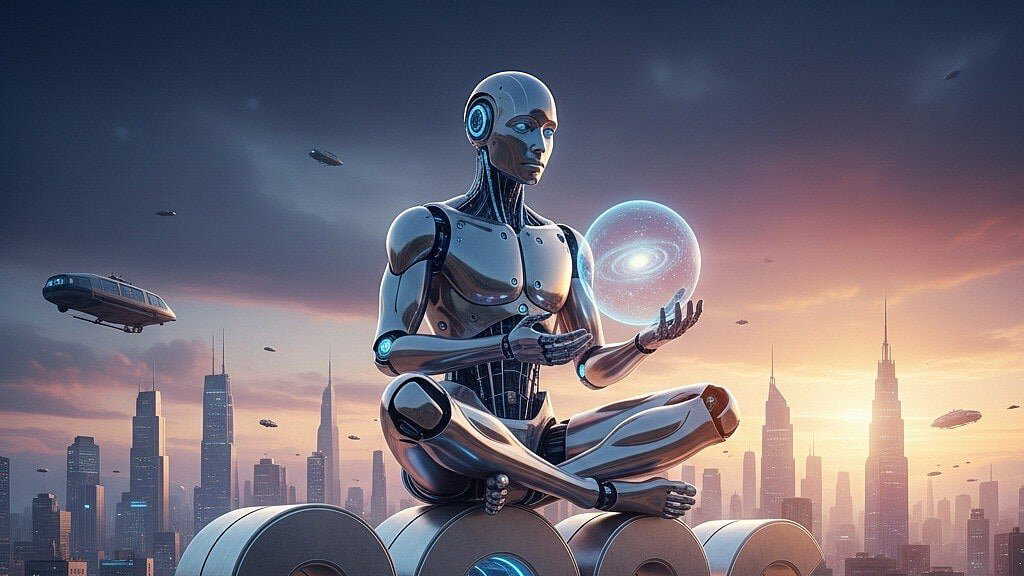
The new year has almost arrived, but the question isn't new: Is humanity's future in its own hands, or in AI algorithm files?
As 2026 begins, people will once again look toward the future, make plans, and give promises. Yet at this same time, a different system is quietly at work—AI-driven predictions. Who will buy what, who will go where, who will succeed in which field, these are no longer mere imagination, but probable calculations based on data.
This gives rise to an uncomfortable question: has the future already been written?
In today's world, algorithms sit behind almost every major decision. Whether banks will give loans, who gets called for job interviews, and which patients have higher risks—AI predicts all these outcomes in advance. The power of this prediction cannot be denied. Massive datasets, rapid analysis, patterns invisible to human eyes—all combined, AI makes decisions more effective. But does effective necessarily mean fair? And most importantly, where does human freedom stand?
Humans make decisions while standing before uncertainty. They make mistakes, learn, and suddenly change. Life's course shifts sometimes with a single word, sometimes with an opportunity. AI prediction wants to reduce that uncertainty, calculating averages of possibilities. But there's no such thing as an average human. There are individuals, each with their own story. When an algorithm declares 'you won't succeed' or 'your risk is high', how much does that label bind a person?
This is where the danger of data-driven prophecy begins. If someone is told their chances are low, they might not get opportunities at all. And without opportunities, chances truly diminish. This way, AI prediction doesn't just guess reality—sometimes it shapes it.
ALSO READ | Five exciting Apple launches coming in 2026, from foldable iPhone to new MacBooks
Are we reading the future, or writing it?
This culture of prediction isn't new. Humans have always tried to guess the future through astrology, statistics, experience—everything. The difference is that AI has given that guesswork the language of authority. People easily bow before numbers and graphs. 'Data says'—this phrase has become almost the final word today. But data is a picture of the past. Is the future merely a repetition of the past? Another major question emerges—whose data is determining whose future? Many AI models have been built with data that contains existing social biases, discrimination, and inequality. Consequently, predictions also carry that discrimination. So, is someone being called risky truly risky, or are they part of a group that has always been viewed with suspicion throughout history?
Here, the importance of human decision-making becomes clearer. Humans don't just calculate; humans consider. They understand context and make room for exceptions. A teacher knows that exam results aren't the final word. A judge knows that beyond written law, there's also a sense of justice. AI prediction can help in these areas, but it cannot replace them—at least it shouldn't.
Yet humans are gradually walking toward that replacement. Because prediction provides comfort, reduces responsibility. If something goes wrong, one can say, 'The system said so.' The biggest danger of this new era lies here: avoiding responsibility. If the future is already written, then why try? What need is there for moral decisions?
This question has no single answer. AI-dependent predictions can warn, can prepare. In disasters, diseases, and economic risks, in all these areas, it can save lives. But the problem arises when prediction becomes destiny. Humans then no longer remain decision-makers, but become followers of predictions.
Multiple international surveys show that currently, over 70 percent of major decisions use AI-based predictions in some way—from banking, health, education to law enforcement. Due to AI-dependent risk assessment, loan approval decisions have moved from human hands to algorithms in nearly 60 percent of cases. While this trend increases efficiency, it brings forward a question—when probability becomes the basis of decisions, where is room for exceptions? Where data sees the average person, isn't individual potential getting suppressed?
More worryingly, research indicates that while many AI prediction models are up to 90 percent accurate, the remaining 10 percent of wrong decisions can cause the most damage, because they relate to important aspects of people's lives. Not getting jobs, insurance cancellations, or falling under extra surveillance—once these decisions are made, they're hard to reverse. Yet change is a constant truth in human life. The question, therefore, becomes sharper—if the future gets trapped in statistical averages, where will space for personal transformation remain?
ALSO READ | Systemic change needed to control pollution, global warming
In India's context, this question becomes more complex. According to recent reports, approximately 65-70 percent of decisions in India's banking and fintech sector now depend on AI-based scoring and predictive analytics, especially in loans, credit limits, and fraud detection. Comparatively, human decision-making still plays a larger role in rural and informal economies, but algorithmic filters are gradually entering there too. Consequently, on one side, urban India's future is already being 'scored', while on the other side, marginalised populations' futures are being determined based on unequal data, making the question of independent decision-making even sharper.
Therefore, if humans want, they can make AI such a companion that shows possibilities but doesn't decide paths. That raises questions but doesn't impose answers. That says 'this might happen' but never says 'this will happen'. The future isn't a file that can be opened and read once. The future is created through decisions—small ones, sometimes brave ones, sometimes wrong decisions. AI can open eyes, but humans must walk themselves. The calculations of 2026 aren't fully written yet—humans can determine them themselves, unless they hand over the pen to algorithms.
The author is a management consultant and AI strategist