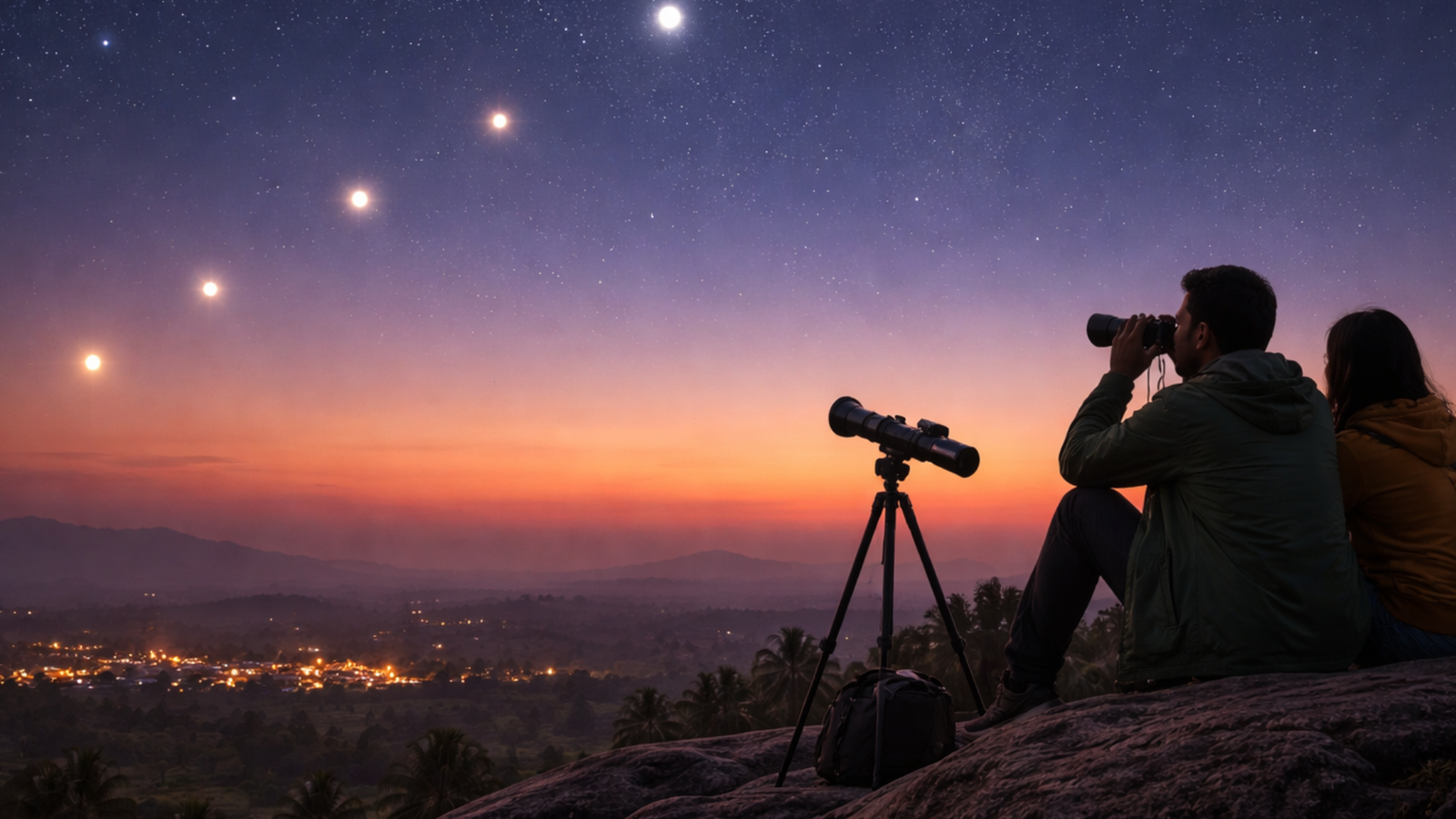
As the sun sets and the western sky is painted a warm amber colour, people across the country today can step out hoping to catch a rare sighting of a “planetary parade.”
On social media, people have been sharing news of a rare alignment of six planets in the sky on February 28. However, scientists at the Indian Institute of Astrophysics in Bengaluru are urging people to get a reality check on the claims being made.
What is really happening?
The term planetary parade is used loosely on social media platforms. It is used when a number of planets are visible in the same region of the sky. However, the reality is quite different from the claims being made on social media platforms. The fact is that the planets are separated by millions of kilometres and are not in a straight line.
What may actually be visible in the sky on the specified date is a gentle curve of planets in the sky following the ecliptic path of the Sun.
Also Read | Six-planet alignment on February 28: Which Indian cities can see the rare planetary parade best?
On February 28, Mercury, Venus, Jupiter, Saturn, Uranus, and Neptune are technically in the evening sky. However, the extent of their visibility is a different matter altogether.
Jupiter takes centre stage
Jupiter will be the easiest of all to spot. It will shine brightly and be positioned high in the evening sky. It will be visible until about 3:30 am. With the aid of binoculars or a small telescope, you can see Jupiter’s cloud belts and its Galilean moons.
Venus, Mercury, and Saturn will be low in the sky in the west and will disappear below the horizon about 45 minutes to 1.5 hours after sunset. According to the Indian Institute of Astrophysics (IIA), they will be hard to spot. This will be especially true for the naked eye.
IIA says that to spot the planets, you will need a telescope for Uranus and Neptune. Of the two, Neptune will be harder to spot because it will be located close to Saturn and low on the horizon.
Also Read | Brighten your feed: 50 Holi captions and wishes to share with those who make your life colourful
Precautions for skywatchers
The IIA has a stern warning for those planning to use their telescopes and binoculars in search of the planets. They warn that people shouldn't use their equipment before sunset because they could suffer serious and irreversible damage to their eyes.
Even if the viral show fails to come off as planned, people can still step out and look at the sky in the west after sunset. With reasonable expectations and precautions in place, the evening sky in February will be a good opportunity for people to catch a glimpse of our solar system.