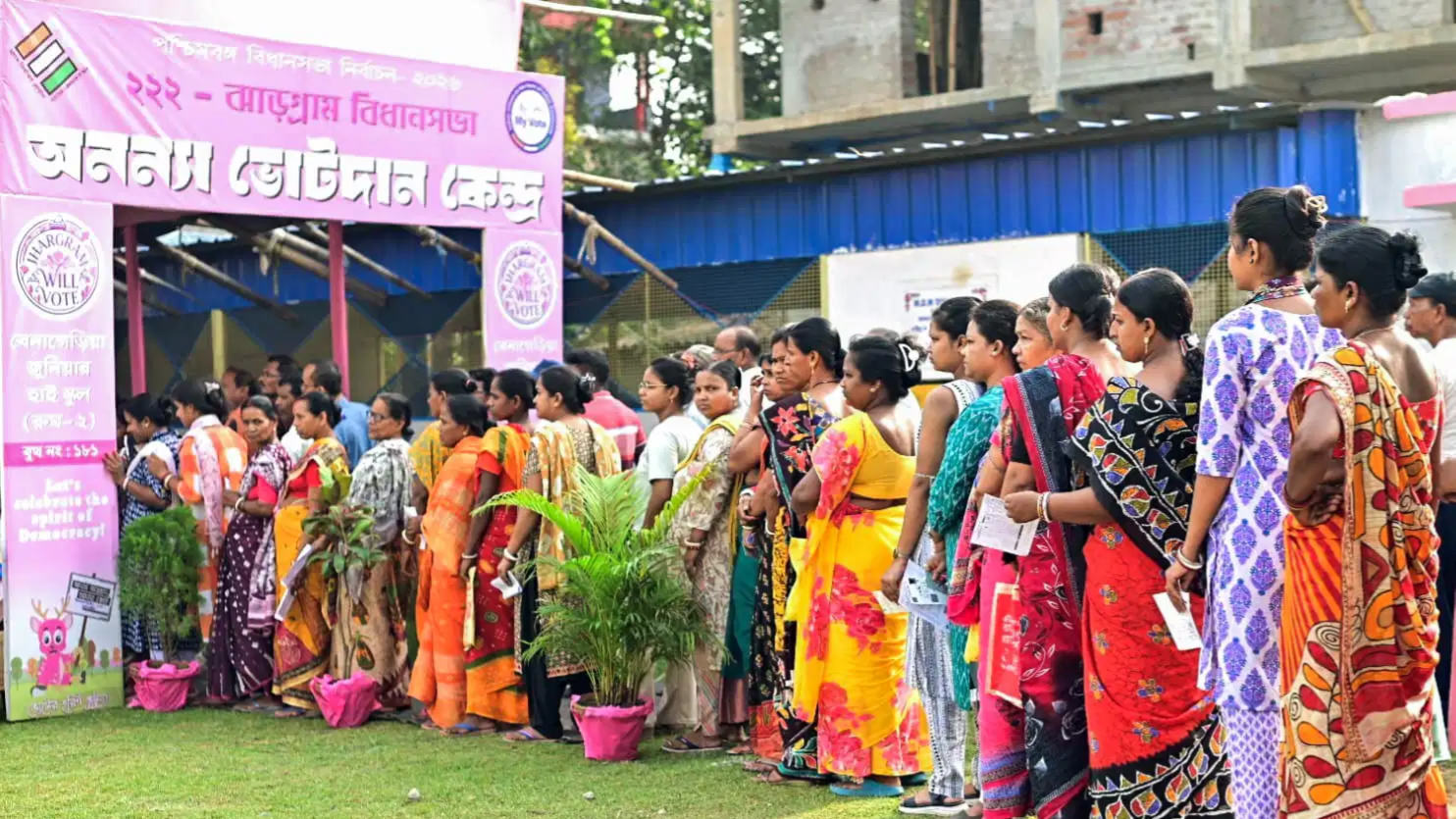
Even after the SIR exercise, women voters continue to outnumber men in several constituencies heading into the upcoming Assembly polls. Data shows that in 23 out of 142 Assembly segments voting on Wednesday, the number of registered women voters is higher than that of men, per The Times of India.
Jadavpur tops list
Leading the list is Jadavpur, where there are 11,759 more women voters than men. Panihati is another key constituency where women voters are in the majority. These segments are largely concentrated in and around Kolkata and Salt Lake.
Also Read | EC orders probe after Diamond Harbour 'intimidation' video goes viral
Behala West follows Jadavpur, recording 1.37 lakh women voters compared to 1.28 lakh men. Other constituencies in the top 10 include Tollygunge, Behala East, Dum Dum, Bidhannagar, Rajarhat Gopalpur, Rashbehari, Baranagar and Burdwan South.
At the lower end of the list, Barasat has a surplus of 373 women voters, while Champdani in Hooghly has 122 more women voters than men, per TOI.
Clear gender gap in key constituencies
The trend is also visible in several prominent Assembly segments. In Bidhannagar, there are 98,891 male voters and 1,04,979 female voters. Rashbehari records 76,263 men and 82,137 women voters, while Baranagar has 90,690 male and 95,847 female voters. Kasba also reflects a similar pattern, with 1,31,451 men and 1,34,158 women on the rolls.
Phase 1 voting showed similar trend
The pattern of higher female participation was also seen in the first phase of polling. In 18 Assembly segments, more women voted than men. Kurseong recorded the highest difference, with 87,002 women voters compared to 83,405 men.
In Sitalkuchi (Cooch Behar), 1.41 lakh women voted against 1.37 lakh men. Darjeeling saw 86,211 women voters and 82,914 men, while Kalimpong recorded 73,813 women compared to 70,810 men. Karandighi and Phansidewa also reported higher female turnout.
Higher female turnout despite ratio dip
The Times of India had reported that despite the SIR reducing the voter gender ratio to 950 across the 16 districts that voted on April 23, a greater percentage of women turned up at booths, compared to men. EC data released on Thursday indicated that female voter turnout reached 92.7 per cent across 152 Assembly segments and the male count 91 per cent.
Final figures from the Election Commission are still awaited.