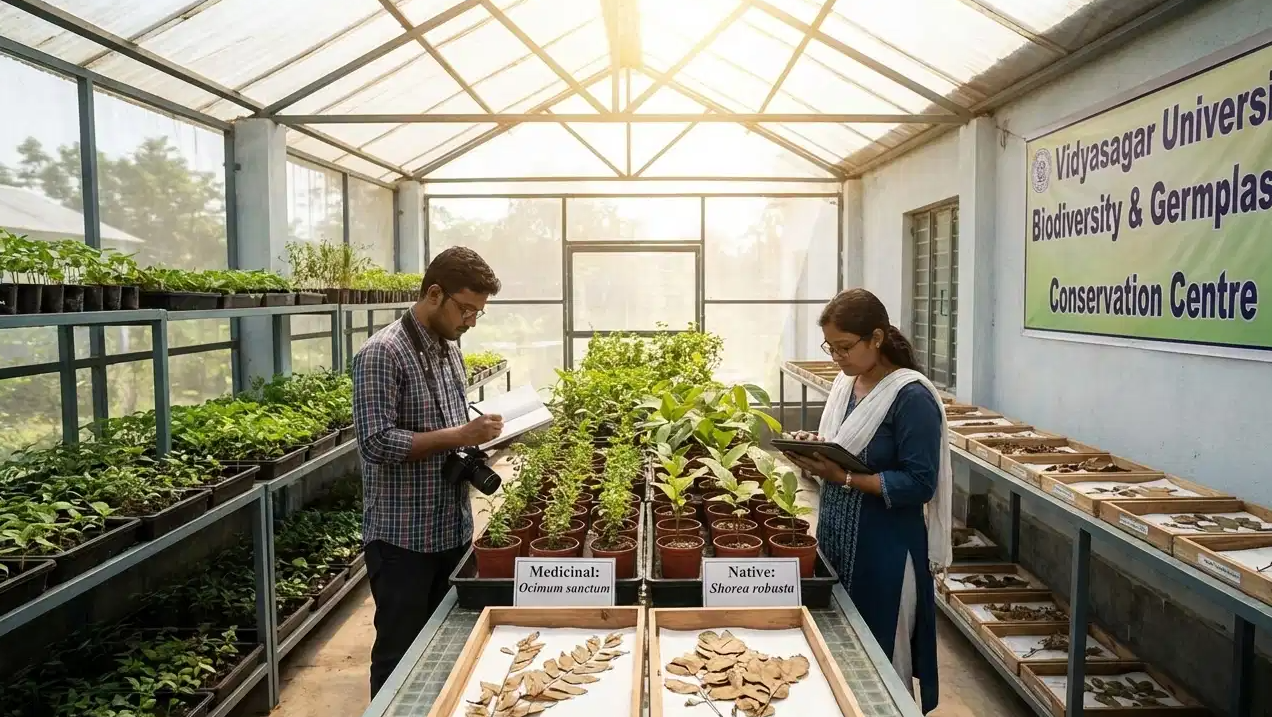
Jangalmahal means a collection of various types of trees and plants. Besides this, new plants are also discovered from time to time. But where will information about all these scattered plants be found? With this goal, Vidyasagar University has now taken the initiative to conserve biodiversity and its genetic identity. Its formal name is Biodiversity and Germplasm Conservation Centre. The work has already begun. It is being carried out by the university's Department of Botany and Forestry. University Vice-Chancellor Dipakkumar Kar says, "This initiative is to document the biodiversity and genetic identity around us, so that future generations can easily access all the information."
Also Read | Jayramabati gets direct train link from Bankura as MEMU route extended
What the new centre will preserve?
Professor Amalkumar Mandal of the university's Department of Botany and Forestry informs that the Biodiversity and Germplasm Conservation Centre is a vast undertaking. It includes digitized information of 1,400 trees, including 90 medicinal plants in the university campus. There will also be a digital herbarium.
Here, information about all trees from five districts which includes East and West Midnapore, Jhargram, Purulia, and Bankura—will also be preserved digitally. For instance, a medicinal garden named Charaksamhita has been created in the university campus. Similarly, 40 endangered and nearly extinct trees have been identified, and gardens of these trees will be created in the university campus. A biodiversity park will also be established.
Rare plants, gene banks and global access
Additionally, Amazing Plants will be maintained. Such as Giant Lily, Krishnabot, branched palm tree, blue lotus, etc. Krishnabot and branched palm trees have already been planted. Infrastructure is being prepared for planting Giant Lily. Such wonder plants from various parts of the world will find a place at Vidyasagar University. Gene banks will be created by conducting DNA tests of medicinal plants. Gene banks of 30 medicinal plants like Sarpagandha, neem, tulsi, and marigold have been created.
Also Read | Balurghat municipality's sanitation workers halt work over unpaid salaries amid leadership vacuum
Work is ongoing in other areas, Amalkumar informed. Alongside, two newly discovered plants will also be maintained (Solenostoma vidyasagarensis and Fossombronia bengalensis). Once the work is completed, not only students, researchers, or professors from the district or state, but researchers from abroad will also benefit, claims the university authorities.
Amalkumar says, "The Vice-Chancellor has full cooperation in this vast endeavour. Once the work is completed, the university's reputation will increase. When the work is complete, it will also be available on the website. As a result, people from any corner of the world will be able to get all information with just one click."