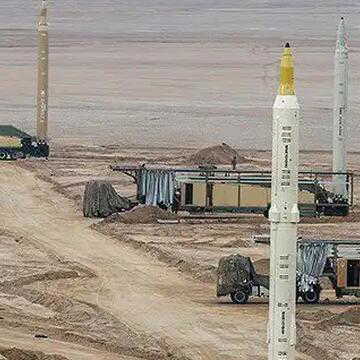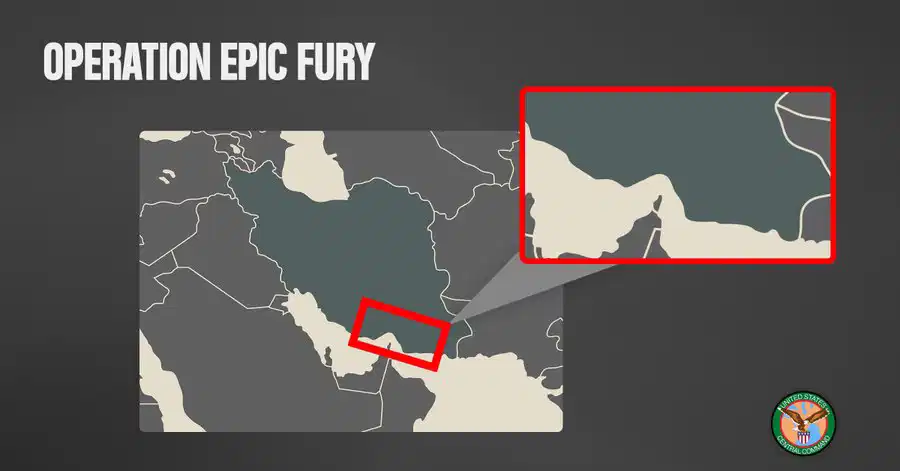
The United States has carried out airstrikes on Iranian missile positions along the coast near the Strait of Hormuz, using heavy “deep penetrator” bombs weighing about 5,000 pounds, according to a statement from the United States Central Command.
US officials said the strikes targeted hardened missile facilities believed to house anti-ship cruise missiles capable of threatening vessels moving through the strategic waterway.
"US forces successfully employed multiple 5,000-pound deep penetrator munitions on hardened Iranian missile sites along Iran's coastline near the Strait of Hormuz," Central Command said in a statement posted on X.
US forces dropped bunker-buster bombs on Iranian missile sites near the Strait of Hormuz
Hours ago, U.S. forces successfully employed multiple 5,000-pound deep penetrator munitions on hardened Iranian missile sites along Iran’s coastline near the Strait of Hormuz. The Iranian anti-ship cruise missiles in these sites posed a risk to international shipping in the… pic.twitter.com/hgCSFH0cqO
— U.S. Central Command (@CENTCOM) March 17, 2026
The strikes come amid rising tensions between the United States and Iran after Tehran shut down the Strait of Hormuz, a key shipping route through which roughly one-fifth of the world’s oil supply passes.
Meanwhile, Mohammad Baqer Qalibaf, the speaker of the Iranian Parliament, has issued a warning that the Strait of Hormuz situation will not return to its "pre-war state," he wrote on X.
The Strait of Hormuz situation won't return to its pre-war status.
— محمدباقر قالیباف | MB Ghalibaf (@mb_ghalibaf) March 17, 2026
Strategic waterway at centre of conflict
The Strait of Hormuz, located between Iran and Oman, is one of the world’s most critical energy corridors. Tankers carrying crude oil and liquefied natural gas from the Gulf pass through the narrow channel before entering global markets.
US officials said the missile sites were capable of targeting ships passing through the strait and posed a threat to international shipping.
According to a 2022 report by Air Force Times, each of the 5,000-pound bunker-buster munitions costs roughly $288,000. The weapons are designed to penetrate reinforced underground structures before detonating.
However, the bombs used in this strike are smaller than the 30,000-pound bombs previously deployed by the United States against Iranian nuclear facilities last year.
Projectile reported near nuclear facility
Separately, Iran informed the International Atomic Energy Agency that a projectile struck the premises of the Bushehr Nuclear Power Plant on Tuesday evening.
The UN nuclear watchdog said the incident caused no damage to the plant and no injuries to staff. IAEA chief Rafael Grossi again called for restraint from all sides to avoid the risk of a nuclear accident as fighting continues in the region.
The IAEA has been informed by Iran that a projectile hit the premises of the Bushehr NPP on Tuesday evening. No damage to the plant or injuries to staff reported. Director General @RafaelMGrossi reiterates call for maximum restraint during the conflict to prevent risk of a… pic.twitter.com/fhze0vOqrQ
— IAEA - International Atomic Energy Agency ⚛️ (@iaeaorg) March 18, 2026
Iran launches fresh strikes after senior officials killed
The airstrikes followed reports that senior Iranian figures were killed in earlier attacks linked to the conflict involving the US and Israel. Iranian authorities confirmed the death of Ali Larijani, a senior political figure close to former supreme leader Ayatollah Ali Khamenei.
Iran’s Fars News Agency reported that Larijani was targeted while at his daughter’s home in the Pardis district near Tehran.
Also Read | Did Israel just kill Iran’s top security strategist? What we know about Ali Larijani airstrike claim
Iran also said Gen. Gholam Reza Soleimani, commander of the Basij paramilitary force, was killed in the same operation. Following the deaths, Iran launched multiple-warhead missile strikes toward central Israel. Israeli emergency services reported that two people were killed in Ramat Gan, near Tel Aviv.
Missile and drone attacks were also reported over parts of the Gulf region, including Saudi Arabia and Kuwait, where air defence systems intercepted incoming projectiles.