Marco Rubio used a three-country Gulf tour on Wednesday to reassure regional partners that Washington would not sacrifice their security in its dealings with Tehran, even as the fragile US-Iran arrangement moved into its implementation phase.
In Kuwait City, the US secretary of state met leaders in the United Arab Emirates and Kuwait and later headed to Bahrain, saying, “We’re going to be completely aligned with our partners in the Gulf,” and "We're not going to do anything that undermines the security of our allies, our longstanding allies in the region.”
Reuters reported that Rubio’s trip was aimed at easing anxieties among Gulf capitals that the proposed Iran deal is too soft on a state that struck them during the war.
Also Read | As temperatures hit 44.3C, France finds a new political battleground: Air conditioning
NEW!! Wheels down in Bahrain! 🇧🇭
— Alex Raufoglu (@ralexdc) June 24, 2026
Rubio has arrived for the final stop of his Gulf trip, with a packed schedule of high-level meetings kicking off tomorrow.
Stay tuned.
🎥 @RFERL pic.twitter.com/5xa7hIA8og
The devil resides in the details
The diplomatic push comes as the US and Iran begin the harder phase of talks over how the deal will work in practice.
Technical negotiations are set to resume at the end of the month and are likely to return to Switzerland. Rubio said technical talks with Iran are scheduled for next week in Geneva and Tehran could lose sanctions relief if it fails to meet its commitments.
The agreement reached last week was the first signed by American and Iranian presidents since Iran’s 1979 Islamic Revolution and includes a proposed $300 billion fund as well as some sanctions waivers.
The remaining questions are still significant, including Iran’s nuclear program. Iran’s parliamentary speaker Mohammad Bagher Ghalibaf said the deal to end the war with the US was not the result of “pressure and coercion.”
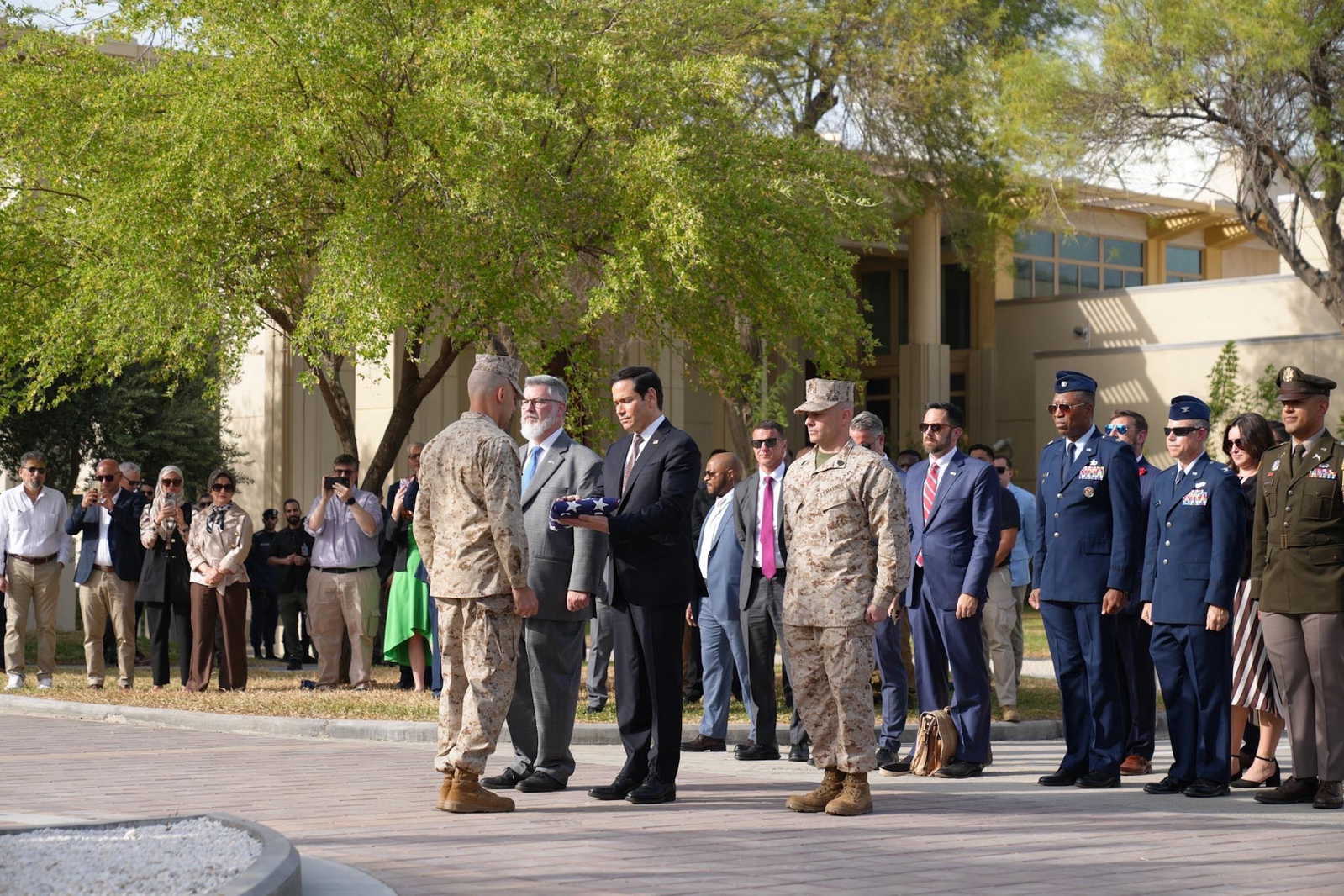
The American flag: a symbol of liberty, unity, and freedom now flies proudly once again over Kuwait City.
— Secretary Marco Rubio (@SecRubio) June 24, 2026
Kuwait is an indispensable partner for regional security and stability.
The United States looks forward to strengthening our partnership across all areas of cooperation. pic.twitter.com/hXTnyvOGLK
Commerce returns to troubled waters
The Strait of Hormuz, the narrow waterway at the center of the dispute, is also beginning to reopen under a UN-backed maritime evacuation scheme.
Ships have begun sailing through the strait under a plan by the International Maritime Organization to move hundreds of vessels carrying about 11,000 seafarers out of the Gulf after months of disruption. Vessels will use two temporary tracks, one through Iranian waters and another through waters coordinated by Oman and the United States, with ships told to wait for instructions before proceeding.
At least two dry bulk ships and one cargo ship had already passed through under the plan, while three stranded tankers carrying 5 million barrels of crude were also leaving the strait.
Not out of the woods just yet
The wider shipping picture remains unsettled despite the evacuation effort. Reuters said between 500 and 600 ships are still stranded inside the Gulf, including as many as 100 tankers, and that traffic through Hormuz remains far below pre-war levels even as voyages have picked up in recent days.
The IMO scheme does not help vessels heading into the Gulf to load oil cargoes, and maritime risk advisers warn that navigation remains sensitive because of the risk of mines and other safety hazards. Separate regional talks are also being arranged on the future of the waterway, with Qatar’s prime minister recently visiting Oman to discuss negotiations involving Iran, Iraq, and Gulf Arab states.
Now, the deal’s most consequential tests remain unresolved: whether the diplomatic reset can hold and whether the shipping lane that carries a large share of the world’s energy flows can stay open.
Also Read | Senate's Iran vote sparks constitutional debate over limits of presidential war powers
FAQs
Q1: Why is the Strait of Hormuz important to global energy markets?
Ans: The Strait of Hormuz is a critical shipping route through which a significant share of the world's oil and energy supplies passes.
Q2: What are the next steps in the US-Iran agreement process?
Ans: Technical negotiations between the United States and Iran are expected to resume in Geneva to discuss implementation details and compliance mechanisms.