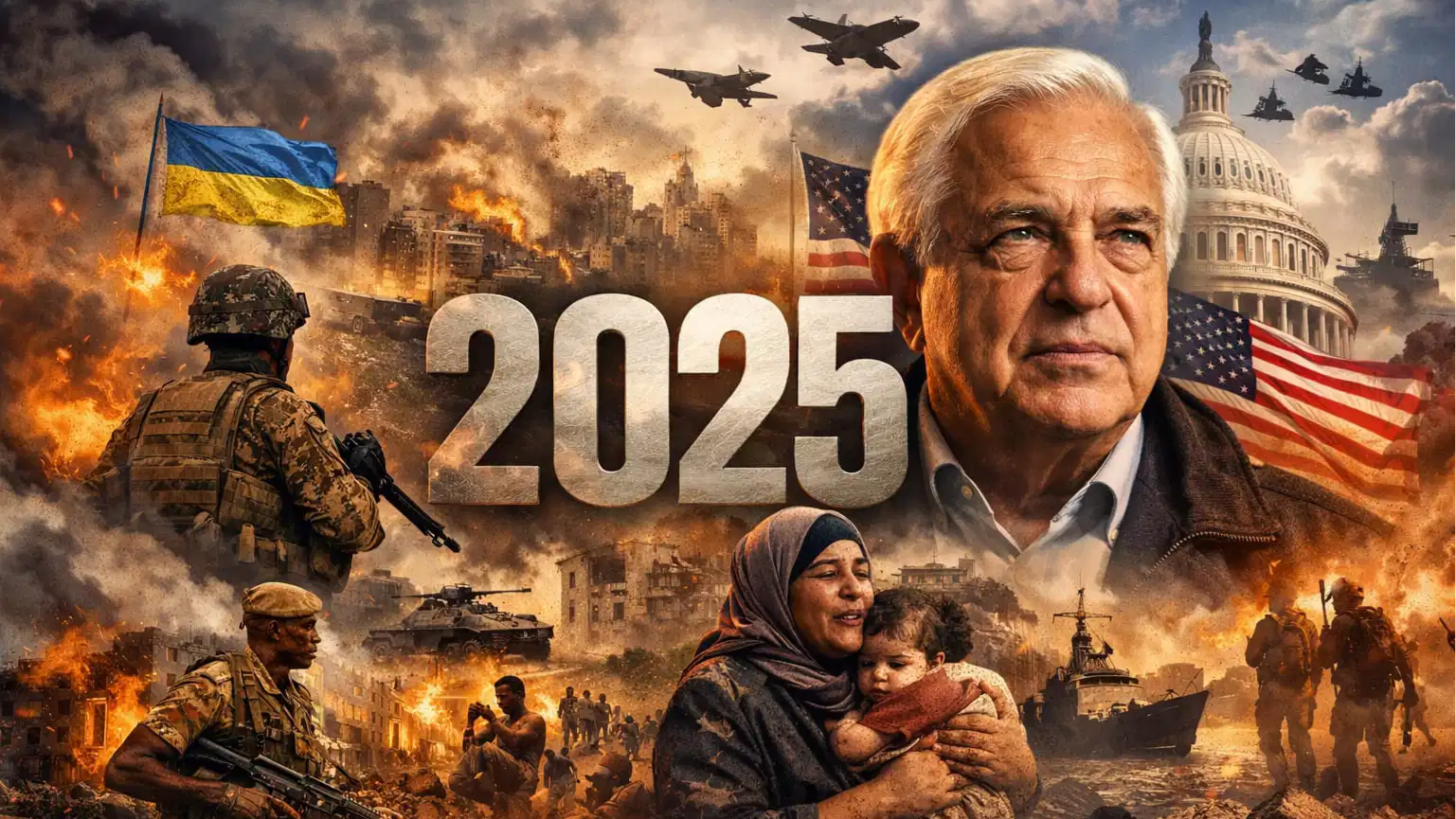
For John Simpson, alarm does not come easily. Over six decades, the BBC’s World Affairs Editor has covered invasions, insurgencies and collapsed states across continents. Yet as wars stretch from Eastern Europe to the Middle East and Africa, Simpson says 2025 represents a convergence he has never witnessed before.
As per the column, his concern is not just about violence, but about alignment. Conflicts today no longer sit in neat regional boxes. Instead, they overlap politically, economically and strategically, all unfolding against a backdrop of shifting American priorities.
Also Read | Climate activist Greta Thunberg detained in London under UK Terrorism Act
Three wars, one fragile world order
Simpson points first to Ukraine, where Russia’s invasion has settled into a brutal stalemate. Civilian casualties continue to rise, cities remain under threat, and Europe’s security architecture is under constant pressure. What has changed, however, is the tone of Western support. In Washington, military aid and strategic backing are increasingly framed through domestic politics, raising doubts about how sustainable Ukraine’s lifeline will be.
In the Middle East, the war in Gaza has exposed the limits of international influence. Israel’s campaign against Hamas has resulted in widespread destruction and humanitarian catastrophe. Regional tensions have intensified, drawing in actors from Lebanon to the Red Sea. The United States remains indispensable as Israel’s ally and the region’s primary power broker, yet its ability to shape outcomes has narrowed as the conflict drags on.
Sudan’s civil war, Simpson notes, is the least discussed but perhaps the most damning. Tens of thousands have died, millions have been displaced, and state collapse looms. Yet global engagement has been muted. For Simpson, Sudan reflects a harsher reality of 2025, where attention and intervention are unevenly distributed, even as suffering reaches staggering levels.
Also Read | Royal insiders slam Meghan Markle and Prince Harry over Hollywood party appearance
America’s uncertainty, the world’s risk
What binds these conflicts together is America’s evolving posture. Simpson observes that the United States appears more cautious, more selective and more inward-focused than at any point since the Cold War. Long-standing security assumptions are no longer taken for granted, not just by adversaries like Russia and China, but by allies who once relied unquestioningly on American guarantees.
In Europe, this has triggered unease about NATO’s future credibility. In the Middle East, it has constrained Washington’s diplomatic leverage. Elsewhere, it has created openings for regional powers to act with fewer restraints.
Simpson’s warning is measured but stark. The danger of 2025 lies less in the outbreak of a single global war and more in the steady weakening of the systems that once contained conflict. With deterrence fraying and diplomacy struggling to keep pace, the defining question of this year may be whether the world’s most powerful nation is still prepared to anchor an increasingly unstable order.