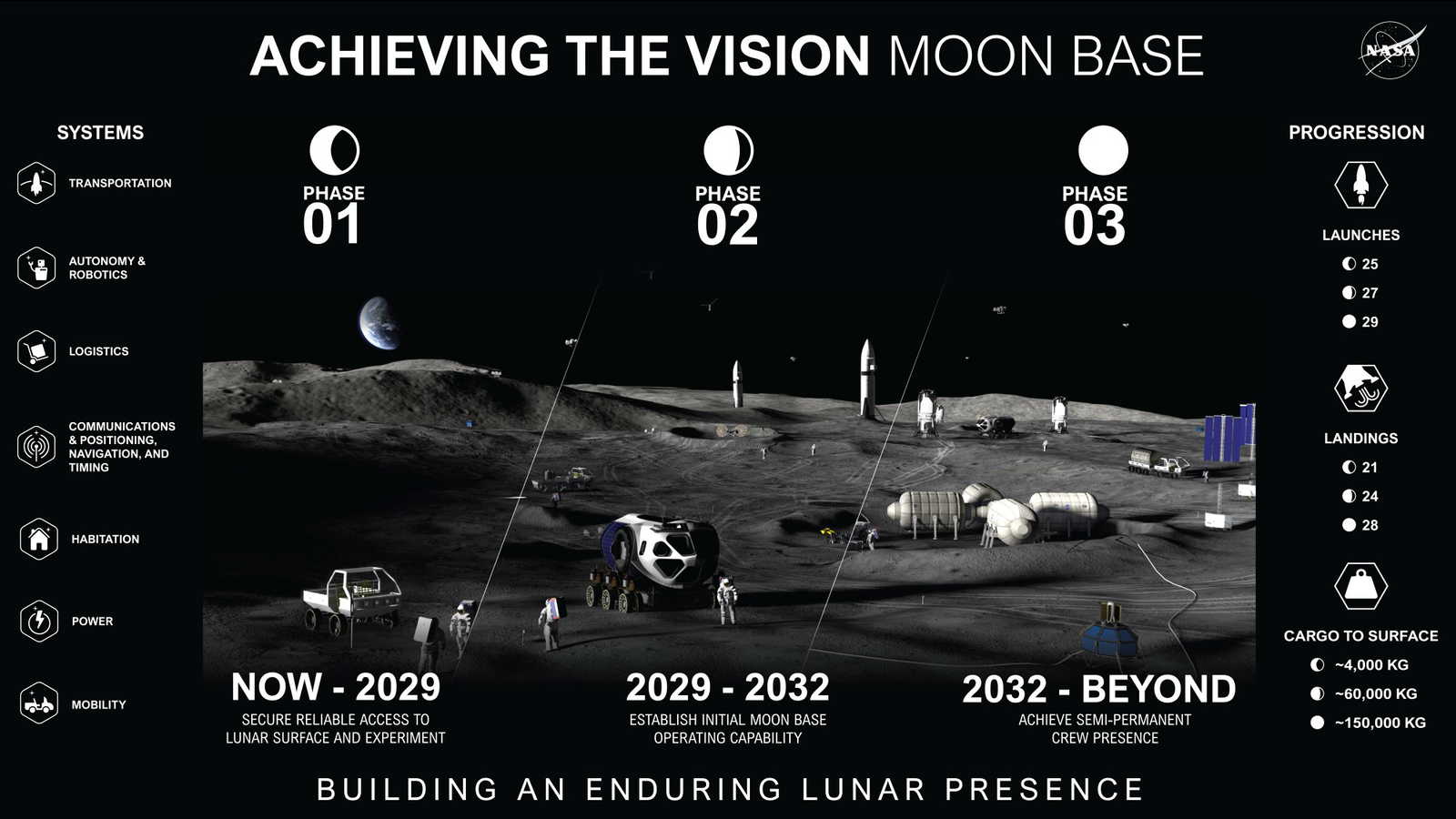
America's National Aeronautics and Space Administration (NASA) has set out a step-by-step strategy for developing a Moon base in the lunar South Pole region, saying the programme will advance through three phases over the next several years.
The agency says the approach is “phased” and "iterative", beginning with near-term technology demonstrations, robotic missions and early experiments designed to test systems before crews are sent to live and work there for longer periods.
Also Read | Europe's early heat wave breaks records, with deaths reported in Britain and France
LIVE: We're sharing the latest updates on @NASAMoonBase, our lunar habitat where astronauts will work and live. https://t.co/7oWZYx0GYx
— NASA (@NASA) May 26, 2026
A brisk first sortie
Under Phase One, which runs through 2029, NASA plans a rapid series of robotic missions to scout the South Pole, prepare surface operations and test hardware for future human activity.
The agency says this stage could involve up to 25 missions, including 21 landings, as well as crewed and autonomous rovers, communications relay and observation satellites, and technology demonstrations aimed at surviving the long lunar night.
The first tangible footprint of the effort will include four tonnes of payload delivered to the lunar surface.
NASA just officially unveiled their master plan for a permanent Moon Base at the lunar South Pole
— X Freeze (@XFreeze) May 26, 2026
This is not just about flags and footprints. NASA is moving to establish an enduring, sustained human presence, and they are heavily relying on commercial innovators to build it… pic.twitter.com/nbMI7a7r5B
Precision before pageantry
A central part of that first phase is Moon Base I, a Blue Origin-led mission using the Blue Moon Mark 1 lander, also known as Endurance.
The mission will land on the Shackleton Connecting Ridge and help reduce risk for future Artemis landings planned for 2028 by testing precision landing, cryogenic propulsion and autonomous guidance systems.
NASA also says the lander is scheduled to carry science and technology payloads, including cameras to study how engine plumes interact with the lunar surface and a laser retroreflective array to improve spacecraft positioning.
@NASAMoonBase is the stepping stone towards everything that comes next. https://t.co/yoQxp2W0El
— Jeff Bezos (@JeffBezos) May 27, 2026
Two more dispatches to the moon
NASA’s roadmap also includes Moon Base II and Moon Base III.
Moon Base II is scheduled to carry more than 1,100 pounds of cargo aboard Astrobotic’s Gryphon lander, along with Astrolab’s FLIP rover, to test mobility systems for future lunar terrain vehicles.
Moon Base III will use Intuitive Machines’ Nova-C Trinity lander to deliver the Lunar Vertex investigation to the Moon’s Reiner Gamma swirl, along with payloads from the European Space Agency and the Korea Astronomy and Space Science Institute.
We have awarded @AstroLab_Space with a lunar terrain vehicle award. Their Crewed Lunar Vehicle is a rover designed to transport astronauts and supplies across the lunar surface.
— NASA (@NASA) May 26, 2026
This vehicle will be deployed to the Moon by 2028 through our commercial lunar payload services… pic.twitter.com/5DvOc41ZyJ
Mobility gets its moment
The agency has also moved to expand surface mobility through new lunar terrain vehicle contracts.
NASA says it has awarded about $219 million to Astrolab and $220 million to Lunar Outpost to build the first phase of the vehicles, with the programme intended to support crewed and uncrewed mobility systems on the lunar surface by 2028.
The first vehicles are being designed for autonomy, teleoperation and crewed operations, while a separate Blue Origin task order worth $188 million, with an option value of more than $280 million, is meant to support rover delivery missions to the Moon’s South Pole.
Also Read | 'Complete fabrication': Iran-US peace framework claim rejected by Trump administration amid ongoing talks
The long game
Beyond 2029, NASA says Phase Two will focus on early habitation, expanded power systems, enhanced communications and larger cargo deliveries, while Phase Three, beginning after 2032, aims at a sustained human presence with routine crew rotations, semi-permanent habitats and continuous surface activity.
The plan is intended to build the infrastructure needed for long-duration lunar exploration and future use of lunar resources.