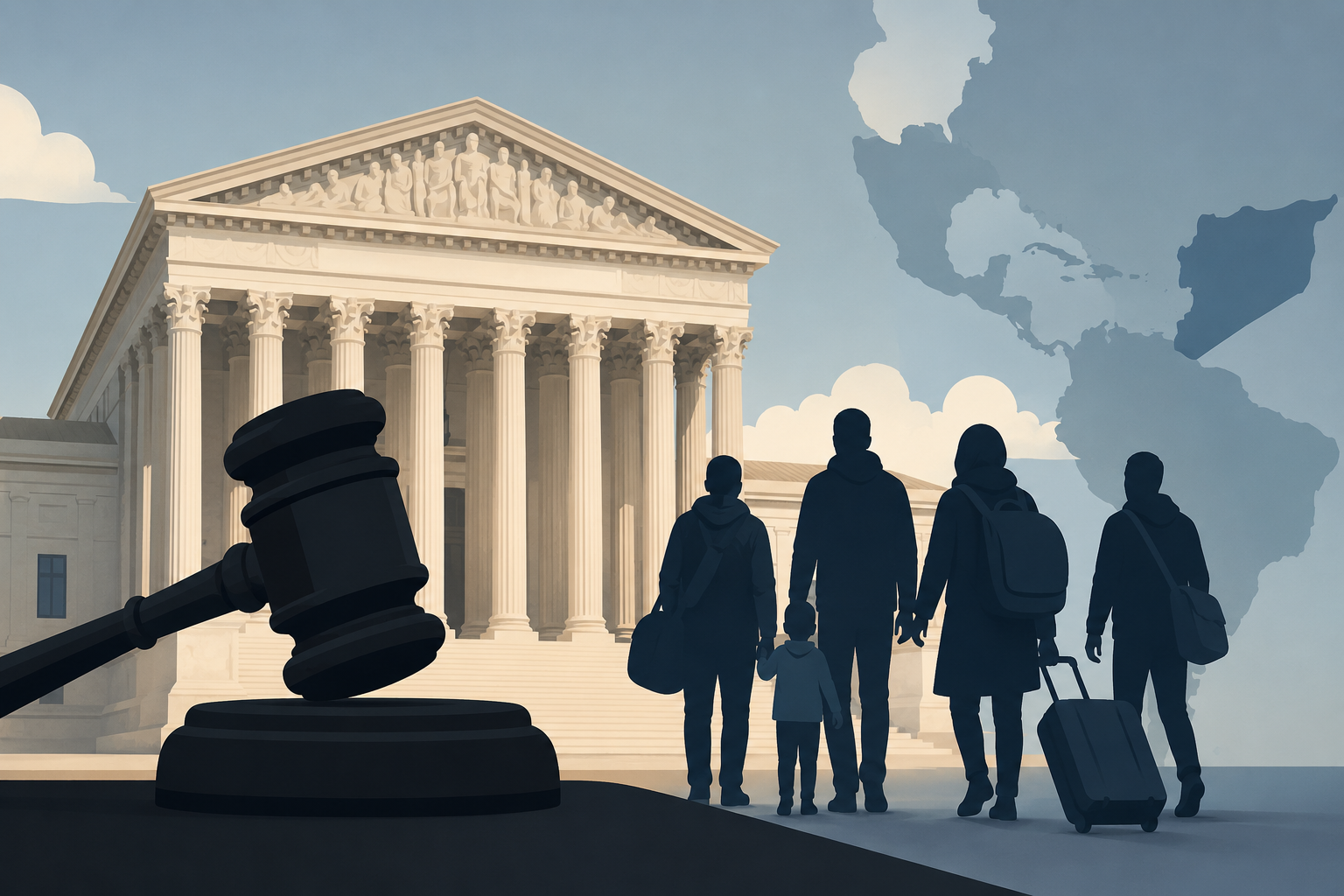
The US Supreme Court on Thursday allowed President Donald Trump’s administration to strip deportation protections from hundreds of thousands of Haitian and Syrian immigrants, handing the White House another significant victory in its drive to tighten immigration rules.
In a 6-3 decision, the court overturned lower-court rulings that had blocked the government from ending Temporary Protected Status, or TPS, for more than 350,000 people from Haiti and about 6,100 from Syria.
Also Read | Why is Polestar leaving the US? Trump's EV technology rule has the answer
🚨 BREAKING:
— Mario Nawfal (@MarioNawfal) June 25, 2026
🇺🇸The Supreme Court has ruled 6-3 that Trump can end Temporary Protected Status for Haitians and Syrians.
The decision overturns lower court injunctions, allowing the Trump admin to proceed with ending TPS for over 350,000 Haitians and 6,000 Syrians, exposing them…
Explaining TPS
TPS is a humanitarian designation for people from countries hit by war, natural disaster, or other crises, allowing them to live and work in the United States when conditions at home are considered unsafe.
The US first extended TPS to Haitians after the 2010 earthquake and to Syrians after civil war engulfed the country in 2012. The State Department currently warns against travel to either Haiti or Syria, citing violence, crime, terrorism, and kidnapping.
The court's reasoning
Justice Samuel Alito, writing for the conservative majority, said the law governing TPS “plainly bars” judicial review of the administration’s decisions.
He also said the Haitian plaintiffs were unlikely to succeed in their claim that the government’s actions were racially biased in violation of the Constitution’s equal-protection guarantee.
The court’s three liberal justices dissented. In her dissent, Justice Elena Kagan said the statute allows courts to review whether the Homeland Security secretary followed the procedures required by law and argued that evidence of race playing a role in the Haiti decision was visible in the president’s own statements.
Border Czar Thomas Homan (@RealTomHoman) on U.S. Supreme Court ruling ending temporary protected status for Syrians and Haitians: "Temporary means temporary... when the condition of that country gets better, they need to go home...I'm grateful for that decision." pic.twitter.com/gvZhZZZrGz
— CSPAN (@cspan) June 25, 2026
How the legal battle unfolded
The challenge centered on actions taken last year by Kristi Noem, then Trump’s Homeland Security secretary, who moved to revoke TPS for Syria and Haiti, saying the protections were contrary to US national interests.
The lawsuits, filed separately by groups of Syrian and Haitian TPS holders, argued that the terminations were part of a preplanned effort to dismantle the program.
A federal judge in Washington, Ana Reyes, had found that the Haiti decision was likely influenced in part by what she described as “racial animus,” but Alito rejected that reasoning, saying the plaintiffs themselves pointed to a “strong, race-neutral explanation” for the termination.
A broader immigration shift
Trump had sought to end TPS protections long before returning to office, and while campaigning in 2024 he vowed to revoke TPS for Haitian immigrants after making false claims that they were eating household pets in Ohio, Reuters reported.
The administration says TPS was always meant to be temporary. The ruling could affect 1.3 million immigrants from all 17 countries currently covered by TPS, according to the report, and comes as the Supreme Court has repeatedly sided with Trump on immigration disputes, including last year’s decision letting the administration end TPS for hundreds of thousands of Venezuelans.
Fear, fallout and what comes next
The impact was described sharply by one of the Haitian TPS holders involved in the case.
Viles Dorsainvil, a co-founder of the Haitian Support Center in Springfield, Ohio, said the ruling places families in immediate fear and argued that conditions in Haiti remain unsafe.
Lawyers for the Syrian plaintiffs said the decision allows the government to ignore a humanitarian protection Congress created decades ago, while attorneys for the Haitian plaintiffs said responsibility now rests with lawmakers.
The court, on the same day, backed the Trump administration in a separate immigration case involving asylum seekers at the US-Mexico border.
Also Read | Iran accuses NATO of complicity after Rutte says 'Ally after ally' backed US war effort
FAQs
Q1: What is Temporary Protected Status (TPS) in the US?
Ans: Temporary Protected Status (TPS) allows eligible nationals from crisis-hit countries to live and work legally in the United States for a limited period.
Q2: Why did the US Supreme Court allow Trump to end TPS for Haitians and Syrians?
Ans: The Supreme Court ruled that federal law largely bars courts from reviewing the administration's decision to terminate Temporary Protected Status.