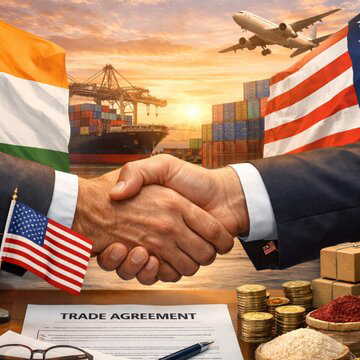
The Donald Trump administration has termed the US-India trade agreement a "historic" milestone which offers access for American goods to the Indian marketplace with 1.4 billion people.
In addition to defining several important items in the agreement, the White House has released a statement which defines the important and key terms of the deal, including a decrease in the reciprocal tariffs charged to Americans when importing into India from 25 per cent down to 18 per cent, according to a report by NDTV.
Also Read | 'We vehemently oppose': In open letter, nearly 1,000 Google employees urge company to cut ties with ICE
The document also defines President Trump's comments regarding India eliminating "tariffs and non-tariff barriers to merchandise from the US" to "ZERO". Finally, the agreement states that Trump will remove the 25 per cent tariff imposed on imports from India due in part to India's commitment to cease purchases of oil from Russia.
Key terms of the deal
According to a statement from the White House, India has also agreed to "eliminate or lower tariffs" on all US industrial goods, as well as on a large number of US food and agricultural products, including dried distillers' grains (DDG), red sorghum, tree nuts, fresh and processed fruit, certain pulses, soybean oil, wine and spirits, and many other products.
It noted that India plans to buy more American products. This includes spending over $500 billion on US energy, information and communication technology, agricultural coal and other goods.
The White House statement pointed out that India has also provided commitments to address non-tariff barriers that impede bilateral trade in specific priority sectors.
In addition to addressing the non-tariff barriers, India has indicated it will eliminate its digital services taxes and agreed to negotiate a robust set of bilateral digital trade rules which address discriminatory or excessively burdensome digital trade practices or other barriers to digital trade, including the regulation of customs duties on electronic transmissions.
Also Read | Are US–China relations improving? Donald Trump confirms Xi Jinping's White House visit later this year
The statement added that the United States and India also agree to "negotiate rules of origin that provides for the major share of the benefits will accrue to the United States and India respectively."
The roadmap ahead
Last week, during a discussion between the Trump and Prime Minister of India Narendra Modi, both parties came up with a framework to reach a temporary agreement on their reciprocal trading relationship as well as reaffirming their mutual desire to continue US-India Bilateral Trade Agreement (BTA) negotiations at the larger level.
The statement said that in the coming weeks, Washington and New Delhi will quickly put this framework into action and work on finalising the interim agreement to create a mutually beneficial BTA that secures advantages for American workers and businesses.
"In line with the roadmap set out in the Terms of Reference for the BTA, the United States and India will continue negotiations to address the remaining tariff barriers, additional non-tariff barriers, technical barriers to trade, customs and trade facilitation, good regulatory practices, trade remedies, services and investment, intellectual property, labour, environment, government procurement, and trade-distorting or unfair practices of state-owned enterprises," it added.