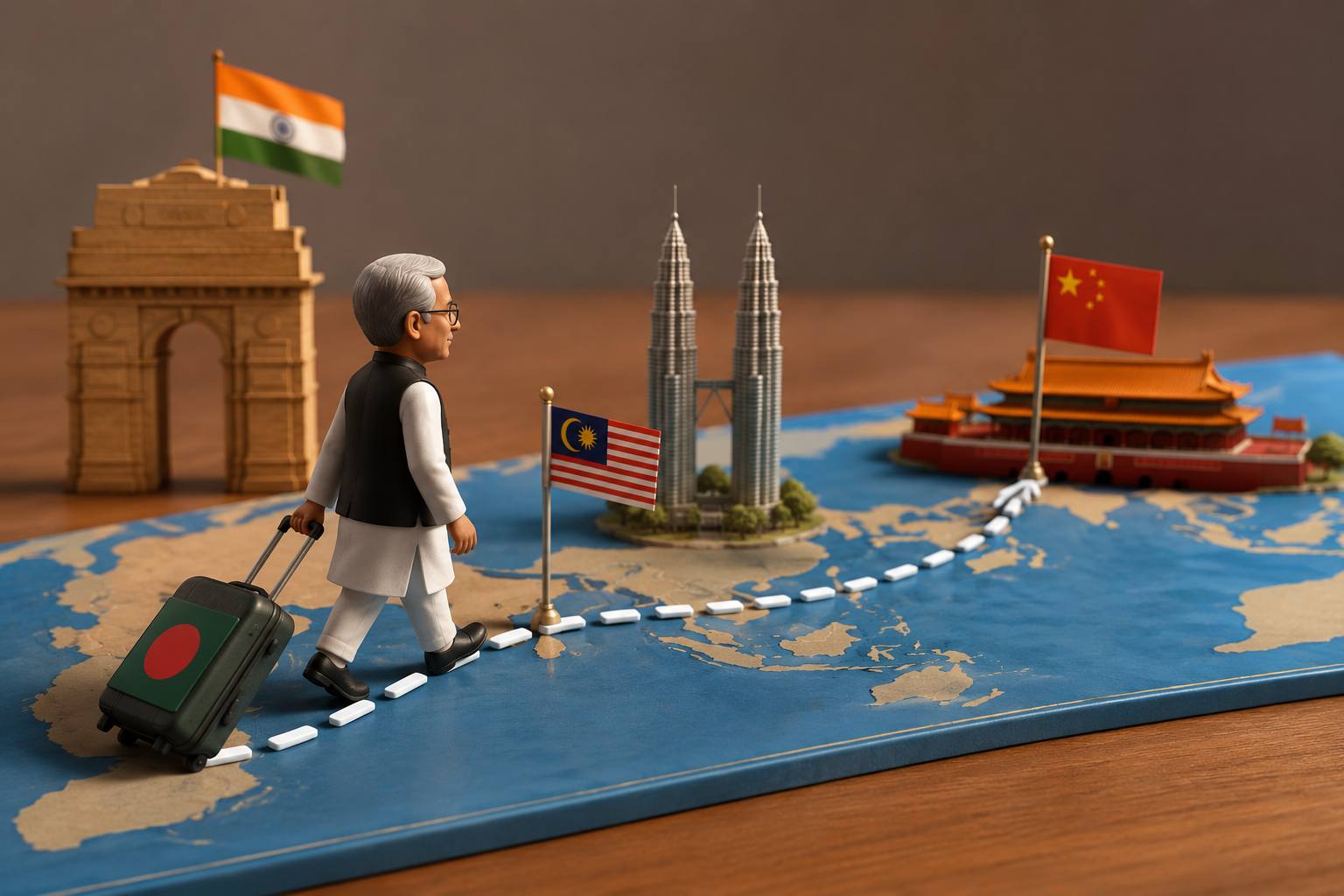
Bangladesh Prime Minister Tarique Rahman has picked Malaysia and China for his first foreign visit, signaling the priorities of his new government and skipping India, which has traditionally been the first stop for Bangladeshi leaders on such trips.
Rahman’s decision is tied to efforts to expand overseas employment opportunities, attract investment, and project a foreign policy approach grounded in what his government describes as a “Bangladesh First” line.
He is set to begin the trip on Sunday, starting with a two-day visit to Malaysia before heading to China for four days, per Hindustan Times.
Also Read | Donald Trump escalates feud with Giorgia Meloni over G7 photo allegation
On his first bilateral visit, Bangladesh’s Prime Minister Tarique Rahman will travel to Malaysia and China tomorrow. During the visit, discussions will focus on integrated river and water management, including the Teesta multipurpose project.🇲🇾🇨🇳 pic.twitter.com/yjBApurL1u
— Patriot.🇧🇩 (@Abubakar1594673) June 20, 2026
Malaysia first, and not by accident
The Malaysia leg is expected to focus on trade, investment, energy cooperation, semiconductors, and new opportunities for Bangladeshi workers. Malaysia is home to nearly 800,000 Bangladeshi workers, which makes the country an important destination for labor mobility and remittances.
The first stop was being read as part of Dhaka’s attempt to balance its ties with both India and China while still broadening economic partnerships beyond the immediate neighborhood.
Beijing awaits with papers aplenty
In China, Rahman is scheduled to attend the World Economic Forum’s Annual Meeting of the New Champions, known as the “Summer Davos,” and hold meetings with President Xi Jinping and Premier Li Qiang.
The visit is expected to produce a substantial diplomatic haul: Foreign Secretary Asad Alam Siam told reporters in Dhaka that Bangladesh and China are expected to sign 17 bilateral instruments, including 13 memorandums of understanding and an action plan. Siam said talks would also cover a project to restore and manage the Teesta River through dredging and embankment construction, while another agreement concerns Chinese participation in modernizing Mongla Port.
🇲🇾🇨🇳 Bangladeş Başbakanı'nın ilk yurt dışı ziyareti Malezya ve Çin'e — Hindistan'a değil!
— Asya Pasifik Gündemi (@AsyaPasifikTR) June 20, 2026
Tarique Rahman, pazar günü Malezya'ya, pazartesi ise Çin'e gidecek. Ziyarette ticaret, altyapı projeleri ve Teesta Nehri projesi ele alınacak. Malezya'da 800 bin Bangladeşli işçi bulunuyor.… pic.twitter.com/gsYj4QO1aY
The regional chessboard comes into view
The visit comes against a backdrop of shifting regional calculations and longstanding sensitivities in India-Bangladesh ties. Prime Minister Narendra Modi had invited Rahman to visit India when Lok Sabha Speaker Om Birla attended Rahman’s swearing-in ceremony in Dhaka in February.
There had been speculation that Rahman might first travel to a South Asian neighbor such as Bhutan or the Maldives before making other overseas visits. Instead, the choice of Malaysia and China has strengthened the impression that Dhaka wants to widen its options while keeping India and China in careful balance.
Beyond ports, roads and balance sheets
Bangladesh’s outreach to Beijing is also expected to go beyond infrastructure and trade. Bangladesh and China may issue a joint communiqué after almost two decades, and Dhaka is expected to sign on to Beijing’s Global Development Initiative, a foreign policy framework unveiled by Xi in 2021.
These moves could shift the relationship from project-based cooperation to a deeper political and economic engagement. At the same time, India is watching Bangladesh’s interest in Chinese involvement in Teesta with caution, given concerns over Beijing gaining access to areas near the Siliguri Corridor, the narrow land link often referred to as the “chicken’s neck” connecting India’s northeast to the rest of the country.
Not every wrinkle has been ironed out
Dhaka has also approved a $340-million infrastructure project for the Chinese Economic and Industrial Zone in Chittagong, backed by concessional Chinese loans.
While ties between India and Bangladesh improved after Rahman’s election victory, friction remains over the presence of former Bangladesh prime minister Sheikh Hasina in India and over border issues linked to the movement of people deemed illegal migrants in West Bengal and Assam.
Also Read | Strait of Hormuz shut again as Iran warns 'if the aggression continues, subsequent steps have been planned'
FAQs
Q1: Why did Bangladesh PM Tarique Rahman choose Malaysia and China for his first foreign visit?
Ans: The visits are focused on boosting trade, investment, labour opportunities and strengthening diplomatic ties.
Q2: Why is Rahman’s decision to skip India drawing attention?
Ans: It breaks from the longstanding convention of Bangladeshi leaders making India their first overseas destination after taking office.