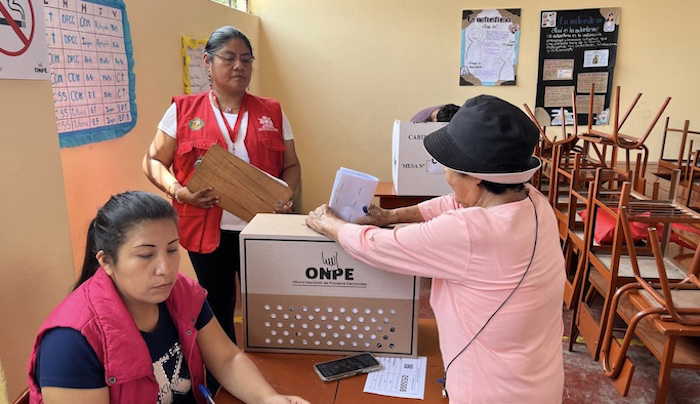
Peru’s presidential runoff has pitted conservative Keiko Fujimori against leftist Roberto Sánchez in one of the country’s closest races in years, with polls showing the two locked in a statistical tie before Sunday’s vote.
The winner will become Peru’s ninth president in 10 years, in an election dominated by public anger over rising crime and deep political instability.
Also Read | Why Americans may finally stop changing their clocks twice a year?
🇵🇪 Right-wing presidential candidate Keiko Fujimori cast her vote in Lima as Peru’s runoff nears its final stretch.
— NewsForce (@Newsforce) June 7, 2026
Her campaign is part of the rightward push shaping the election.pic.twitter.com/sQ1BSLMePs
The family banner flies once more
Fujimori, the daughter of former President Alberto Fujimori, won the first round on April 12 with 17.18% of the vote and is running for the presidency for the fourth time.
She lost the 2021 runoff by about 45,000 votes to Pedro Castillo. In the final stretch of the campaign, she leaned harder into her father’s legacy, presenting herself as the candidate who could restore order.
At a May 31 debate, she said: “Order or chaos. These are the two options our country faces today.”
Peru's election on June 7 is USA vs China. One candidate trained at Columbia, backed by Trump's former officials.
— Atenov int. (@Atenov_D) June 5, 2026
The other visited Beijing on the Communist Party's invitation. Market has Fujimori at 62 cents.
>> This isn't a local election. It's a proxy war.
- Keiko Fujimori… https://t.co/4nBoB8p3lE pic.twitter.com/spS1iL26Sf
legacy proves a troublesome companion
That legacy remains central to the debate over her candidacy. Reuters described Alberto Fujimori as a hardline president later jailed for human rights abuses.
Keiko Fujimori, now 50, has spent much of her political career defending him even as she has sometimes tried to distance herself from his record. She was put in pre-trial detention three times during a money-laundering investigation, though a court last year tossed the case as flawed.
She spent weeks after her 2021 defeat making baseless claims of electoral fraud. Her critics argue that her style of politics has deepened Peru’s institutional churn, while supporters say her family name still carries weight with voters who credit her father with defeating terrorism and stabilising the economy.
Also Read | Can Pashinyan secure another term amid Russia's shadow over Armenia?
Not a whisker between them
Sánchez, meanwhile, has sought to narrow the gap by moderating his message and stressing inequality between Lima and Peru’s rural regions.
An Ipsos poll put him at 43.8% and Fujimori at 43.2%, with 13% of respondents blanking or annulling their ballots. The same survey had a margin of error of plus or minus 2.1%, leaving the race effectively too close to call before voting began.
As Sanchez told Fujimori during a debate, “Instead of seeking development and stability, chaos and disorder has reigned.” Electoral authorities were expected to release first results within hours of polls closing, though the official count could take weeks.