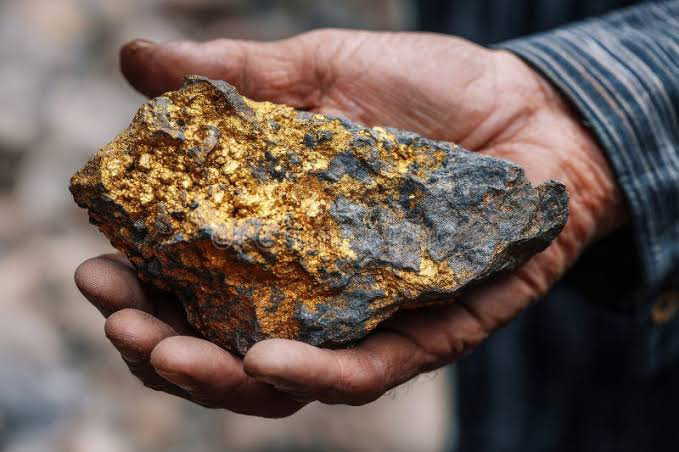
Guinean President Mamadi Doumbouya has banned the export of raw gold, in a move designed to keep more of the value chain inside the country and push the metal through local processing before shipment abroad.
He announced the policy during a meeting with industrial and artisanal gold producers as well as gold-buying offices operating in the West African nation, according to the Bloomberg report.
Guinea 🇬🇳 has imposed a ban on the export of unrefined gold, following a similar move by Zimbabwe 🇿🇼 regarding lithium exports.
— Business Insider Africa (@BusInsiderSSA) June 22, 2026
The decision aims to promote local gold refining and requires that all gold be processed into ingots within Guinea 🇬🇳 before export.
President General… pic.twitter.com/Ni3VpZFfCm
Doumbouya ends raw gold exports
Doumbouya framed the decision as a break with a long-standing pattern in which Guinea’s gold leaves the country unprocessed.
“I am putting an end to that starting today,” he said during the meeting, which was later broadcast on state-owned Radio Télévision Guinéenne. He added: “Raw gold will no longer leave Guinea.”
Gold must now be refined locally
Under the new policy, gold will be exported only after it has been refined into ingots at a facility in Conakry, the capital.
Doumbouya also warned that operators who continue to export raw gold could face suspension of their licences and termination of mining agreements. The announcement signals a tougher line from the Guinean government as it seeks to shift from an extraction-led model to one based on domestic beneficiation.
Guinea is best known globally for being the world’s largest bauxite producer, but it also holds significant gold reserves. The country’s gold is mined by industrial companies including Société Aurifère de Guinée, a unit of AngloGold Ashanti, as well as semi-industrial operators and hundreds of artisanal miners.
The Ministry of Mines and Geology said combined gold exports from these operators totalled 22,142 kilograms in the first quarter of this year. The World Gold Council has described Guinea as Africa’s sixth-largest gold producer.
🇬🇳🚫 Guinea bans raw gold exports to boost local processing: Media
— Sputnik Africa (@sputnik_africa) June 21, 2026
All certification, smelting, and refining of the precious metal must now happen within the country's borders, President Mamadi Doumbouya was quoted as saying.
👉 "Any operator who continues to export raw gold… pic.twitter.com/BJgP2lq9Gr
Part of a wider West African shift
The ban fits into a wider regional trend in West Africa, where several resource-rich governments have been trying to capture more value from their mineral output by insisting on local processing.
Mali planned to establish a state-controlled gold refinery with Russia’s Yadran to boost bullion revenue, and that West African states were increasingly pushing for domestic gold processing.
Reuters reported in November 2025 that Guinea was accelerating plans for domestic mineral refining, including alumina processing, as part of a broader effort to reduce raw exports.
A new test for Guinea's mining sector
For Guinea, the new gold-export restriction adds another layer to a policy shift that has already been visible across its mining sector.
The government has been seeking to extract more economic benefit from its natural resources, and the latest decree places the focus squarely on in-country processing. For miners and gold buyers, the immediate effect is clear: the export route for unrefined gold is now closed, and future shipments will depend on whether the state can make its new refining requirement work on the ground.
Also Read | Labour's next leader? Burnham sworn in after Starmer exit, gains key backing
FAQs
Q1: Why has Guinea banned raw gold exports?
Ans: Guinea says the ban is intended to ensure more gold is refined domestically, allowing the country to capture greater economic value from its mineral resources.
Q2: What happens to gold exports under Guinea’s new rules?
Ans: Gold can now be exported only after it has been processed and refined locally into gold bars or ingots.