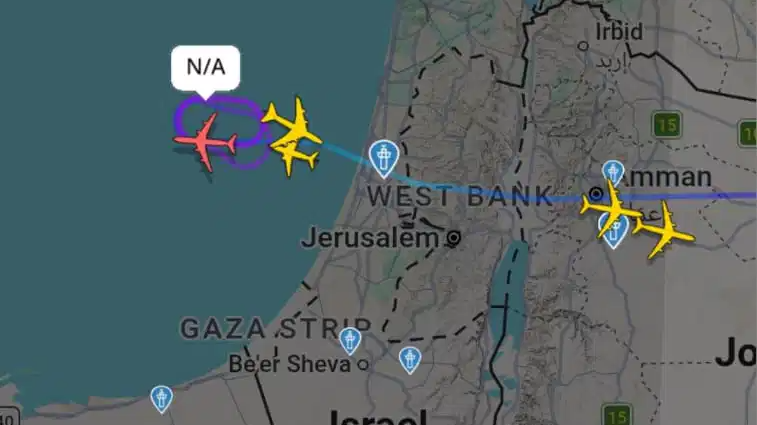
Pictures of at least two US Air Force Boeing KC-135 Stratotanker aerial refuelling aircraft at Ben Gurion International Airport in Tel Aviv, Israel, have gone viral on social media and is being seen now an then on Flightradar24.
Reports say the aircraft has been continuously launching from the airport, operating as an “aerial gas station” to support extended combat operations.
The refuelling aircraft is supporting US and Israeli fighter jets, including F-35s, F-15s and F-16s, enabling long-range strike missions against strategic targets inside Iran.
Also Read | Will the Israel-Iran conflict's escalation give added advantage to Benjamin Netanyahu in upcoming elections?
Amid the buzz around its presence, here is a closer look at what the Boeing KC-135 Stratotanker is and why it remains crucial to the US Air Force.
What is the KC-135 Stratotanker?
The Boeing KC-135 Stratotanker is an American military aerial refuelling tanker aircraft developed from the Boeing 367-80 prototype, alongside the Boeing 707 airliner. It has a narrower fuselage and is shorter than the 707. Boeing gave the aircraft the internal designation of Model 717, a number that was later assigned to a different Boeing aircraft.
The KC-135 was the United States Air Force’s first jet-powered refuelling tanker and replaced the KC-97 Stratofreighter. Initially tasked with refuelling strategic bombers under the Strategic Air Command (SAC), it later proved vital in tactical operations.
It was used extensively during the Vietnam War and in later conflicts such as Operation Desert Storm. In Southeast Asia in the late 1960s, the aircraft’s midair refuelling capability allowed F-105 and F-4 fighter-bombers, as well as B-52 bombers, to strike distant targets and remain in combat zones for longer periods.
According to Boeing archives, more than 732 KC-135s were built, and most remain in service with modifications into the 21st century. It is one of nine military fixed-wing aircraft that have served for more than 60 years with their original operator. The US Air Force is expected to use them at least until 2030. Countries such as Chile, Singapore and Turkey also operate the aircraft.
Features, capabilities and modern upgrades
The KC-135 has a wingspan of 130 feet 10 inches and a length of 136 feet 3 inches. It has a gross weight of 297,000 pounds. The aircraft can reach a top speed of 600 mph and cruise at 552 mph. It has a range of 5,000 miles and a service ceiling of 41,000 feet.
Also Read | 'Illegal aggression': North Korea reacts strongly to US-Israel attack on Iran
Powered by four turbofan engines, upgraded from the original J57 turbojets, the aircraft can be operated by a crew of four. Apart from refuelling missions, it can be configured to carry up to 83,000 pounds of cargo or transport up to 80 troops. Its upper deck can hold 25 tons of cargo or 80 troops, while the lower deck houses the refuelling equipment. It can also be used for aeromedical evacuation missions.
The US Air Force continues to rely heavily on the KC-135 fleet. The newer KC-46 tanker programme, based on the Boeing 767, has faced technical deficiencies, including fuel system leaks and malfunctioning remote vision systems, which have affected mission-capable rates. In February 2011, Boeing received a contract from the US Air Force to build the KC-46 to replace 179 of the service’s 400 KC-135 tankers.
The KC-135 has also undergone major modernisation. Under the Pacer CRAG programme, Rockwell Collins upgraded its avionics systems. The aircraft now includes an integrated flight management system, traffic alert and collision avoidance system (TCAS), enhanced ground proximity warning system (EGPWS), advanced autopilot, flight director, radar altimeter and electronic engine instrument displays. Digital avionics were introduced to improve safety, reliability and efficiency.
From Vietnam to the Persian Gulf conflict and Operation Enduring Freedom over Afghanistan, the KC-135 has supplied fuel to warplanes in multiple theatres. Decades after its introduction, the aircraft continues to act as a key force multiplier, extending the range and endurance of US and allied fighter jets.