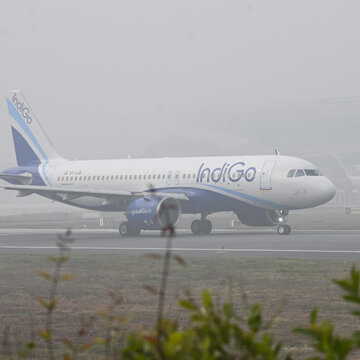
As Indian airports witness increased activities through their flights, the problem of congestion is not limited only to the passenger terminal area. There has been an increase in traffic on the airside that includes buses, baggage trucks, fueling vehicles, catering trucks, and employee vehicles, which could lead to accidents involving vehicles and aircraft.
Bangalore International Airport Limited (BIAL), recognising the need to tackle the problem of safety on the airside, is planning to introduce the Artificial Intelligence (AI) surveillance system at the Kempegowda International Airport Bengaluru.
Also Read | Flight delays likely as storms lash Delhi; IndiGo issues travel advisory
Just last month, a catering van rammed into a stationary IndiGo Airbus A320 at Netaji Subhas Chandra Bose International Airport, damaging the aircraft. Airport officials say such incidents are not uncommon.
According to airport sources, designated taxiways are used for aircraft movement between parking bays and runways, while separate lanes exist for ground vehicles. Rules prohibit airside vehicles from exceeding speeds of 20 kmph, and special protocols are followed whenever vehicles cross aircraft taxi routes.
AI system to strengthen coordination between aircraft and vehicle movement
An airport official said emergency responder vehicles operating near runways are already tracked through systems linked to Air Traffic Control (ATC), allowing controllers to monitor proximity between aircraft and vehicles.
However, many other vehicles operating across the airside currently lack such monitoring systems.
To address this gap, BIAL on Tuesday announced the launch of an Integrated Smart Airside Safety System. The AI-powered platform will primarily monitor aircraft-vehicle intersections and improve movement coordination across the airside area.
Also Read | 'We are proud of our impact...': Spirit Airlines shuts down operations after 34 years
Until now, much of this coordination depended heavily on driver awareness and manual observation. The new system aims to make the process more technology-driven.
During flight operations, aircraft already use systems such as the Aircraft Collision Avoidance System (ACAS), which alerts pilots when another object or aircraft comes dangerously close. Pilots can then take corrective action to avoid a collision.
However, ACAS does not function during aircraft taxiing inside airports. This has raised questions within the aviation sector about whether similar collision-alert technologies could eventually be introduced for vehicles operating on airport airside zones.