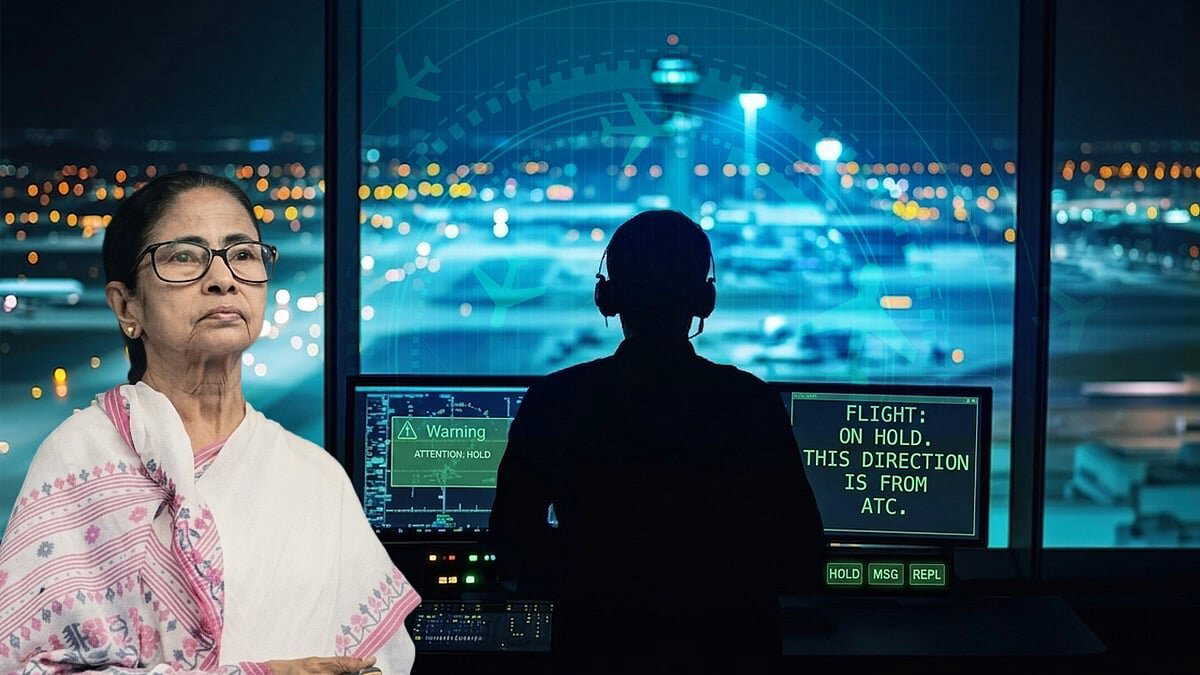
When we hear the word “hold,” we usually think of holding onto something. But in many situations, especially in aviation, it also means being asked to wait or pause.
In the aviation sector, “hold” is used frequently. Before takeoff, the aircraft taxi towards the runway, gain speed, and prepares to lift off. However, if another aircraft is landing or taking off, the pilot of the next aircraft is instructed to wait at the runway entrance. This is known as a “holding point,” beyond which the aircraft cannot proceed until clearance is given.
While waiting on the ground is easy to understand, the idea of an aircraft being in a “hold” while in the air often confuses people. After all, an aircraft cannot remain completely still in the sky. Instead, when a plane is asked to “hold” before landing, it follows a specific flying pattern, usually circular or oval, at a designated altitude. This is called a “holding pattern.”
Aircraft are often put into holding patterns at busy airports where multiple takeoffs and landings need to be managed efficiently. Since runways are shared, a gap is required between successive landings and departures. To manage this flow, incoming aircraft are asked to wait in the air.
ALSO READ | Oil stocks under pressure despite excise cut: Here’s what’s driving the decline
Because of such delays, pilots always carry extra fuel, especially when flying to congested cities. Recently, this was seen when a private Falcon jet carrying Mamata Banerjee had to remain in a holding pattern for over an hour before landing in Kolkata from Ondal due to bad weather.
How do aircraft hold in the sky?
Every aircraft in the air is closely tracked by Air Traffic Control (ATC). On ATC radar screens, each plane appears as a moving dot along with key details such as its flight number, aircraft type, speed, altitude, and exact location. Using this real-time data, ATC officers guide pilots to maintain safe distances and follow designated air routes.
When an aircraft is asked to “hold” before landing, it doesn’t stay still. Instead, it flies in a pre-defined circular or oval path at a specific altitude, known as a holding pattern. ATC assigns this pattern in a safe zone where there is minimal traffic, ensuring no conflict with other aircraft.
Take Thursday’s incident as an example. The aircraft carrying CM Mamata Banerjee was scheduled to land in Kolkata around 4 PM. As the pilot contacted ATC, heavy rain and storm conditions had already set in, making landing unsafe. Both ATC and the pilot agreed that holding was necessary.
ATC officials then identified a secure airspace using radar, an area where no other aircraft were likely to interfere. The Falcon jet was directed to circle in the skies south of Kolkata, towards Sonarpur in South 24 Parganas, until weather conditions improved enough for a safe landing.
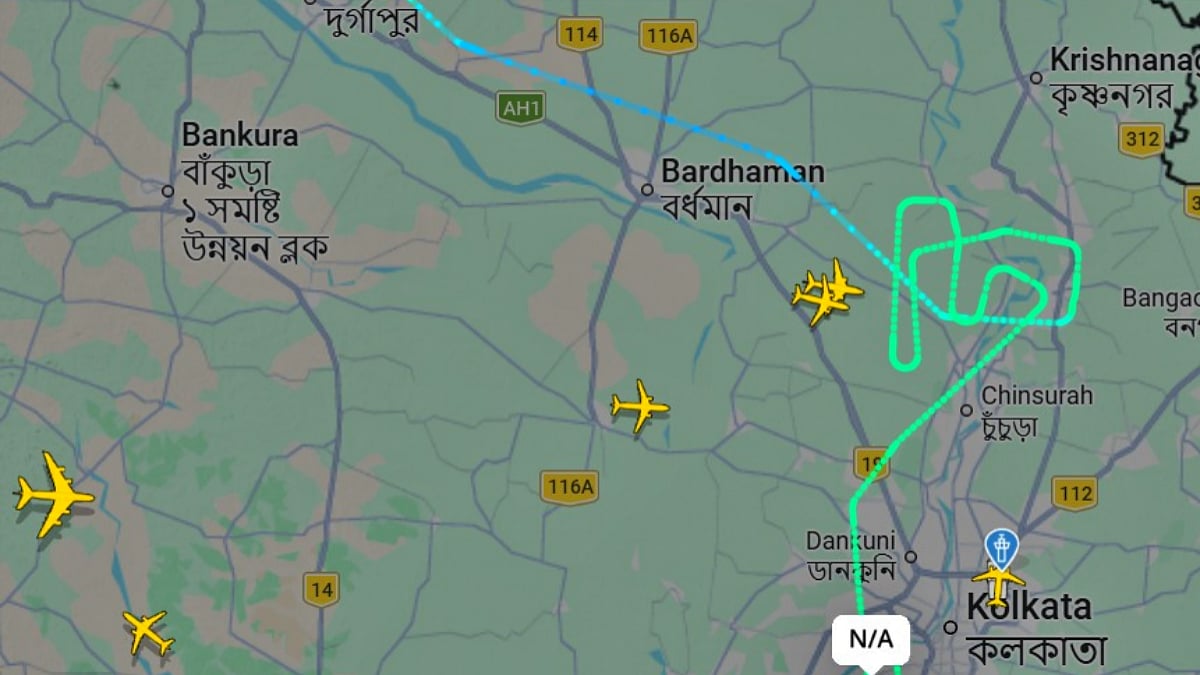 The aircraft was circling in the sky area marked by the green line
When an aircraft is asked to “hold,” it is given specific instructions by ATC-such as circling within a defined area, say a three-kilometre radius, at an assigned altitude like 5,000 feet. The aircraft must continue flying in that pattern until it receives clearance to land. Throughout this time, its movement is constantly tracked on ATC radar, and controllers ensure that no other aircraft enters the same airspace at that altitude.
This system allows multiple aircraft to be held in the sky at once. In a busy airspace like Kolkata, as many as 10 to 20 aircraft can be in holding patterns simultaneously. Each aircraft is assigned a different altitude and position to maintain safe separation. ATC also manages a landing sequence: typically on a first-come, first-served basis. However, exceptions are made for emergencies or VIP flights, which may be given priority.
ALSO READ | Markets fall sharply: Sensex down 1,100 points, here’s what’s behind it
For example, if a SpiceJet flight from Delhi reaches first and is placed in a hold, and an IndiGo flight from Bengaluru arrives shortly after, it will also be instructed to hold, but with a sequence number. Once the runway is available, the SpiceJet flight will land first, followed by IndiGo.
At busy airports like Delhi, Mumbai, and Bengaluru, such coordination is routine. From the ground, it may appear as though aircraft are closely lined up in the sky, waiting to land. This is even more noticeable at global hubs like Heathrow, Changi, Dubai, or JFK, where aircraft seem to follow one another in quick succession.
However, despite appearances, strict separation is always maintained. In India, aircraft must keep a minimum distance of four to five nautical miles during landing, roughly 7 to 8 kilometres. At some of the world’s busiest airports, this gap can be slightly reduced to about 2 to 3 kilometres under controlled conditions.