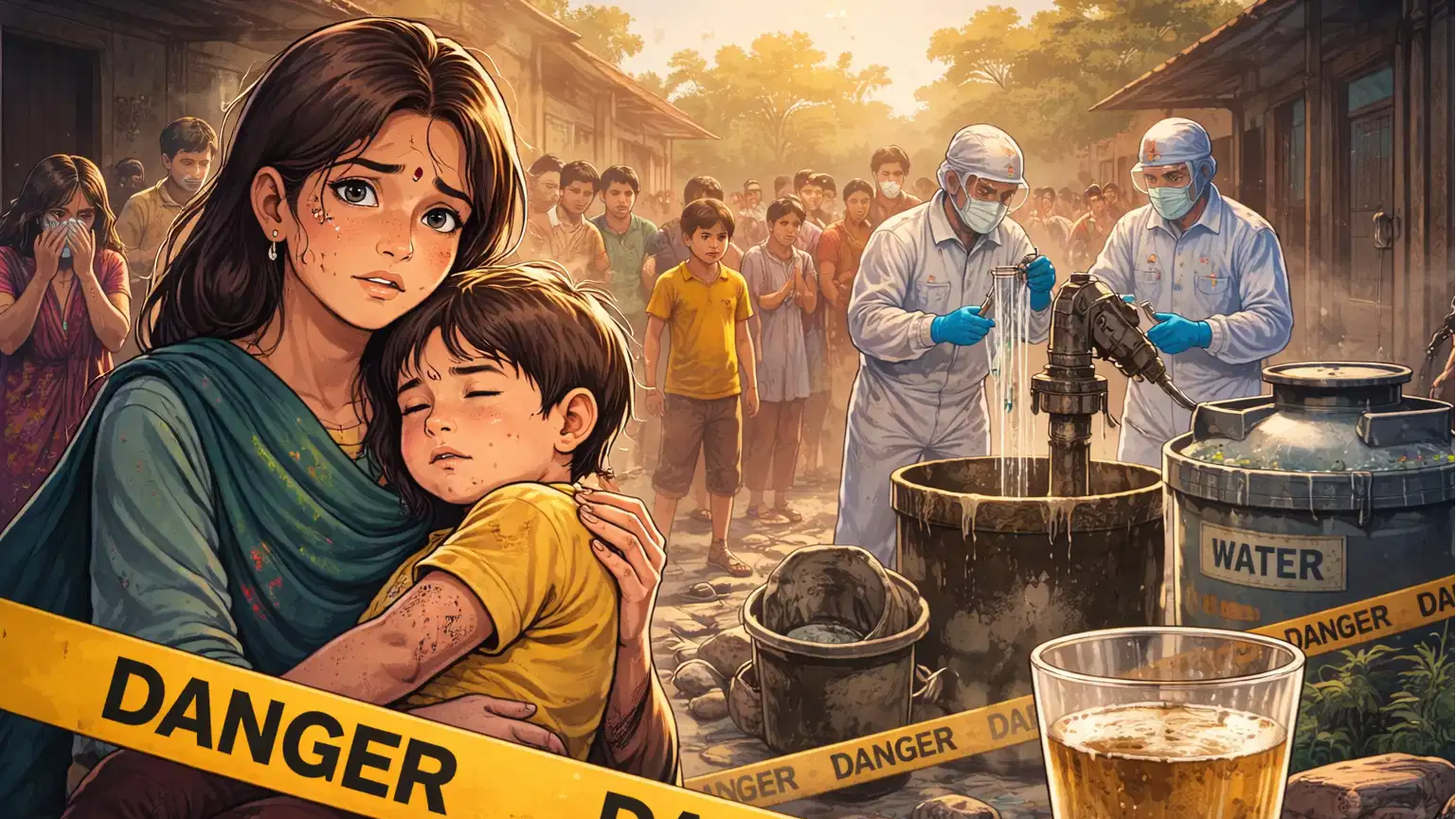
The recent death toll at Chayansa village, located at Palwal, Haryana, over the past 15 days stands at at least 12 fatalities, including five children, prompting a Health department inquiry, with suspicion that infected water and contagious diseases might be at play.
The fatalities, which took place between late January and mid-February, were reportedly due to severe liver problems. Preliminary investigations indicate that viral hepatitis and water contamination might have contributed to the deaths.
The first fatalities due to jaundice were reported on January 31 at Chayansa, a village with a population of 5,700 residents, living in 865 households. A rapid response team was deployed on the next day, and medical camps, door-to-door checks and village-wide screenings have been put in place.
Also Read | From digital powerhouse to AI hub: India hosts mega global summit
Seven fatalities took place between January 27 and February 11, with four fatalities being due to acute hepatitis or liver failure. The patients ranged between nine and 65 years old. According to a report by Hindustan Times, most patients complained of fever, abdominal pain, vomiting and jaundice before their condition deteriorated.
How did the deaths come to light?
The deaths came to light weeks after 16 people passed away due to toxic water intake were reported from Indore, Madhya Pradesh, last month.
The chief medical officer of Palwal, Satinder Vashisth, said that extensive screening and testing are going on in the area. "So far, 1,500 people, including the close contacts of the deceased, have been screened. Close to 800 outpatient visits have been seen, and blood samples were tested for Hepatitis A, B, C, and E," he was quoted as saying by Hindustan Times.
Out of 210 blood samples tested, two tested positive for Hepatitis B, while nine tested positive for Hepatitis C. All the samples tested negative for Hepatitis A and Hepatitis E. Samples for scrub typhus are still pending. Three patients are hospitalised and are said to be stable, reported Hindustan Times.
Water samples from houses being probed
Until now, 107 water samples from homes have been tested, of which 23 did not pass quality checks, indicating bacterial growth and inadequate chlorination. In another testing, storage tanks have been found to contain coliform bacteria. Dozens of water samples have been found to have no chlorine at all, prior to corrective measures.
Also Read | Delhi Red Fort blast: NIA reveals key names, probes alleged terror module link
The public is relying on regular water supplies, storage tanks and water tankers. In some areas, water treated with Reverse Osmosis from neighbouring areas is also available. Inconsistent refilling of water in storage tanks, along with inadequate disinfecting, is causing concern about water-borne diseases.
Precautionary measures
Leptospirosis tests have been negative and veterinary tests have been conducted to confirm that there is no risk from animal sources. As a precaution, around 15,000 halogen tablets have been provided to purify water, along with a helpline number, 01275-240022.
Another health official commented on this issue and was quoted as saying by Hindustan Times, "The investigation is still going on, and we are trying to find out what is causing these deaths, what medical, environmental or behavioural factors are responsible for this, to pinpoint what is causing these deaths precisely."