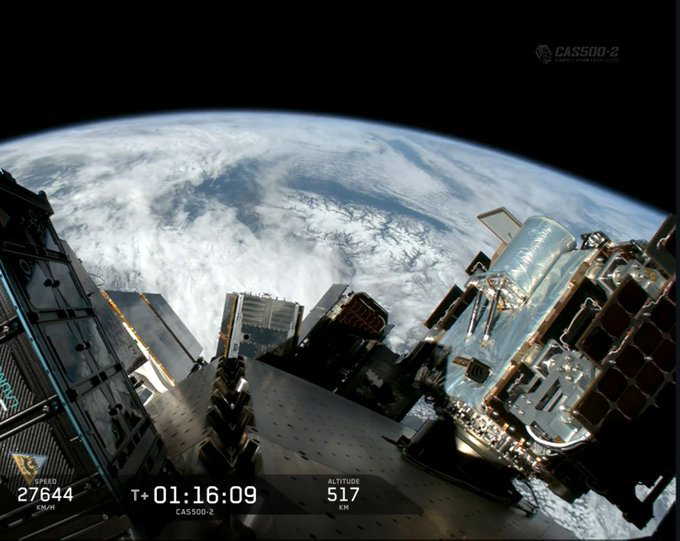
Bengaluru-based space startup GalaxEye placed its first commercial satellite, Drishti, in orbit on Sunday aboard SpaceX’s Falcon-9 rocket. The company described the mission as a milestone for Earth-observation technology and said the satellite marks another step in India’s expanding private space sector.
GalaxEye said Drishti weighs 190kg and is India’s largest privately developed Earth-observation satellite. It also claimed the spacecraft is the first in the world to integrate electro-optical and synthetic aperture radar sensors into a single operational platform, allowing all-weather, day-and-night imaging. The satellite carries what the company calls a “SyncFused OptoSAR” payload.
Prime Minister Narendra Modi congratulated the GalaxEye team on the successful launch of Mission Drishti, describing it as a significant step forward for India’s private space sector. External Affairs Minister S. Jaishankar also praised the mission, calling it a reflection of India’s “growing capabilities” and a global breakthrough in all-weather Earth observation imaging.
Mission Drishti by GalaxEye marks a major achievement in our space journey. The successful launch of the world’s first OptoSAR satellite and the largest privately-built satellite in India is a testament to our youth’s passion for innovation and nation-building.
— Narendra Modi (@narendramodi) May 3, 2026
Heartiest…
Also Read | Pune horror shocks village: Minor’s assault and murder sparks outrage, CM promises fast-track trial
Sees through clouds: all-weather imaging
The satellite is designed to “see” through clouds, darkness, and bad weather while still capturing conventional optical imagery.
GalaxEye said the platform can support border surveillance, defense monitoring, disaster response, agriculture, infrastructure planning, and insurance assessment. Co-founder and chief executive Suyash Singh said onboard AI processing is intended to “reduce the time taken to convert satellite imagery into actionable information.”
A proud moment for India’s space trajectory! The successful launch of @GalaxEye’s Mission Drishti is a milestone towards persistent, all-weather Earth observation.
— India in USA (@IndianEmbassyUS) May 3, 2026
Congratulations to @GalaxEye on the first cutting-edge OptoSAR marking notable step in India’s commercial EO… pic.twitter.com/5T1CqXhI1h
1.5m resolution, global revisit every 7–10 days
Also Read | Child rape-murder in Pune triggers massive protest, Mumbai-Bengaluru highway blocked
According to the company, Drishti can deliver imagery at a resolution of 1.5 meters and revisit locations globally every seven to 10 days.
GalaxEye said it had earlier tested its imaging systems through nearly 500 aerial sorties using drones, Cessna aircraft, and high-altitude platforms, besides flying an earlier payload on an ISRO PSLV mission under the POEM platform.
The startup now plans to build a larger constellation of eight to 12 satellites over the next four years.
Falcon 9 rideshare places Drishti in orbit
SpaceX Falcon 9 lifted Drishti into orbit from Vandenberg Space Force Base in California as part of the CAS500-2 mission, which carried 45 payloads.
The launch took place at 12:30 pm IST and marked the first orbital ride for GalaxEye’s satellite. The Falcon 9 rideshare format allowed Drishti to share the mission with other spacecraft, a common SpaceX approach for customers seeking access to orbit without a dedicated launch.
The deployment added momentum to India’s private space sector and to GalaxEye’s plan for a larger satellite constellation.