India's infrastructure story is increasingly being defined by a simple yet important question. Should the country build entirely new cities and transport networks, or should it focus on repairing and upgrading the ones that already exist?
The answer lies in understanding two terms that have become common in policy discussions: greenfield and brownfield projects.
While they may sound technical, these concepts influence everything from airports and motorways to industrial corridors and railway stations. More importantly, they determine how quickly projects can be built, how much they cost and how cities evolve.
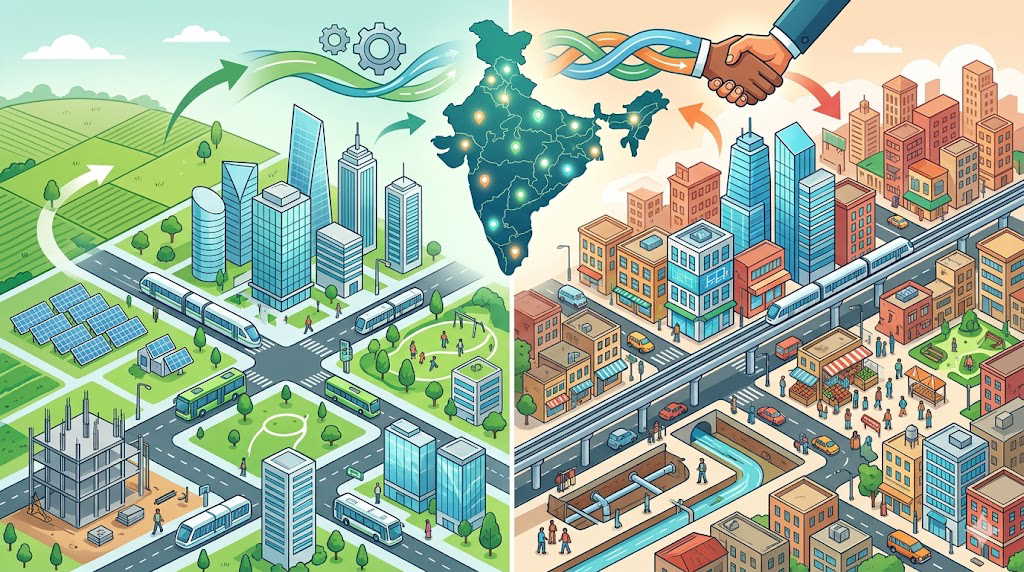
At its core, a greenfield project refers to building something entirely from scratch on previously undeveloped land. Brownfield projects, on the other hand, involve modernising, expanding or redeveloping existing infrastructure.
Greenfield projects create entirely new growth centres
Greenfield developments offer planners a blank canvas.
Since there are no existing structures to work around, engineers can incorporate modern technology, optimise layouts and design infrastructure for future needs rather than present limitations.
NDTV noted that this is one of the reasons large projects such as the Noida International Airport at Jewar, Dholera Special Investment Region and major sections of the Delhi-Mumbai Expressway have adopted the greenfield model.
The biggest advantage is long-term efficiency. Governments can create entirely new economic hubs capable of handling future demand.
However, this freedom comes with challenges.
Land acquisition often becomes a lengthy and politically sensitive process. Environmental clearances, rehabilitation packages and supporting infrastructure significantly increase both costs and timelines.
Greenfield projects are therefore usually associated with transformational projects rather than quick fixes.
Also Read | El Nino alert: Centre asks states to brace for drought risks, activates Kharif action plan
Brownfield projects focus on making existing assets better
Brownfield development takes a more practical approach.
Instead of creating new infrastructure, authorities improve what already exists.
NDTV noted that this method is particularly useful in crowded urban areas where acquiring fresh land is nearly impossible.
The redevelopment of Delhi's railway stations, the expansion of Mumbai airport and upgrades to major metro networks all fall into this category.
Brownfield projects are often cheaper, faster and less disruptive to the economy because basic infrastructure and connectivity are already available.
However, engineers face a different set of problems. They must work around ageing systems, limited space and operational disruptions while construction is underway.
Integrating modern technology into decades-old infrastructure can also become complicated and expensive.
Also Read | EV, petrol or flex-fuel: Which vehicle will actually save Indian families the most money?
India cannot afford to choose only one model
The debate is often framed as building new cities versus repairing old ones, but experts say that is the wrong way to look at it.
India needs both simultaneously.
Greenfield projects will be essential for creating future economic engines, especially as urban populations continue to rise. Brownfield projects, meanwhile, will ensure existing cities remain productive, liveable and economically relevant.
A city such as Dholera represents India's future ambitions, while the redevelopment of Delhi's transport infrastructure addresses present-day realities.
The real challenge for policymakers is striking the right balance.
Building entirely new assets without maintaining older ones creates inefficiencies. At the same time, focusing only on upgrades can eventually limit economic expansion.
India's infrastructure journey, therefore, is unlikely to be a choice between greenfield and brownfield. Instead, it will be defined by how effectively both approaches work together to support the country's long-term growth.