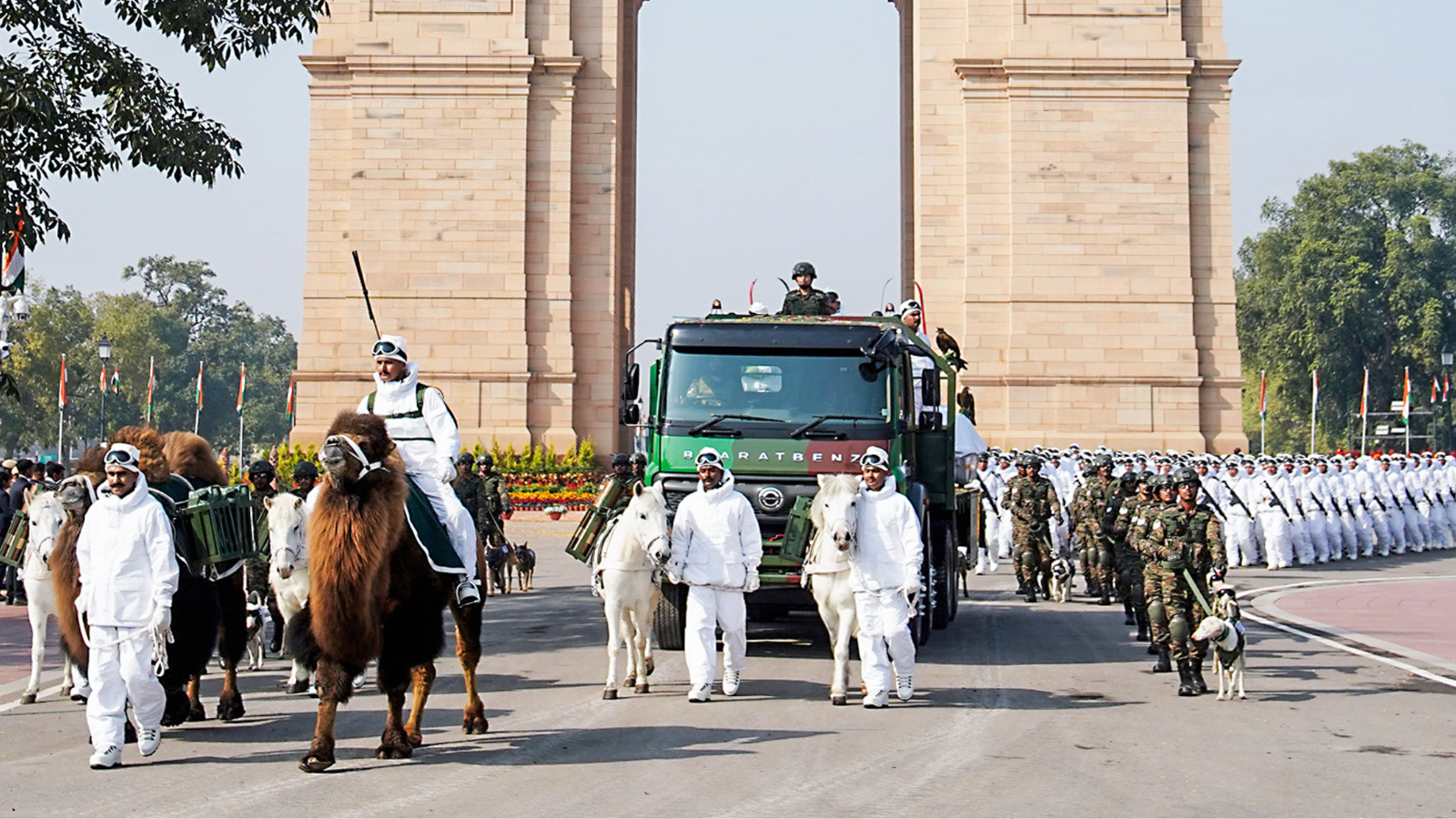
On Republic Day for the first time, two magnificent double-humped Bactrian camels, Galwan and Nubra, walked down Kartavya Path.
Thousands of miles away from their natural environment in the cold deserts of Ladakh, they caught the attention of crowds in Delhi for not just their unique appearance, but because they symbolise India's renewed reliance on tough, high-altitude pack animals for military logistics. This reliance on these rare animals comes in the context of a world that is rapidly embracing drones, robots and high technology to conduct warfare.
The presence of Galwan and Nubra on a national stage is very significant as it marks the first time that Bactrian camels have been on display at the Republic Day Parade. Their historic debut coincides with the Indian Army's recent breakthrough in formally introducing the use of Bactrian camels as a means of carrying necessary supplies, ammunition and equipment to inaccessible regions in Eastern Ladakh where conventional means of transport may be ineffective.
Also Read | 'Mother of all deals': Here's what the groundbreaking FTA agreement between India and EU is all about
What is their operational importance?
In Leh, Colonel Ravikant Sharma, a veterinary doctor at the Defence Institute for High Altitude Research (DIHAR), gave an explanation of their significance in operations.
"They are highly adapted to high altitude desert conditions and have been used for centuries in Central Asia and the Silk Road trade routes. They can carry 150 kg of cargo and travel at altitudes between 14,000 and 15,000 feet for distances of 10 to 12 km," Colonel Sharma was quoted as saying by news agency NDTV.
When asked whether these camels would serve well as pack animals for the Army, Colonel Sharma responded with a definitive, "They have been used and proven to be effective pack animals. The Indian Army plans to use these camels in operation logistics in Eastern Ladakh."
Historic significance
The Bactrian camel was once considered one of the most essential means of transportation along the Silk Route. This was because they would carry heavy goods, such as salt, tea, spice and precious metals, over a distance of 6,400 km through rugged terrains.
In the late 19th Century, when traders from Yarkand, in modern-day Xinjiang, China, brought these animals to Ladakh, this animal was used as a valuable resource. Today, the Bactrian camel has returned and is being used to support tourism and also for military purposes.
What's the secret of two humps?
Their legendary endurance can be attributed to two unique humps they carry on their back. As Colonel Sharma put it, "The humps are essentially fat storage. When there's a lack of food, camels can draw on the fat stored in their humps to provide energy. They can survive for two to three weeks without food."
Also Read | Who are the 11 Padma Shri awardees from West Bengal? Here’s the full list
Research from DIHAR has revealed that the hump of a camel contains concentrated fat which is stored for emergency use during long journeys or when food is scarce, particularly during the winter months when much of Ladakh has snow covering the ground. As camels use the stored energy found in the hump, the fat in the hump begins to shrink and get softer.
This doesn't just happen as an adaptation; it's a survival strategy. The fat stored in the hump gives Bactrian camels the ability to survive for weeks without food, as well as travel beyond their usual distance between feeding without being required to feed. The ability to tolerate minus 40 degree Celsius temperatures and the low level of oxygen and pressure associated with high altitudes enables Bactrian camels to thrive in many different terrains such as rocky, sandy and snowy where wheeled vehicles cannot operate.
They are also able to consume snow to obtain moisture, thus further reducing their reliance on water in liquid form.
Studied extensively by DRDO
Before their induction into the Army, these camels were extensively studied by DRDO-DIHAR, which is headquartered in Leh. To establish the threshold of reliable loads that camels can carry at incremental altitudes, the Institute studied the following body functions and behaviours of camels: body structure (physiology), how long they could endure exertion (endurance), what types and how often to feed camels (dietary patterns), how much wool was produced by camels (wool production), and how to spot health problems before they develop into more serious issues (stress indicators).
Also Read | Who is Shubhanshu Shukla? India’s first ISS astronaut recommended for Ashoka Chakra ahead of Republic Day
Camels successfully carried the weight of 170 kilograms at the altitude of 17,000 feet during recent joint test flights, proving that camels outperform mules and ponies at extreme elevations, where the Army faces numerous challenges while trying to keep its supply chains operational.
In the meantime, DIHAR has created SOPs for each of the following areas of camel care: load carrying, winter feeding, health management, breeding and general care, creating a framework for the use of camels at forward operating bases.