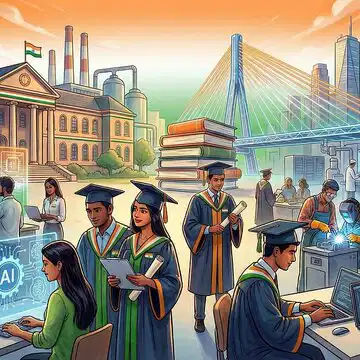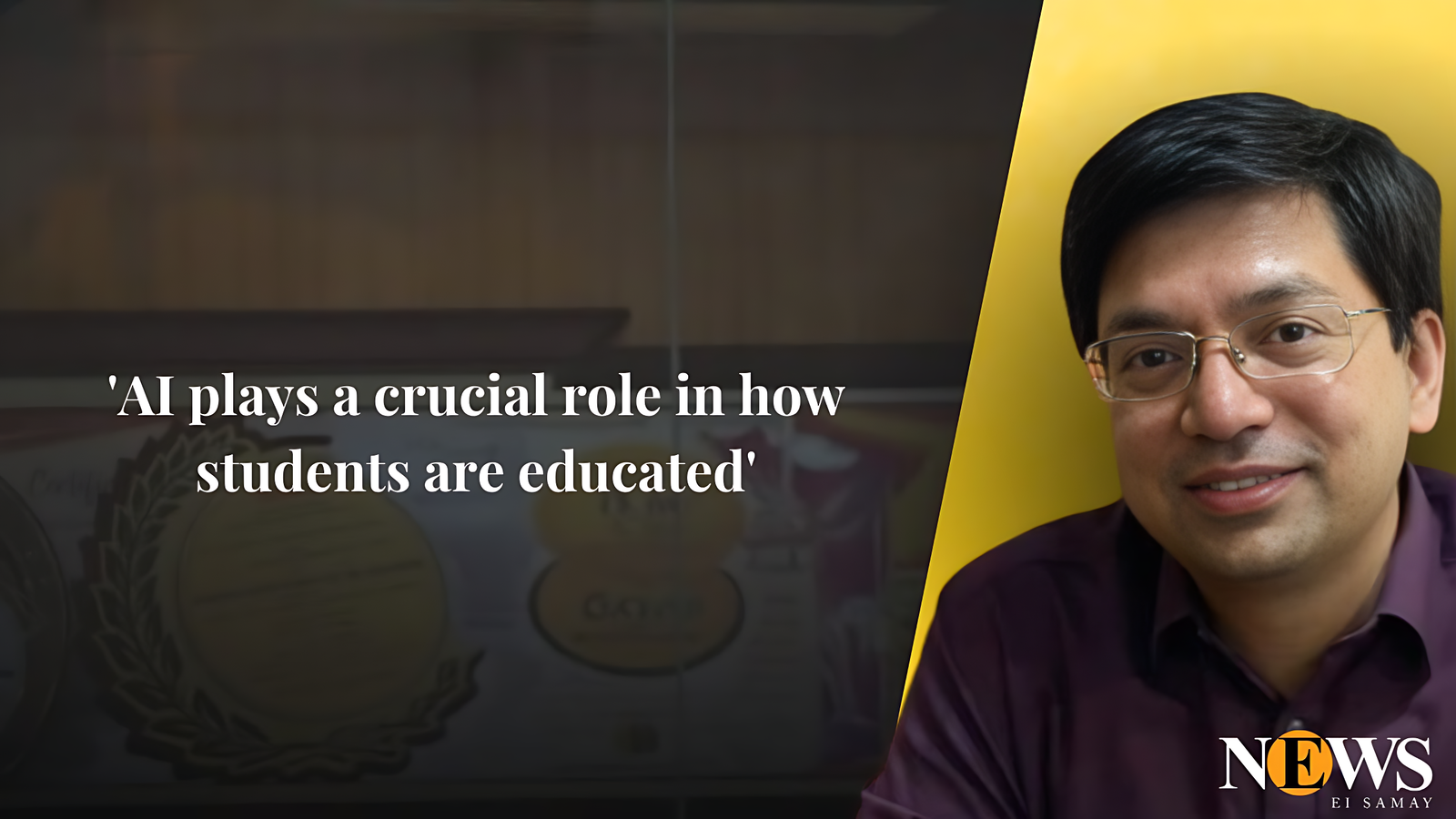
While higher education is undergoing rapid technological and social transformation, in this age of AI, institutions are rethinking how they prepare students for the future. In this context, News Ei Samay spoke with Professor Dr. Satyajit Chakrabarti, guardian of Engineering and Management and the University of Engineering and Management (Kolkata and Jaipur), to understand how academic institutions are adapting to these changes.
Professor Chakrabarti shares that sustainability, innovation and national self-reliance are now central to the institution’s vision. He said, “All this has necessitated incorporating sustainability, incorporating the 17 United Nations SDGs, Sustainability Development Goals, as well as the Make in India products to make India self-sufficient. So, we are already at the forefront, we are already contributing in terms of innovation by patents, by startups, as well as trying to contribute to the research output of India.”
ALSO READ | How strong is your campus internet? UGC rolls out new digital connectivity rating
He added that student-led innovation is encouraged to reach the market. He continued, “The products that are being made by the students are indeed sold in the industry, sold in the marketplace, and we are encouraging that. So, we want to take a leadership not only in all India but also as a top-ranked global university.”
AI to enhance future-ready skills
Highlighting the growing role of technology, he said, “AI plays cruicial role in how students are educated”
Emphasising preparedness, he added, “So, we make sure every student is well-versed in artificial intelligence and machine learning not only usage, not only from a user’s perspective or from a using-tools perspective, but also from making AI tools, making AI models, and training the AI models to completely align with client requirements or align with business requirements. That is where we are going.”
On preparing students for economic uncertainty, he said, “There are economic cycles, there are business cycles, and there is a period of recession and a period of boom. Boom and bust keep on happening. We are 37 years old, so in this period we have seen four major recessions and four major booms.”
He added, “One thing I’m proud to say is that after each recession, IEM has grown stronger, better, bigger, with more opportunity for students and more placements. So this time also it is no different. This time it is about AI, it is about automation, it is about quantum computing and cyber security, and the IEM curriculum and IEM courses are completely aligned with the industry and completely aligned with the emerging technologies.”
ALSO READ | Union Budget 2026 signals shift from degree-based to skill-driven education
Bridging gaps and understanding Gen Z
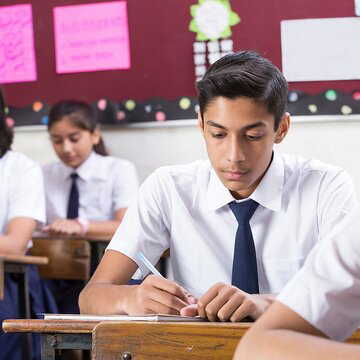
Addressing teacher–student engagement, Professor Chakrabarti said, “From our 37 years of experience and four generations in teaching, we have seen a clear gap and communication barrier between teachers and students in many colleges and universities. Our aim is to ensure that such a gap does not exist.”
He explained, “This is achieved through both formal and informal means, including counselling sessions where students can have confidential one-to-one interactions with counsellors.”
On perceptions about younger students, he said, “If you look at Gen Z over a 10–20 year horizon, it may seem very different from how things were done earlier. But in defence of Gen Z, this did not happen overnight. It has been a gradual process of evolution and change.” He added, “If you compare just today with 20 or 30 years ago, the difference looks sharp. But on a day-to-day, year-to-year basis, the change has been slow. I wouldn’t blame the younger generation because they are facing different challenges. For instance, today drones can do the job of helicopter pilots, and many professions,like content writing have also changed over time.”
Challenging common stereotypes, Chakrabarti concluded, “People say Gen Z doesn’t have attention span or loyalty, but I don’t see it that way. Gen Z has everything earlier generations had, but they face a different set of challenges. You have to put yourself in their shoes, mentor them, give them the comfort that you are there for them, that you have their backs, and truly connect with them.”