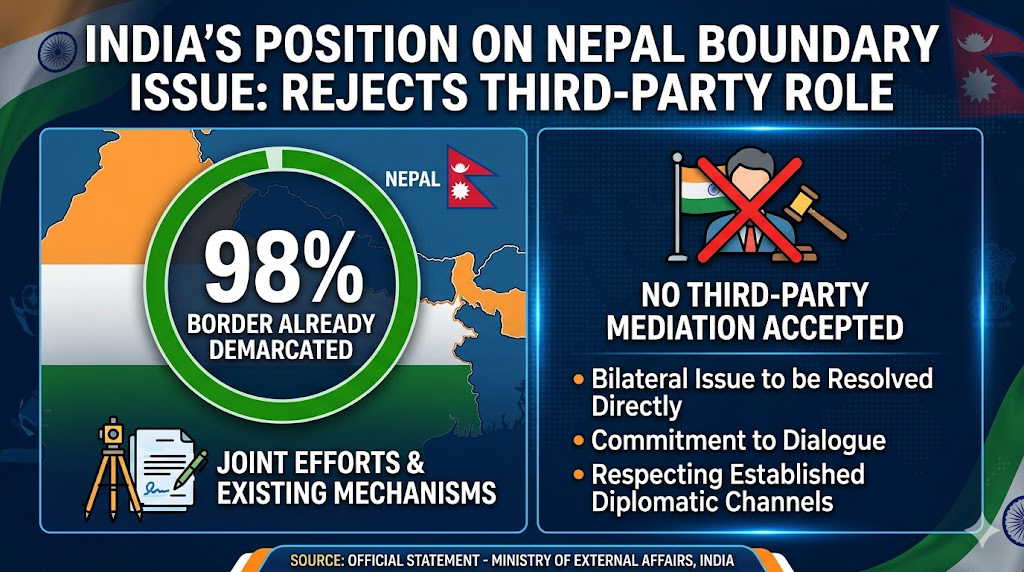
India on Tuesday firmly rejected any role for external parties in addressing boundary-related issues with Nepal, reiterating that such matters are strictly bilateral and should be resolved through existing mechanisms between the two neighbours.
The response came after Nepal Prime Minister Balendra Shah made comments in Parliament regarding land encroachment and suggested that international expertise could help settle longstanding border concerns. New Delhi, however, maintained that the vast majority of the India-Nepal boundary has already been settled and that the remaining issues are being addressed through established channels.
India says border issues are largely resolved
Addressing a media briefing, Ministry of External Affairs spokesperson Randhir Jaiswal said India had taken note of both Shah's remarks and the clarification later issued by Nepal's foreign ministry.
Jaiswal stated that around 98 per cent of the India-Nepal border has already been demarcated. According to him, only a few stretches remain unresolved, largely because of geographical factors such as changes in the course of rivers, including the Gandak.
He added that both countries are jointly mapping instances involving encroachment on no-man's land and cross-border occupation in already demarcated areas. These efforts, he said, are part of ongoing cooperation between the two sides to address outstanding concerns in a structured manner.
Also Read | Facebook friendship led to suspected ISI honeytrap attempt in Jammu and Kashmir
New Delhi rules out outside intervention
Making India's position clear, Jaiswal stressed that bilateral mechanisms already exist to deal with every aspect of boundary management and dispute resolution.
He said there was no role for any third party in matters concerning the India-Nepal border. The statement appeared to be a direct response to suggestions that external experts or foreign governments could assist in finding solutions.
India has traditionally maintained that all border-related issues with neighbouring countries should be handled through direct dialogue and mutually agreed diplomatic channels. The latest remarks reaffirm that stance.
Also Read | Kerala awaits monsoon arrival again as IMD revises onset date; here's what's holding it back
Shah's comments trigger debate in Nepal
The controversy began when Prime Minister Balendra Shah told Nepal's Parliament that border encroachments were not a one-sided issue and claimed that Nepal had also occupied Indian territory in certain locations.
He further suggested involving historians, surveyors and technical experts in efforts to resolve boundary disputes. Shah also indicated that Kathmandu had discussed aspects of the issue with countries including China and the United Kingdom.
His remarks quickly sparked criticism within Nepal, with opposition lawmakers demanding evidence and clarification. Several leaders questioned the basis of the claims and called for either substantiation or withdrawal of the statement.
Nepal's foreign ministry later clarified that Shah's comments referred to issues involving no-man's land and cross-border occupation rather than formal territorial claims, seeking to ease concerns generated by the remarks.