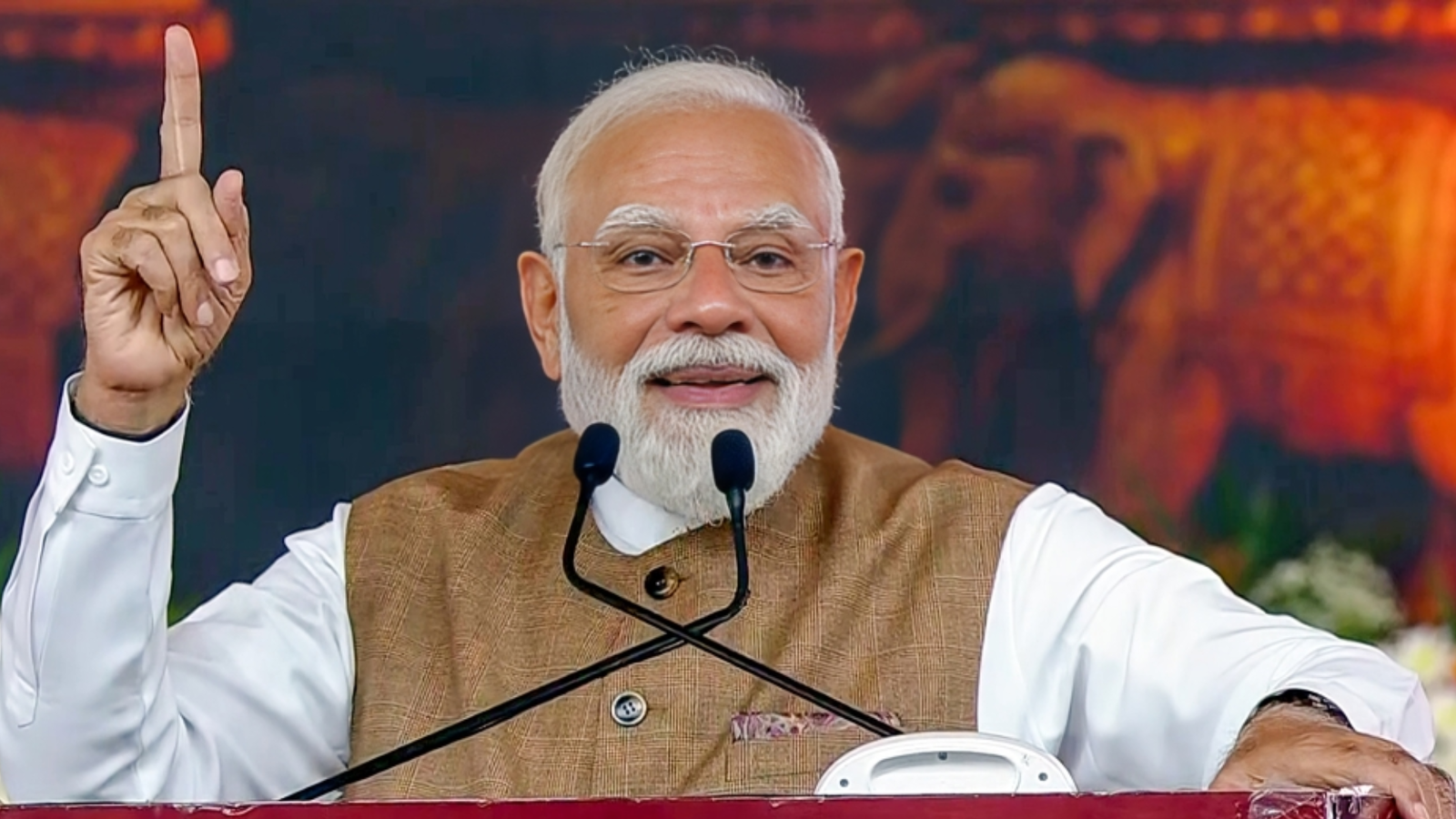
Prime Minister Narendra Modi, in his 133rd Mann Ki Baat, spoke about saving the Great Indian Bustard, a bird that is in great danger. He said that hard work and scientific methods are helping to protect it.
The Great Indian Bustard, known as the “hallmark” of the desert, has lost many of its numbers over time. Today, fewer than 200 birds are left, making it one of the rarest birds in the world.
But now, things are getting better. With special care, breeding programmes, and new methods, there is hope that this bird can survive and grow again.
Also Read | Why El Niño could trigger heatwaves, weaker monsoon and water stress in India this year?
Scientific efforts and breeding success
According to a Hindustan Times report, talking about the improvement, PM Modi said, “At one point, its [Great Indian Bustards] numbers had dwindled to a trickle. The situation was such that this bird was on the verge of extinction.” He said scientific methods like artificial insemination and breeding centres at Ramdevra and Sudashri in Jaisalmer helped the bird recover.
The Bustard Recovery Programme, started in 2016, is a joint effort by the Rajasthan government, the Ministry of Environment, Forest and Climate Change, and the International Fund for Houbara Conservation. It mainly focuses on breeding the birds in captivity and creating a safe environment to release them back into the wild.
The Great Indian Bustard (GIB) is one of the heaviest flying birds and is the state bird of Rajasthan. It is very rare and is in great danger of disappearing.
Earlier, it was found in many parts of India, but now fewer than 200 birds are left. Most of them are in Rajasthan and Gujarat, with a few in Maharashtra, Karnataka, and Andhra Pradesh.
According to a Hindustan Times report, in 2022, 30 eggs were collected, out of which 24 hatched successfully, though some chicks later died. By April 2023, more eggs were hatched using artificial incubation, helping to increase the population.
Also Read | Delhi under orange alert as heatwave continues, scorching conditions to continue for next 3 days
What is the current status and are there signs of hope
The species, listed under Schedule I of the Wildlife Protection Act and recognised as critically endangered worldwide, is now mainly found in Rajasthan and Gujarat. Smaller populations are present in Maharashtra, Karnataka, and Andhra Pradesh.
Desert National Park in Rajasthan has shown positive signs of recovery, with the birds now starting to reproduce naturally.
According to recent data from Hindustan Times, it reveals 11 chicks have been recorded this season, including three born through natural mating. This is an important milestone, showing that conservation efforts are helping the species grow naturally.
PM Modi highlighted the importance of living in harmony with nature, saying, “When we understand nature, respect it and live in harmony with it, positive changes are bound to happen.” His message shows that conservation needs both awareness and action.
With continued effort and scientific support, the Great Indian Bustard’s recovery is a rare success in conservation. It shows timely action can reverse serious environmental decline.