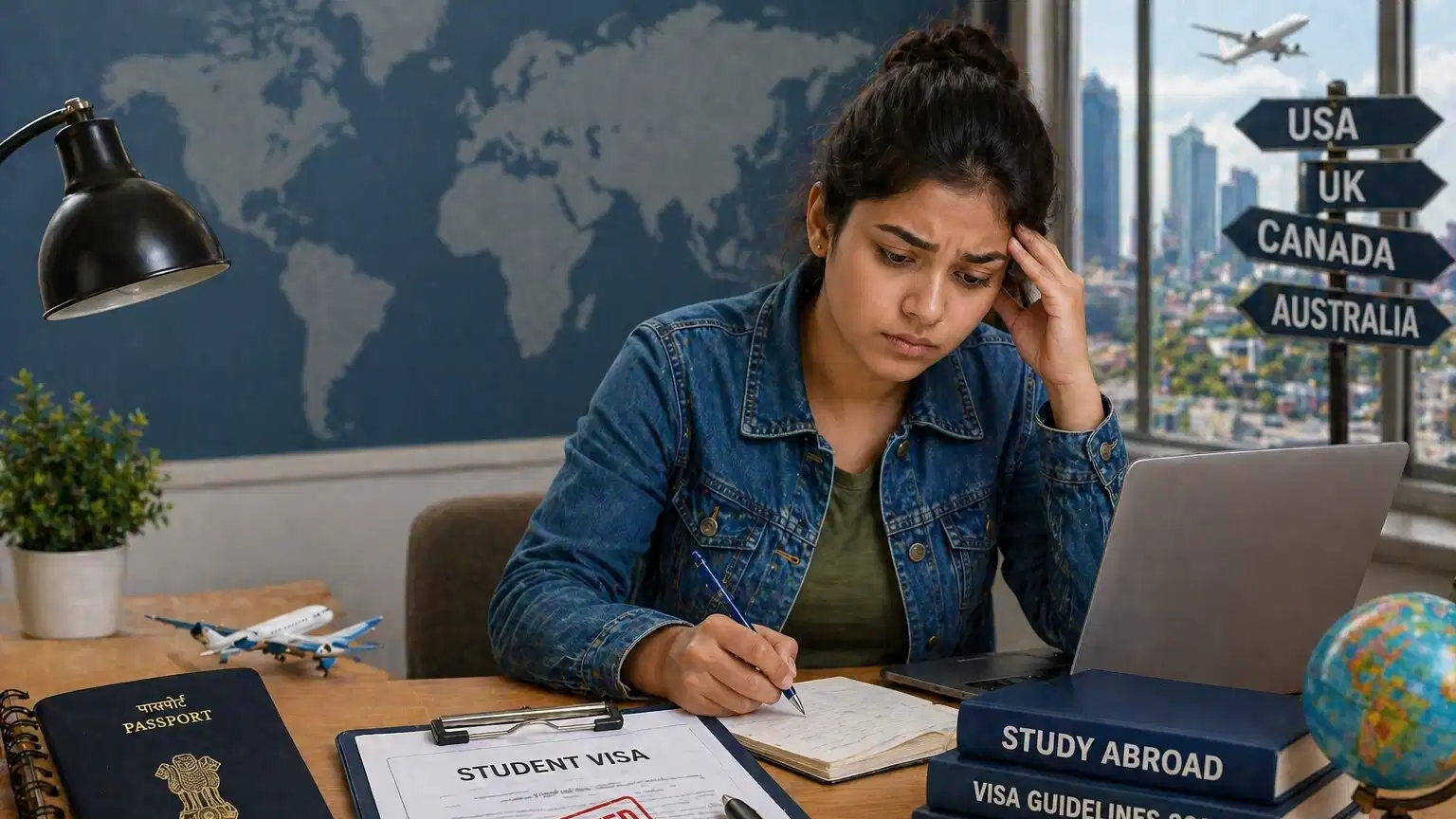
Indian students planning to study abroad are facing a significantly tighter visa landscape, as several major destinations roll out stricter entry norms between 2024 and 2026.
According to recent policy updates across countries including Canada, the UK, Australia and the US, governments are moving away from high-volume international admissions toward a more selective approach which is prioritising applicants with clear academic intent, financial stability and long-term employability.
Also Read | Where are the world’s ultra-rich moving? India is climbing the list fast
Stricter rules raise the bar for applicants
This new visa structure stresses financial autonomy and curriculum correlation. Students must provide better documentation that proves they have sufficient resources and do not need to rely entirely on part-time jobs for survival.
Additionally, there is an increased focus on English language proficiency. Many countries require a higher score on standardised examinations like IELTS and PTE.
One of the most significant changes is the rise in importance of the "Genuine Student" aspect. Visa assessors are scrutinising if the selected program is compatible with the applicant's past learning experience and future profession.
Country-wise changes reshape choices
Some of the major study destinations have made certain changes which could affect students' choices when applying.
In Australia, there has been an increase in visa costs, requiring students to prove they earn at least AUD 29,710 per year as well as more rigorous eligibility tests under its new student framework.
Canada has eliminated its SDS fast track program and imposed limits on students' study permits, with financial evidence increasing to CAD 22,895.
The UK has made it costlier, stringent on language and thinking about imposing limitations on students' dependents, while reducing post-study working periods.
Also Read | CBSE class 10 re-exam 2026 sees 6.7 lakh registrations: what’s driving the surge?
The US has added a visa integrity fee and intensified the level of scrutiny in the interview process, although it still provides good employment options upon completion of study, particularly in STEM-related subjects.
Germany is inexpensive, yet it insists on at least EUR 11,904 in blocked accounts, while offering opportunities to obtain employment after finishing their courses. New Zealand has simplified its application procedure but raised the required amount to NZD 20,000 yearly.
Planning becomes essential
The changing requirements for obtaining a visa suggest that studying overseas remains a possibility but would require more systematic planning compared to previous years. This includes selecting the proper course and preparing financially, among other considerations.