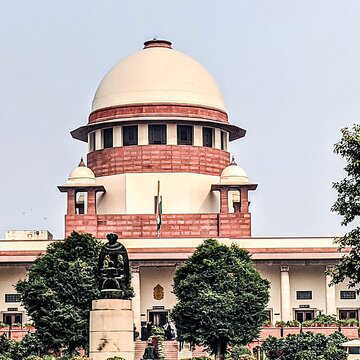
Considering "misuse" of the Protection of Children from Sexual Offences (POCSO) Act, the Supreme Court on January 9 asked the Union government to consider introducing a "Romeo-Juliet" clause to exempt "genuine adolescent relationships" from the law's strict provisions.
The bench of Justices Sanjay Karol and N Kotiswar Singh observed repeated misuse of the law and directed a copy of the judgment be sent to the Secretary, Law, Government of India, as per a report by Live Law.
Also Read | Calcutta HC prioritizes election before hearing Bar Council Fund irregularities
"Considering the fact that repeated judicial notice has been taken of the misuse of these laws, let a copy of this judgment be circulated to the Secretary, Law, Government of India, to consider initiation of steps as may be possible to curb this menace inter alia, the introduction of a Romeo – Juliet clause exempting genuine adolescent relationships from the stronghold of this law; enacting a mechanism enabling the prosecution of those persons who, by the use of these laws seeks to settle scores etc," the bench ordered.
What is Romeo-Juliet clause?
The Romeo-Juliet clause is widely recognised in several jurisdictions and offers exception to statutory rape laws where the age difference between the two involved is minor and their relationship is consensual. It helps in preventing harsh penal punishments to those who are willingly engaged in a relationship. The Romeo-Juliet clause also helps to differentiate these situations from exploitative or abusive conducts.
SC sets aside Allahabad HC order
The top court made these observations while setting aside an Allahabad High Court order that had ordered mandatory medical age determination of survivors in POCSO cases at the time of bail. The Supreme Court said that these directions were against the Juvenile Justice (Care and Protection of Children) Act, 2015, "which prescribes a mandatory procedure under Section 94 to determine the victim's age".
Also Read | 'Jana Nayagan' lands in censorship trouble as Madras High Court stays film's certification
According to the provision, "age is to be determined first on the basis of a matriculation or equivalent certificate, failing which a birth certificate issued by a municipal authority or panchayat is to be relied upon".
The Supreme Court said that "only in the absence of these documents can medical tests such as ossification tests be ordered".
The Allahabad High Court, while granting bail to the juvenile, had issued "sweeping directions to the investigative agencies to conduct medical tests, such as ossification tests, at the very outset of investigation to determine the age of victims".
'Such prosecutions result in...'
While acknowledging the growing misuse of POCSO Act, the apex court remarked that such prosecutions often criminalise youthful relationships and lead to serious consequences for the accused as well as the victim and their families.