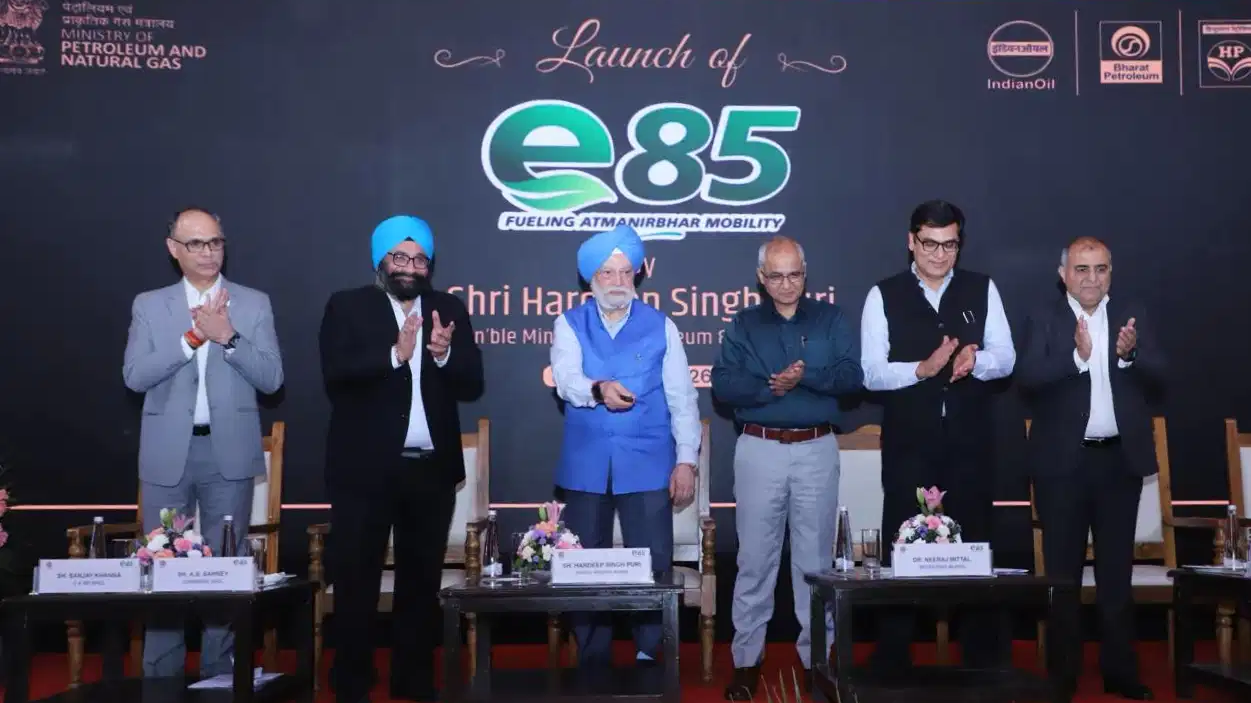
India has taken another step in its ethanol-blending programme with the launch of E85 fuel, a high-ethanol blend designed specifically for flex-fuel vehicles (FFVs). Union Petroleum and Natural Gas Minister Hardeep Singh Puri launched the fuel at a retail outlet in New Delhi on June 5, a day after attending the launch of India's first passenger FFV.
E85 contains 80-85 per cent ethanol and 14-19 per cent petrol. Unlike conventional vehicles, FFVs are engineered to operate on a wide range of ethanol-petrol blends, from E20 to E100.
Also Read | From Shah Rukh Khan to Madhuri Dixit: Electric cars celebrities drive and you can too
What makes E85 different?
According to a Press Information Bureau (PIB) statement, E85 is priced nearly Rs 20 per litre lower than conventional petrol. The government says the pricing is aimed at passing on the benefits of domestically produced ethanol to consumers.
The fuel is also being promoted for its environmental advantages. As per the PIB, FFVs running on E85 can reduce lifecycle greenhouse gas emissions by around 61 per cent compared to conventional petrol vehicles. Ethanol-based FFVs are also classified by NITI Aayog as zero-emission vehicles.
Shri Hardeep Singh Puri, Hon’ble Minister of Petroleum and Natural Gas, launched E85 Fuel for compatible Flex Fuel Vehicles at an IndianOil retail outlet in New Delhi, marking a significant milestone in India's biofuel journey.
— Ministry of Petroleum and Natural Gas #MoPNG (@PetroleumMin) June 5, 2026
The event was attended by Dr. Neeraj Mittal,… pic.twitter.com/yT4xC7lQyz
Can all vehicles use E85?
The short answer is no.
Puri clarified during the launch that E85 is intended only for specially designed flex-fuel vehicles and should not be used in regular petrol-powered cars.
Addressing concerns about existing vehicles, the minister told The Indian Express, “Your E20 vehicle will run for a long time… E20 and E85 are fuels from two different categories, designed for different types of vehicles. The arrival of E85 by no means implies that E20 or petrol vehicles will be discontinued. E85 dispensers will display big boards with the message ‘E85-compliant cars only’.”
Rollout across India
The rollout of E85 will begin at 48 retail outlets operated by public sector oil marketing companies. According to the PIB, the number is expected to increase to 500 outlets by December 2026 and around 5,000 by December 2027.
Also Read | Haryana’s EV push could reshape cab rides and deliveries across Delhi-NCR
The government hopes the expansion will help raise India's overall ethanol blending levels to nearly 26 per cent by 2030-31.
Puri also noted that ethanol blending has risen from 1.53 per cent in 2014 to 20 per cent today, achieving the target five years ahead of schedule while helping reduce crude oil imports and foreign exchange expenditure.