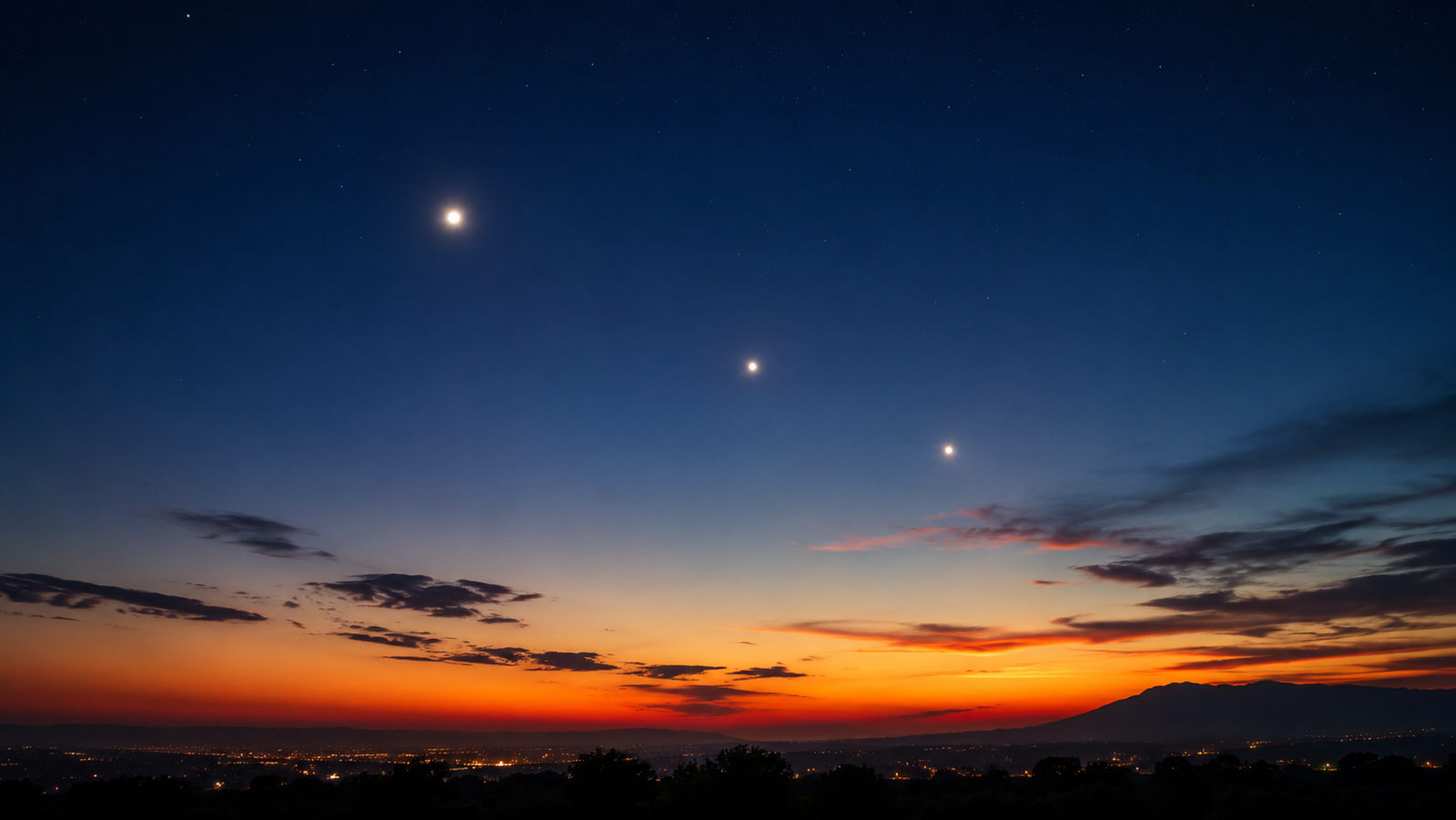
A rare celestial display is set to grace the evening sky on June 12 as Venus, Mercury and Jupiter appear together in a striking alignment shortly after sunset. Often referred to as a "mini planetary parade", the event will give skywatchers a brief window to spot three planets lined up above the west-northwestern horizon.
According to Space.com, the alignment will become visible around 30 minutes after sunset and remain observable for only 30 to 45 minutes before Mercury and Jupiter dip below the horizon. The short viewing period makes timing crucial for those hoping to witness the event.
Where and when to look
The best chance of seeing the three planets will be from a location with a clear, unobstructed view of the western horizon. Venus will be the easiest object to identify, shining brightly in the twilight sky. Once Venus is located, observers can look slightly lower and to the right to find Mercury and Jupiter nearby.
The event also presents an excellent opportunity for astrophotography. A wide-angle camera lens or even a smartphone may be enough to capture the trio against the fading evening light.
Why the planets appear together
The alignment comes just days after Venus and Jupiter appeared in a planetary conjunction on June 9. Since then, Mercury has climbed higher above the horizon, placing all three planets in a visually appealing line.
Venus, often called the Evening Star, will appear brightest due to its highly illuminated gibbous phase. Mercury will appear half-lit, while Jupiter will show up as a larger disk. However, Jupiter's low position near the horizon may make finer details difficult to observe.
NASA explains the phenomenon
In a video shared on its official YouTube channel, NASA said, “From June 11th through June 15th, Mercury joins the scene, creating a mini parade of planets low in the western sky. This happens because the planets orbit the sun along nearly the same path in our sky, called the ecliptic. So, from our point of view on Earth, they sometimes appear to gather in the same part of the sky.”
Also Read | Super El Niño intensifies in Pacific: Why scientists say 2027 could be the hottest year yet
The space agency added, “Venus will be the brightest and easiest to spot with Jupiter nearby. Mercury will sit lower toward the horizon, so you will need a clear view to the west to catch it in the glow of twilight.”
More skywatching ahead
The celestial show will not end with the planetary parade. On June 17, a thin crescent Moon will join the scene in an event known as a lunar occultation. Observers along the right viewing path in parts of the United States, Canada, Brazil and Venezuela may see Venus briefly disappear behind the Moon before emerging again later.