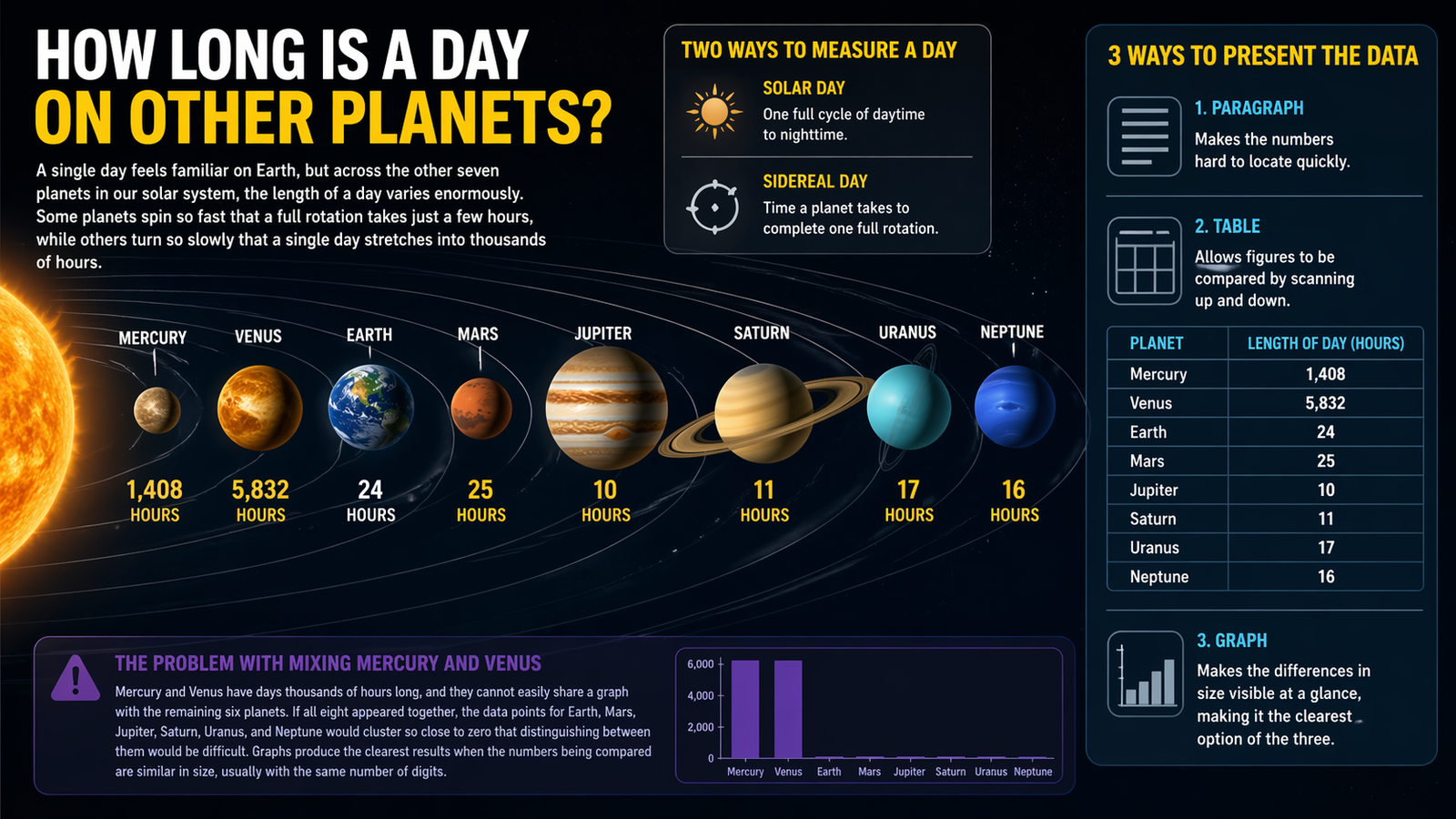
A single day feels familiar on Earth, but across the other seven planets in our solar system, the length of a day varies enormously. Some planets spin so fast that a full rotation takes just a few hours, while others turn so slowly that a single day stretches into thousands of hours.
A day can be measured in two ways. A solar day tracks one full cycle of daytime to nighttime. A sidereal day measures the time a planet takes to complete one full rotation. On Earth, the solar day runs approximately 24 hours, while the sidereal day comes in at 23 hours and 56 minutes.
Day lengths across the planets
As cited by NASA, Jupiter has the shortest day at just 10 hours, followed by Saturn at 11 hours, Neptune at 16 hours, and Uranus at 17 hours. Mars is closest to Earth, with a day of 25 hours.
Also Read | ‘Amul pagal hogaya hai?’ Viral post sparks debate over strange products online
Mercury and Venus sit in a category of their own, Mercury's day lasts 1,408 hours, while Venus takes 5,832 hours to complete one full rotation.
Three ways to present the data
According to the report of NASA, the same information can be shown as a paragraph, a table, or a graph. A paragraph makes the numbers hard to locate quickly. A table allows figures to be compared by scanning up and down. A graph makes the differences in size visible at a glance, making it the clearest option of the three.
The problem with mixing Mercury and Venus
As per the report of NASA, Mercury and Venus have days thousands of hours long, and they cannot easily share a graph with the remaining six planets.
Also Read | South Korean fighter pilot fined $59,200 for mid-air selfie crash
If all eight appeared together, the data points for Earth, Mars, Jupiter, Saturn, Uranus, and Neptune would cluster so close to zero that distinguishing between them would be difficult. Graphs produce the clearest results when the numbers being compared are similar in size, usually with the same number of digits.