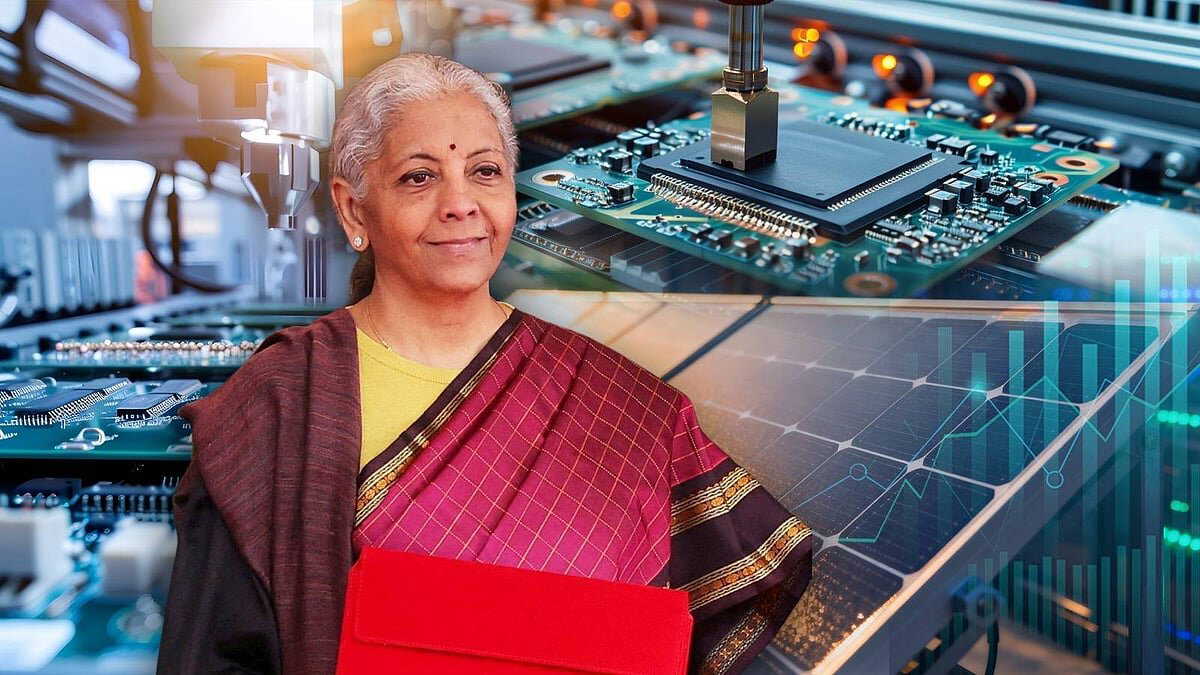
Union Finance Minister Nirmala Sitharaman announced a major expansion of India's electronics and semiconductor industry in her budget speech on Sunday. She announced an increase in allocation for the Electronics Component Manufacturing Scheme (ECMS) to ₹40,000 crore. Alongside this, she announced the launch of India Semiconductor Mission 2.0 (ISM 2.0). Both these projects are being operated under the Ministry of Electronics and Information Technology (MeitY).
In her budget speech, the Finance Minister said the ECMS project, launched in April 2025, had an initial allocation of ₹22,919 crore with a tenure of six years. The government had stated that this project would create production worth ₹10.34 lakh crore and employment opportunities for approximately 1.42 lakh people.
Also Read | ‘Tax holidays are nothing new....’ Industry expert weighs in on new tax hiatus announced during Union Budget
Scheme attracts investments beyond initial government targets
According to Nirmala Sitharaman, the project has already attracted more than double the government's initial target investment. Earlier, Union Minister Ashwini Vaishnaw had informed that through 249 applications, this scheme has received investment of more than ₹1.15 lakh crore, while the government's initial target was ₹59,350 crore.
Currently, the number of approved projects under the ECMS scheme is 46. Total investment stands at ₹54,567 crore. Through this, production worth ₹3.67 lakh crore and more than 50,000 direct job opportunities will be created, it has been announced. The government has stated that this project will help build a $500 billion electronics manufacturing ecosystem by 2030-31.
Also Read | As Union Budget signals long-term investment push, THIS industry leader welcomes infrastructure focus
India Semiconductor Mission 2.0 announced as next phase
Simultaneously, India Semiconductor Mission 2.0 has been announced as the next phase in the semiconductor sector. The Finance Minister said, "ISM 1.0 has enhanced India's semiconductor capabilities. Building on that, ISM 2.0 will strengthen equipment and component manufacturing, full-stack indigenous IP design, and supply chains. Industry-based research and training centers will be established to create skilled workers."
The 2026 budget announcements are being seen as strengthening India's electronics and semiconductor industry further and as a major step towards technological self-reliance.