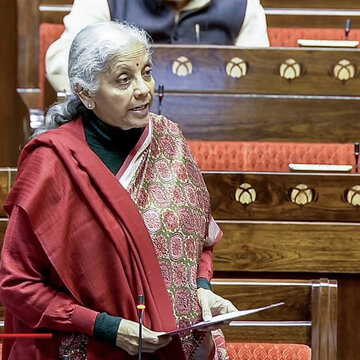
Finance Minister Nirmala Sitharaman on Sunday presented the Union Budget for 2026–27, outlining a roadmap that seeks to balance growth-led public spending with a continued commitment to fiscal consolidation, as the government navigates global economic uncertainty and domestic development priorities.
At the centre of the Budget is a fiscal deficit target of 4.3% of GDP for FY27, underscoring the Centre’s intent to stay on its medium-term consolidation path. The government signalled that disciplined finances would remain a priority even as it steps up investments in infrastructure and productive capacity.
Capital expenditure scaled up to drive growth
Capital expenditure has been pegged at ₹12.2 lakh crore for the coming financial year, marking a rise over the previous year’s allocation. The increase reinforces the government’s strategy of using public investment to crowd in private capital, boost job creation and strengthen logistics, transport and industrial infrastructure. Officials described capex as a key engine of growth, especially at a time when global demand remains uneven.
Also Read | Market sentiments hit by sharp sell-off, NIFTY crashes amid Union Budget 2026
The Budget’s revenue arithmetic assumes continued buoyancy in tax collections. Gross tax revenue projections remain strong, supported by steady direct tax growth and resilient GST collections. The government expects indirect tax receipts to remain a stable pillar of finances, reflecting improving compliance and expanding formalisation of the economy.
On the debt front, the Centre laid out a glide path aimed at gradually reducing the debt-to-GDP ratio over the medium term. Borrowing for FY27 is calibrated to finance the deficit without exerting excessive pressure on bond markets. Analysts said the borrowing programme appeared manageable and broadly in line with expectations, helping maintain investor confidence.
Inflation outlook tied to consumption stability
Inflation assumptions in the Budget rest on the expectation that price pressures will continue to moderate toward the Reserve Bank of India’s comfort zone. A stable inflation outlook is seen as crucial for sustaining consumption and investment momentum.
Also Read | Missed your tax return deadline? Budget 2026 offers a longer window
The Budget also introduced a broader policy framework focused on growth, inclusion and opportunity expansion. Government sources indicated that spending priorities would continue to favour infrastructure, manufacturing, and productivity-enhancing sectors, while maintaining social sector commitments.
Market participants closely tracked the headline fiscal and capex numbers, viewing them as signals of policy continuity. Early reactions on the Internet suggested that the Budget attempts a careful balancing act, sustaining growth impulses without loosening fiscal discipline.
As India positions itself among the world’s fastest-growing major economies, the FY27 Budget sets the tone for a year in which infrastructure expansion, revenue stability and fiscal prudence are expected to shape the country’s economic trajectory.