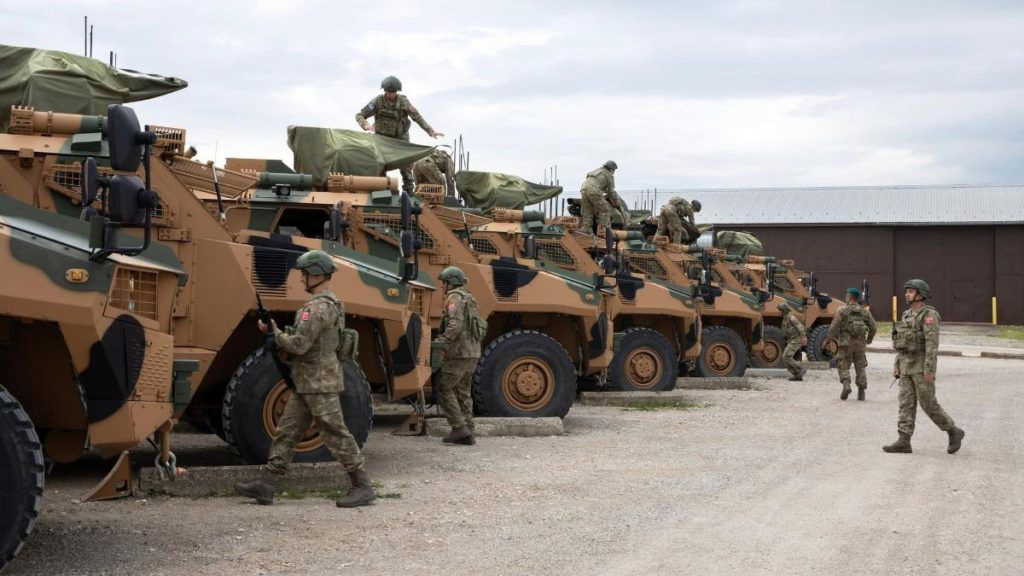
The United States plans to significantly reduce the aircraft and warships it makes available for NATO operations in Europe.
According to a New York Times report, the changes would cut the number of F-16 and F-15E fighter jets from about 150 to 100, reduce maritime reconnaissance aircraft from 26 to 15, and remove all eight aerial refuelling tanker jets previously assigned to Europe.
Also Read | 'A major step forward': Ukraine, Moldova clear first EU membership hurdle as Hungary lifts block
🇺🇸 Speaking to @nytimes about US plans to cut NATO forces in Europe, @gspataf95 noted that while each of these cuts can be managed individually, together they represent a significant posture change & pose broad challenges to European deterrence readiness. https://t.co/xigCvh9kPx
— EU Institute for Security Studies (@EU_ISS) June 12, 2026
US military assets set for redeployment
The report says Washington also wants to redeploy a missile-launching submarine, an aircraft carrier, several warships and additional jets tied to the carrier’s missions.
One of two bomber groups previously assigned to Europe’s defence may also be moved elsewhere. The changes would limit NATO’s ability to launch long-range strikes and conduct surveillance. The cuts could force the alliance to weigh alternative defence plans for Europe in the event of a Russian attack.
NATO defends the shift in responsibilities
NATO has acknowledged the planned US reductions, but has tried to frame them as part of a wider redistribution of responsibilities inside the alliance.
NATO spokesperson Allison Hart told Reuters, “Historically there has been an over-reliance on US forces and capabilities,” adding that as Europe and Canada invest more in defence and develop greater capabilities, “the balance of responsibility can shift.”
She also said the move would strengthen NATO’s defence by reducing reliance on a single ally.
The US wants Europe to step up its defenses and is winning that argument (esp. Poland, Germany, Nordics/Baltics). A transition needs to be planned and not leave gaps that Russia can exploit. Does this reported pullout meet that objective?https://t.co/2kDU6hd5c5
— Daniel Fried (@AmbDanFried) June 12, 2026
Commanders urge a faster capability build-up
NATO’s supreme allied commander, US Gen. Alex Grynkewich, has said the alliance should focus on capabilities that can be acquired and deployed quickly.
He said, “We need to focus on things that we can acquire quickly, that we can field quickly, and that we can scale rapidly and sustain over time,” adding that such capabilities can help mitigate near-term risk.
Grynkewich described the current system as having an “unhealthy co-dependence” on US forces and said the situation “will change.”
Also Read | ECB raises benchmark rate to 2.25%, warns Middle East war is weighing on growth
Trump-era pressure shapes the debate
The planned drawdown comes against the backdrop of repeated Trump administration criticism of European NATO members for underinvesting in their militaries and relying too heavily on US protection.
Reuters reported that the US European Command said last week it would “rightsize” its contributions to the NATO Force Model, without giving details.
The issue is likely to be discussed again when Trump and his NATO counterparts meet for a summit in Turkey on July 7-8.
FAQs
Q1: Why is the US planning to reduce military assets for NATO operations in Europe?
Ans: The planned reductions align with a broader push for European NATO members to take on a greater share of the alliance's defence responsibilities.
Q2: How could the US military cuts affect NATO's operations in Europe?
Ans: The reductions could limit NATO's surveillance, aerial refuelling and long-range strike capabilities while prompting the alliance to adjust its defence plans.