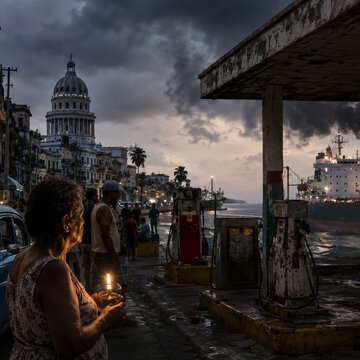
Cuba’s night is no longer simply night. Across large parts of the island, darkness has become a way of life.
What began as a prolonged electricity shortage has now evolved into one of the gravest infrastructure crises Cuba has faced in decades. From Havana’s fading colonial neighbourhoods to hospital corridors and tourist districts, daily life is increasingly paralysed by power cuts that stretch up to 20 or even 22 hours a day.
The scale of the collapse was acknowledged publicly this week by Cuba’s Minister of Energy and Mines, Vicente de la O Levy, who admitted during a televised appearance that the country has effectively exhausted its reserves of diesel and fuel oil.
“We have absolutely no diesel,” de la O Levy said on Cuban state television, as noted by CNN.
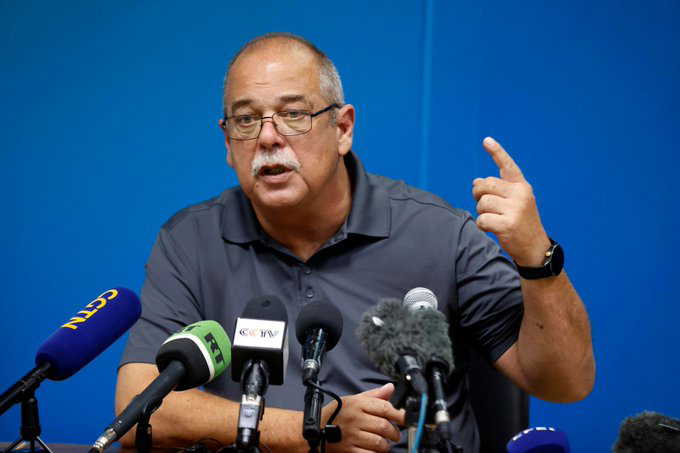 Cuban Energy Minister Vicente de la O Levy X/ Vicente de la O Levy
 The minister described the condition of the national electricity grid as “very tense,” warning that the crisis could worsen further during the island’s scorching summer months, when energy demand rises sharply.
For millions of Cubans, electricity has stopped being a guaranteed public service. In many neighbourhoods, power returns briefly in the middle of the night, forcing residents to wake up suddenly to cook meals, charge phones, pump water or preserve food before the lights disappear again.
The daily routine of darkness: 2 hours of light, 22 hours of waiting
Power outages are not new in Cuba. But the horror of the current situation lies in its duration, scale, and social impact. In many areas, people are spending most of the day without electricity. In some places, power returns late at night, when sleeping residents suddenly wake up to turn on refrigerators, charge phones, pump water, and finish a little cooking. Electricity here is no longer a normal public service; it has become a brief moment of rescue.
In a modern state, electricity does not merely light bulbs. It powers oxygen support in hospitals, keeps operating theatres functional, runs fans in classrooms, keeps mobile networks alive, sustains banking systems, preserves food, pumps water, operates traffic signals, and activates the invisible nervous system of civic life. In Cuba, that nervous system is now almost paralysed.
The blackout has been accompanied by extreme heat, food shortages, medicine scarcity, and a collapsing transport system. Food stored in refrigerators is rotting. Water supply has been disrupted in many areas because pumps cannot operate. Government offices, educational institutions, hospitals, and small businesses are all victims of this darkness. According to Reuters, a partial collapse of the grid in eastern Cuba left Santiago de Cuba and large surrounding regions without electricity; although some emergency services were restored, many areas remained in darkness for long periods.
A nation waiting for power
The blackouts are now disrupting nearly every layer of civic life.
Hospitals are struggling to maintain critical services. Water pumps cannot operate consistently. Food stored in refrigerators spoils quickly in the tropical heat. Schools and universities are facing disruptions, while transport systems and communication networks remain under pressure.
Eastern Cuba recently suffered a partial grid collapse that left Santiago de Cuba and surrounding regions without electricity for extended periods.
Also Read | Did Netanyahu secretly visit the UAE? Abu Dhabi shuts down Israeli claim
In Havana, the situation has become especially severe. CNN reported that blackouts in several parts of the capital are now lasting between 20 and 22 hours daily, leaving residents with only brief windows of electricity to complete basic household tasks.
Many Cubans now complain that they cannot even charge electric mopeds or mobile phones regularly. Some families reportedly sleep lightly through the night, waiting for the short moments when power briefly returns.
The country’s energy crisis has also intensified existing shortages of food, medicines and fuel, pushing daily life deeper into instability.
Fuel supplies dry up as grid weakens
Cuba’s electrical system relies heavily on imported oil, diesel and fuel oil, alongside limited domestic crude production and renewable energy.
But the government says imported fuel supplies have sharply declined in recent months.
According to CNN, Cuban officials claim the country has effectively been cut off from major fuel shipments for more than four months following increased US pressure on Venezuela, one of Cuba’s key oil suppliers.
The island had briefly received relief in late March when Russia donated a shipment of oil. However, Energy Minister Vicente de la O Levy confirmed that the supply was exhausted by early May.
Aging infrastructure has made the situation worse. Several thermoelectric plants are decades old, while shortages of foreign currency and spare parts have hampered maintenance work for years.
The fragile grid now struggles to function even when limited fuel becomes available.
Cuban authorities say they are increasingly relying on solar energy generated through Chinese-donated panels. However, de la O Levy admitted that weather conditions and cloud cover make solar generation unstable. Without large-scale battery storage systems, the electricity produced during the day cannot reliably support nighttime demand.
Reports cited by El País earlier noted that Cuba had installed around 1,300 megawatts of solar capacity with Chinese assistance, though storage limitations continue to undermine its effectiveness.
Anger spills onto Havana streets
When electricity disappears, people first wait. Then they adjust. Then anger accumulates. And one day, that anger spills onto the streets.
On Wednesday night, May 13, that accumulated anger erupted across several areas of Havana. Reuters reported that hundreds of people took to the streets in different parts of the capital to protest against the power cuts. They banged pots and pans, shouted slogans, and in some places set piles of garbage on fire to block roads. The central demand of the protests was simple: bring back the light.
CUBA: Ayer continuaron las protestas en varias partes de la Habana. La gente explotó y salió a las calles a prenderle fuego a la basura y la represión no se hizo esperar. Vean en el vídeo cómo las fuerzas del régimen golpea a la gente y los arresta. Sucedió en Playa. pic.twitter.com/rozKjVY6vy
— Ariel Maceo Tellez (@arielmaceo86) May 14, 2026
It would be wrong to see these protests merely as a demand for electricity. They are a collective explosion against food shortages, medicine scarcity, unbearable heat, broken transport, damaged living conditions, and years of accumulated frustration. When a city remains in darkness for more than 20 hours a day, public anger is not directed only at the electricity department; it begins to question the capacity of the state, the structure of the economy, and the country’s political future.
Reports of protests came from San Miguel del Padrón, Playa, and other densely populated areas of Havana. According to one report, a resident said people wanted at least three hours of electricity so they could complete basic daily tasks. That single statement captures the reality of present-day Cuba: people are no longer demanding 24 hours of power; they are asking for a few hours of light simply to survive.
Tourism and economy under pressure
Tourism is one of the main pillars of Cuba’s economy. Old Havana, the beaches of Varadero, music, cigars, classic cars, revolutionary history — together, these have long attracted foreign tourists to Cuba. But tourism requires light, water, transport, hotel services, internet, safety, and reliability. At this moment, almost all of these are under pressure.
Reuters reported in April 2026 that Cuba’s popular tourist destinations were becoming deserted because of power and fuel shortages. Blackouts lasting up to 22 hours a day, lack of fuel for rental cars, water shortages, and weak communication systems were pushing tourists away.
Also Read | Hantavirus cases rise to nine as MV Hondius passengers return home: How far has it spread?
Another report said that the fuel crisis and power cuts had dealt a major blow to Cuba’s tourism industry in the first quarter of 2026. Hotels were unable to run generators, transport was disrupted, and uncertainty among international tourists had increased.
This damage is not limited to hotel owners. Taxi drivers, restaurants, tour guides, musicians, handicraft sellers, small shops, and private homestays linked to tourism are all suffering. In other words, the fuel crisis is drying up one of Cuba’s key sources of foreign currency.
US aid: Humanitarian offer or political condition?
Amid the worsening crisis, the United States has offered Cuba $100 million in humanitarian assistance tied to what Washington described as “meaningful reforms” to the country’s political and economic system.
As per the report, the US State Department said the aid package was intended to address urgent shortages affecting Cuban citizens.
“The decision rests with the Cuban regime to accept our offer of assistance or deny critical life-saving aid,” the State Department said in a statement.
Cuban officials, however, have reacted cautiously.
Por primera vez, el gobierno de #EEUU formaliza de manera pºblica, mediante un comunicado del Departamento de Estado, un ofrecimiento de ayuda a #Cuba valorado en 100 millones de d³lares.
— Bruno Rodrguez P (@BrunoRguezP) May 14, 2026
Sigue sin aclararse si ser ayuda en efectivo o material, y si se destinar a las pic.twitter.com/GjOhrfkupt
Foreign Minister Bruno Rodríguez said Havana was “ready to listen” to the proposal but stressed that the government still lacked clarity about the nature of the assistance and whether it would address immediate shortages of fuel, food and medicines.
The Cuban government has repeatedly accused the United States of intensifying the crisis through sanctions and pressure on international fuel suppliers.
Cuban President Miguel Díaz-Canel said such an offer would encounter “no obstacles or ingratitude from Cuba,” but he insisted that there’s an alternative solution to the crisis.
La experiencia de nuestro pas en recibir ayuda internacional, incluyendo de EE.UU, es amplia y constructiva. Cualquier donante puede dar fe de esa realidad.
— Miguel Daz-Canel Bermºdez (@DiazCanelB) May 14, 2026
Si verdaderamente hay disposici³n del gobierno estadounidense a brindar ayuda en los montos que anuncia y en plena
Washington, meanwhile, argues that the island’s economic collapse stems largely from internal mismanagement and political control.
Is Cuba standing at a new political turning point?
Public protests are not unknown in Cuba, but due to state control they are usually contained quickly. Yet since the major protests of 2021, internal dissatisfaction has grown. The energy crisis of 2026 has made that dissatisfaction even more visible. In March 2026, Al Jazeera wrote that Cuba was facing one of its deepest crises in decades, where power cuts, fuel shortages, and political uncertainty were operating together.
The question is whether this crisis is merely a temporary fuel problem, or whether it reflects a deeper crisis in Cuba’s political economy. If fuel supplies are not restored quickly, if the grid is not stabilised, if tourism revenue continues to fall, and if food and medicine shortages worsen, public anger may grow further.
A crisis bigger than electricity
Cuba today stands at a crossroads where the electricity crisis has become a crisis of the state itself. When a country cannot provide light to its citizens, it is not only homes that go dark; public trust, the economy, healthcare, education, tourism, and international relations are all covered in darkness.
The Cuban people are not asking for grand political speeches now. They are asking for light. They want enough electricity to keep food in a refrigerator. They want medical treatment in hospitals. They want water pumps to run. They want their children’s education not to stop. They want the city to remain safe at night.
Also Read | 'We have no reserves': Cuba faces 22-hour blackouts and fuel shortage crisis
This Caribbean island once wrote its name on the map of world politics through the fire of revolution. Today, that island is searching for light. The Cuba that once stood as a symbol of resistance against imperial pressure is now trapped in a multilayered blockade of fuel, food, economy, and diplomacy.
The solution to this crisis does not lie in a single oil tanker. What is needed is lasting energy security, grid reform, effective storage for renewable power, revival of tourism, protection of food and healthcare services, and above all, a diplomatic path that does not turn ordinary people’s lives into bargaining chips.
Cuba’s darkness, therefore, is not merely the electricity crisis of one country. It is a brutal warning for the twenty-first century: no matter how brightly modern civilisation shines, without fuel, infrastructure, and political will, an entire nation can be pushed back into an age of darkness in an instant.