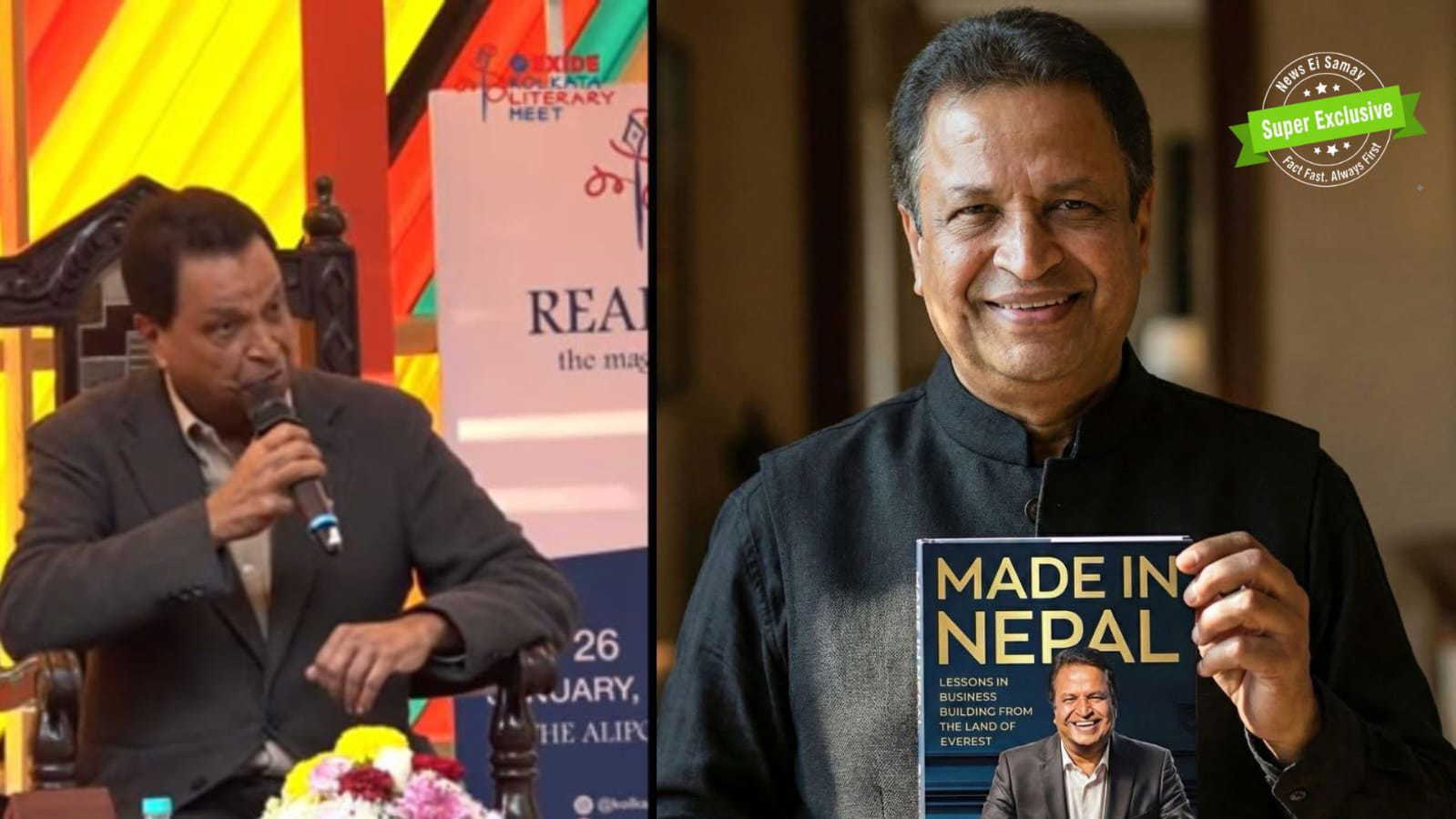
Binod Chaudhary, Nepal’s only billionaire and the man behind the global Wai Wai brand, has long been a central figure in the country’s business and public life, straddling entrepreneurship, philanthropy and politics.
In an exclusive interaction with News Ei Samay at the Kolkata Literary Meet 2026, Chaudhary said his book ‘Made in Nepal’ is both a personal journey and a factual testimony to the country’s untapped business potential, even amid crises such as earthquakes, COVID-19 and political churn.
Calling the book a practical document rather than a theoretical one, Chaudhary positions it as a counter to the long-held belief that Nepal is an impossible place to do business.
“It's a story about how Nepal is been able to position itself in the field of business and has dealt with difficult situations like the Nepal earthquake, COVID and the changing political landscape from time to time, and still there are entrepreneurs who are doing business, who are doing business successfully,” he said.
Referring to the global expansion of Wai Wai noodles, which originated in Nepal, Chaudhary added, “The book is not theoretical, it’s a practical document, how we have taken the Wai Wai which was originated in Nepal, the instant noodle, you know, I mean from Northeast as well as from Nepal to the whole world… it’s an inspirational story based on facts and reality.”
India, China and Nepal’s geopolitical balance
Addressing frequent criticism that legacy business families benefit from political proximity, especially after Nepal’s recent unrest, Chaudhary underscored the inevitability of regional interdependence.
“Nepal has to understand very well that with India our coexistence, our synergies, our complementary relationship across all aspects is very very crucial and if anybody tries to sort of ignore that, it’s not going to work,” he said, adding, “Our destinies are tied in because of geographies.”
At the same time, he rejected the idea of choosing sides. “That doesn’t mean that we are not going to deal with China, but you don’t have to deal one against the other, both have their own respective roles.”
Gen-Z unrest, elections and rebuilding trust
Chaudhary described the Gen-Z-led protests as a reflection of deep-rooted frustration among young Nepalis, many of whom leave the country for education and employment.
“Eight-nine million Nepalese people have to leave this country for education or for jobs, out of 30 million. So you can imagine that everybody feels that there is no future for us in this country,” he said.
While acknowledging vandalism and violence during the protests, he attributed it to external interference rather than the core movement. “It all started with a very good, very pure, very appropriate wishes and aspirations of the youth… but wrong elements, there were in many cases… It was a case of infiltration, but that doesn’t change the real pure aspiration to see a prosperous Nepal for their own future.”
As Nepal heads into elections on March 5, Chaudhary, who is contesting as a Nepali Congress Party candidate, said he remains optimistic about political change. “I feel that a new government will emerge out of this whole electoral process, who will be far more serious, far more aggressive, whose agenda will be more economic centric.”
ALSO READ | Global cuisines through the lens of Bengal: Kaberi Biswas launches new cookbook at Boi Mela
Rather than offering quick advice to the youth, Chaudhary stressed systemic reform. “We need to have a more prosperous Nepal. We need to have a Nepal where we have a good quality education, which is affordable… We need to have job… Nobody wants to leave their homeland.”
Calling for collective responsibility, it was concluded that everybody needs to work together for a single goal of rebuilding Nepal and its governance through a corruption-free, action-oriented government, giving the new change a chance.