Indian equity markets opened sharply lower on Monday, with benchmark indices witnessing a steep fall in early trade. Weak global cues, rising oil prices and geopolitical tensions weighed heavily on investor sentiment.
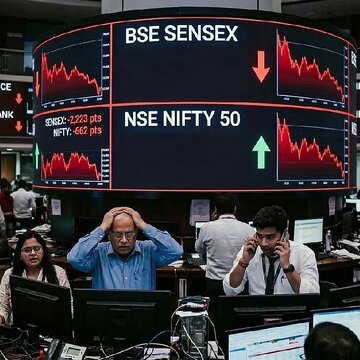
At around 10.29 am, the S&P BSE Sensex was down 1,822.25 points at 72,710.71, while the NSE Nifty50 declined 533.30 points to 22,581.20. Both indices slipped over 2.4 per cent, reflecting broad-based selling across sectors. The sharp decline also led to a significant erosion of investor wealth, with over Rs 10 lakh crore wiped out from the BSE market capitalization, reported India Today.
Geopolitical tensions drive uncertainty
The primary trigger behind the fall remains the ongoing conflict in West Asia, which has now entered its fourth week. Escalating tensions between the US and Iran have kept global markets on edge, especially due to concerns surrounding the Strait of Hormuz, a crucial route for global oil supply.
Also Read | Big drop in bullion: Gold declines, silver falls nearly twice as much
VK Vijayakumar, Chief Investment Strategist at Geojit Investments Limited, was quoted as saying by The Times of India, "With the war in West Asia getting into the fourth week, there is no clarity on when the war will end. Unfortunately, the war is escalating with President Trump giving ultimatum to Iran to open the Strait of Hormuz in 48 hours. Iranian president’s response that the Strait of Hormuz is open to all except those who violate our soil has prevented panic in the oil market. However, the uncertainty is huge and markets will be waiting and watching the outcome."
He further noted the broader impact across asset classes. "It is important to understand that the huge risk-off globally has impacted all assets including stocks, bonds and precious metals like gold and silver. In fact, the crash in the safe haven gold is worse than in equities," Vijayakumar said.
Rising crude oil prices add pressure
Crude oil prices have surged sharply amid the ongoing conflict. Brent crude was trading at $112.94 per barrel, up 0.67 per cent, while WTI crude stood at $99.23 per barrel, up 1.02 per cent.
The crisis has pushed oil prices up by over 50 per cent this month. Concerns around potential disruption in the Strait of Hormuz, which handles over 20 per cent of global oil supply, have further intensified the rally. Iran has also warned of shutting the route indefinitely if tensions escalate further.
Higher oil prices increase input costs for businesses and fuel inflation, which in turn impacts corporate earnings and overall market sentiment.
Rupee hits record low
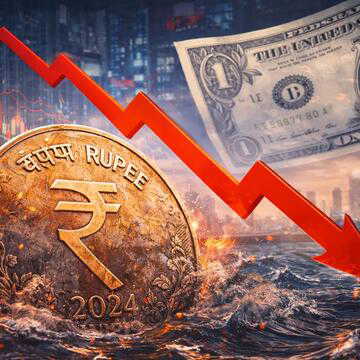
The Indian rupee also came under significant pressure, falling to a record low of 93.84 against the US dollar. This breached its previous low of 93.7350 recorded just days earlier.
Also Read | Gold prices drop ahead of wedding season —should you buy now?
The currency has weakened by nearly 3 per cent since the conflict began, making it one of the worst-performing Asian currencies. A weaker rupee raises import costs, particularly for crude oil, adding to inflation concerns.
FII outflows and rising US yields weigh on markets
Foreign institutional investors (FIIs) have continued to pull out funds from Indian equities. On Friday, FIIs extended their selling streak to a 16th consecutive session, offloading shares worth Rs 5,518 crore.
At the same time, US Treasury yields have risen, with the 10-year yield crossing 4.4 per cent, its highest level in nearly a year. Higher bond yields tend to attract investors towards fixed-income assets, reducing the appeal of equities.
Together, these factors have contributed to the sharp fall in the stock market, as investors remain cautious amid heightened global uncertainty.