Thirty-three years later,
The striped royal returns to Bapu's land.
Kabhi toh aaiye Gujarat mein!
Did the tiger ever hear Amitabh Bachchan's iconic line from that famous advertisement? Or was it driven purely by the instinct to expand its dominion that, after nearly 33 years, a Royal Bengal Tiger has once again made its home in Bapu's state?
The tiger comes to Gujarat
In the recent history of wildlife conservation in India, there is no state other than Madhya Pradesh that hosts at least three species of the 'big cat' family roaming freely in the wild. Most states are home to tigers and leopards. Madhya Pradesh stands apart with its triumvirate: tiger, leopard, and cheetah. Gujarat, until now, belonged to a different category: the land of lions and leopards. Until now, because 'he' has officially arrived on the books in the land of Mahatma Gandhi. Gujarat is now poised to become the country's only state where lions, leopards, and tigers share free-ranging forest habitats. From the new year, Gujarat will also join other states in the nationwide tiger census.
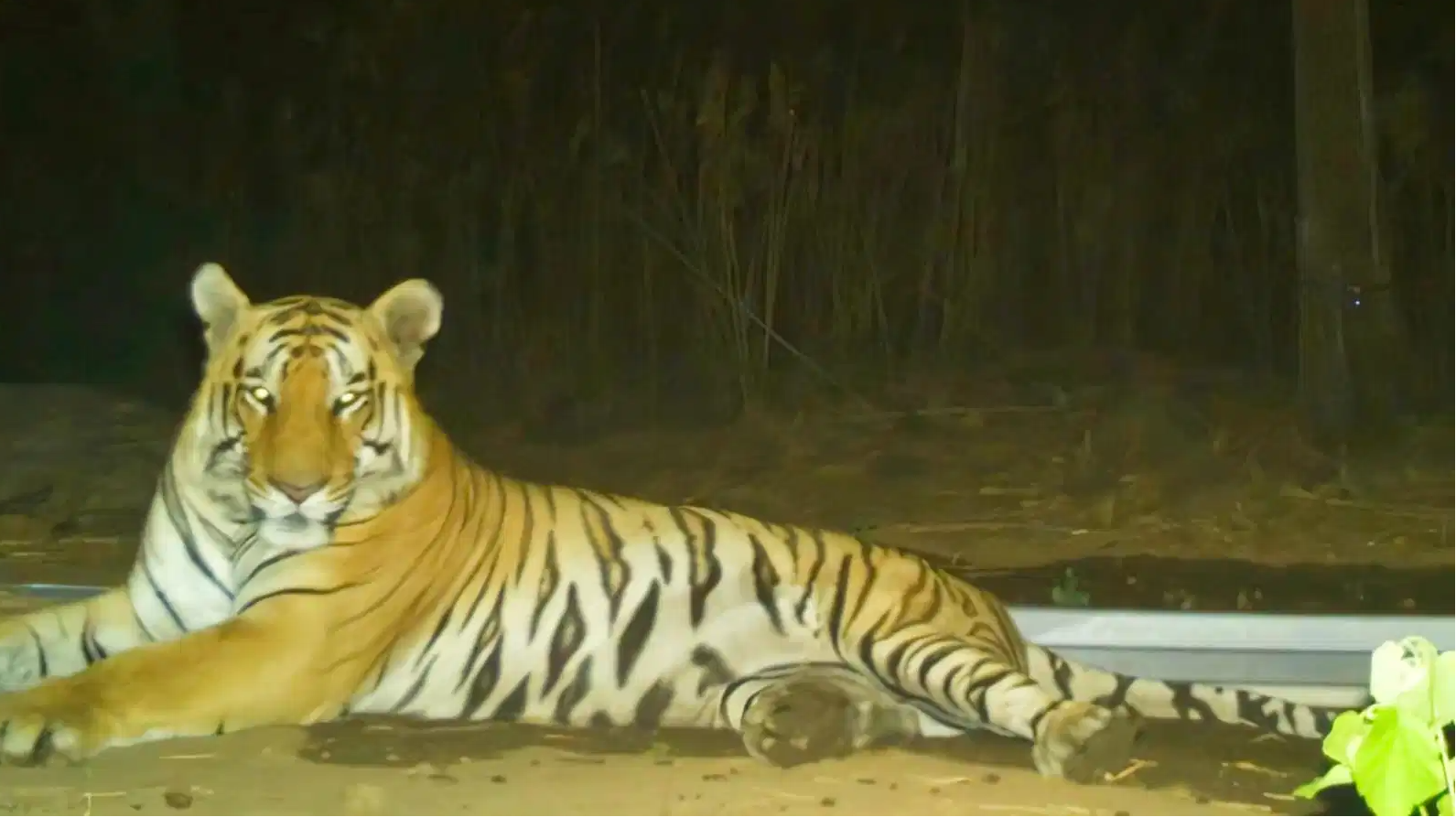
The story began in February this year, when a nearly four-year-old male tiger crossed state borders from neighbouring Madhya Pradesh's Jhabua or Alirajpur district and entered Dahod district in Gujarat. About 150 kilometres from Vadodara, the area houses the Ratan Mahal Sloth Bear Sanctuary. For the past ten months, the tiger has largely remained within this protected forest.
Also Read | Tata Nagar-Ernakulam Express AC coaches catch fire in Andhra Pradesh, 1 dead
What do officials say?
According to Gujarat's Head of Forests, A.P. Singh, "Since this is a protected sanctuary, we did not have to take any special steps for the tiger’s security. However, we installed several camera traps to track its movement. The same water hole where sloth bears have been photographed drinking water has also been visited by the tiger at different times of the day. The forest is dense and has a substantial leopard population as well, so the prey base suitable for a tiger is not lacking."
A few months ago, the National Tiger Conservation Authority (NTCA) sent a team to Dahod to assess the 'migrant' tiger. Based on observations of its movement and the local ecosystem, the team submitted a detailed report in July. Acting on the recommendations of that report, Gujarat is now being included in the nationwide tiger census, according to NTCA sources.
The reason is clear. What was a 'migrant' ten months ago is gradually beginning to look like a resident, almost a 'son of the soil'. Despite the absence of a female companion, the tiger has not ventured more than 10-15 kilometres beyond the sanctuary's boundaries. So far, camera traps have not captured any instances of conflict between the tiger and sloth bears or leopards within the sanctuary.
Also Read | Dense fog disrupts Delhi flights: 128 flights cancelled, several delayed at IGI airport
Will Gujarat become a 'Tiger State' again?
Does this mean Gujarat is reclaiming the tag of a 'Tiger State'?
"Time will tell", says the state's Principal Chief Conservator of Forests, Jaypal Singh. Gujarat last officially recorded the presence of a tiger in 1992. After that, there was no documented evidence of tigers in the state. This time, however, the tiger's sustained presence in Dahod over the past ten months has led scientists to conclude that the census should not be limited to the Ratan Mahal Sanctuary alone. It will also cover the potential 'tiger corridor' connecting Gujarat and Madhya Pradesh. The arrival of the tiger might be a sign of inception.
Notably, one end of this Gujarat-facing corridor lies in Jhabua, near the inter-state border, while the other points to Ratapani Tiger Reserve, located near Bhopal, the capital of Madhya Pradesh. Only a few months ago, before being officially notified as a tiger reserve, Ratapani held a unique distinction: it was the country's only 'urban area' with a resident tiger population. It's tigers even earned a special moniker: urban tigers.
Also Read | Madhya Pradesh students allegedly forced to stand bare-chested; school fined ₹1 lakh
NTCA experts are keen to examine whether a new corridor has emerged, stretching nearly 420 kilometres from Ratapani to Dahod. If such a corridor exists, the male tiger in Gujarat may not have to remain without a mate for too long.
For now, Gujarat's forest officials are focusing on a different equation, the remarkably peaceful coexistence between the sloth bear and the tiger. Jaypal Singh explains, "Camera trap footage shows sloth bears drinking water at a water hole and moving away. Soon after, the tiger arrives at the very same spot to quench its thirst. Both animals are clearly aware of each other's presence, yet neither has chosen the path of conflict. On several occasions, the tiger even ventured into the nearby Udaipur Forest Division outside Ratan Mahal, but eventually returned to the sanctuary."
And so, the wait is now for the tiger census. Only the final report will reveal whether this 'migrant' tiger has truly become Gujarat's 'own son'.