






















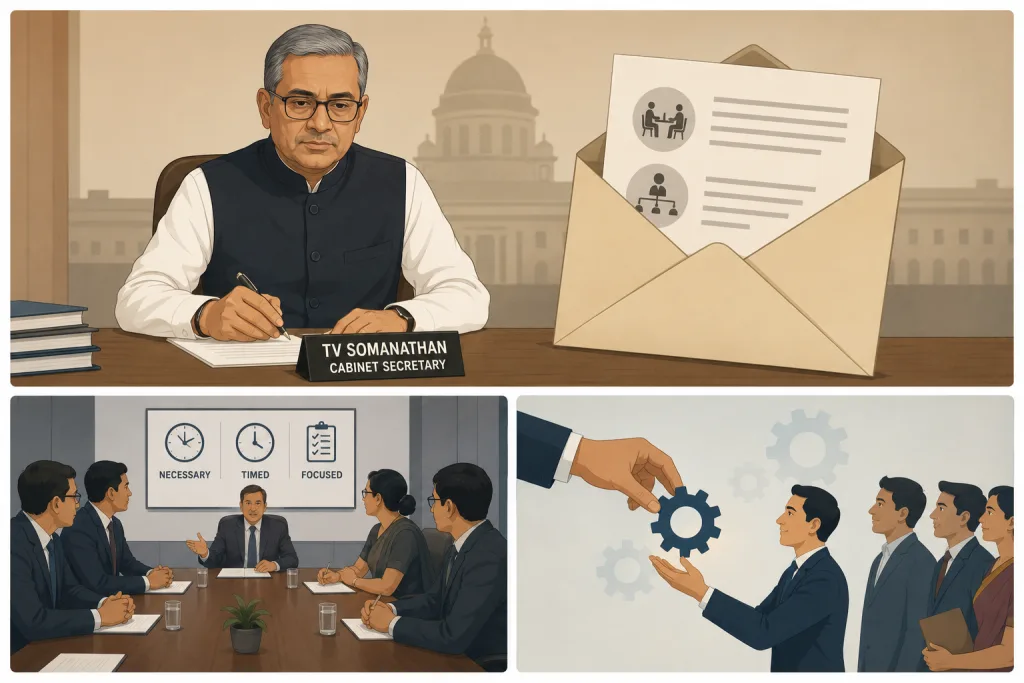
Cabinet secretary TV Somanathan is pressing India’s top bureaucracy to change the way it works, with a series of letters that call for better governance, quicker decisions, and a more practical, less risk-averse style of administration.
Hindustan Times has accessed two of those communications, one focused on meetings and another on delegation, as he continues to outline what he sees as everyday fixes for the civil service.
Also Read | Sonam Wangchuk out of hospital, to visit Rajghat before returning to Ladakh
Guidance before grand reform
In a June 12 letter, the most senior bureaucrat, who works directly under the Prime Minister, said he had spoken to officers across services and found that several middle-ranking officials wanted more practical guidance beyond training.
He wrote, “I have the pleasure of meeting many officers…” and urged officers to reflect on whether they were improving each year or simply continuing old habits.
The communication, addressed to chief secretaries and advisers in states and Union territories, also carried a guide on how to conduct and chair official meetings.
Less chatter, more clarity
Somanathan’s note on meetings set out the basics of whether a meeting is necessary at all, how it should be timed, and how an agenda should be framed so that it leads to clear takeaways.
He said the topic was chosen first because meetings consume a lot of officials’ time each day.
The letter asked recipients to circulate the guide to civil servants under their jurisdiction and said the material was meant to be imbibed “in the right spirit.”
Let go, and let governance work
A second letter, dated July 21, made the case for stronger delegation within the bureaucracy. Addressed to all secretaries to the Government of India, it urged senior officers to move beyond the “playing safe” approach and trust junior colleagues with more responsibility.
The note argued that excessive centralization can slow the government, overload senior officers, and leave subordinates without enough room to grow as decision-makers.
It also attached a guide on what to delegate, what to retain, and how much authority to hand over.
A calculated leap of faith
To counter objections that delegation can create risk, inefficiency, or corruption, the letter cited the familiar idea that caution can be useful but cannot be the only operating principle.
Somanathan’s note quoted John A. Shedd to argue that safety alone cannot be the point of administration, saying a ship is safest in a harbor, but that is not what ships are built for.
The letters are being seen as an attempt to push behavioral and managerial change inside the bureaucracy.
It remains to be seen how widely such practices will be adopted and how quickly they will show results on the ground.
Also Read | Bombay HC lets Nitin Gadkari sue Meta, Google, X over alleged E20 deepfakes
FAQs
Q1: Why has Cabinet Secretary TV Somanathan written to civil servants?
He has urged officials to improve governance by holding more effective meetings, delegating responsibilities and taking timely decisions.
Q2: What is the main message of the Cabinet Secretary’s letters to babus?
The letters encourage civil servants to move away from excessive caution and adopt a more efficient, accountable and delegation-driven approach to administration.
